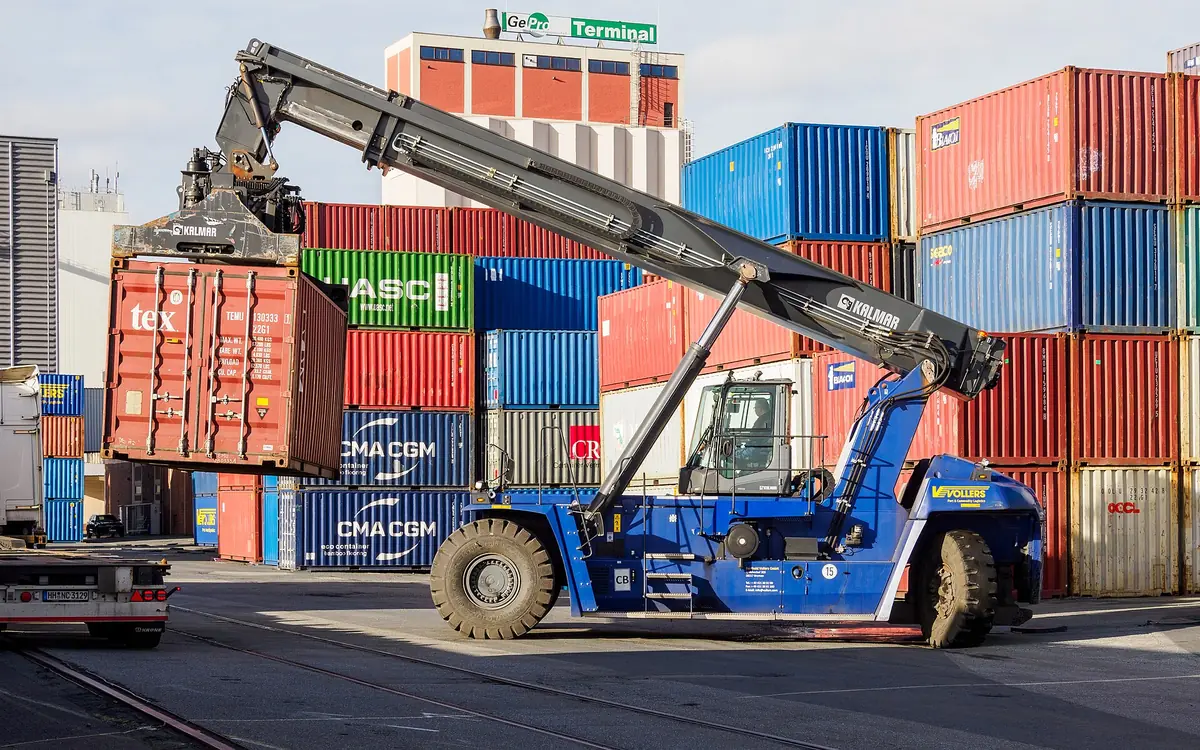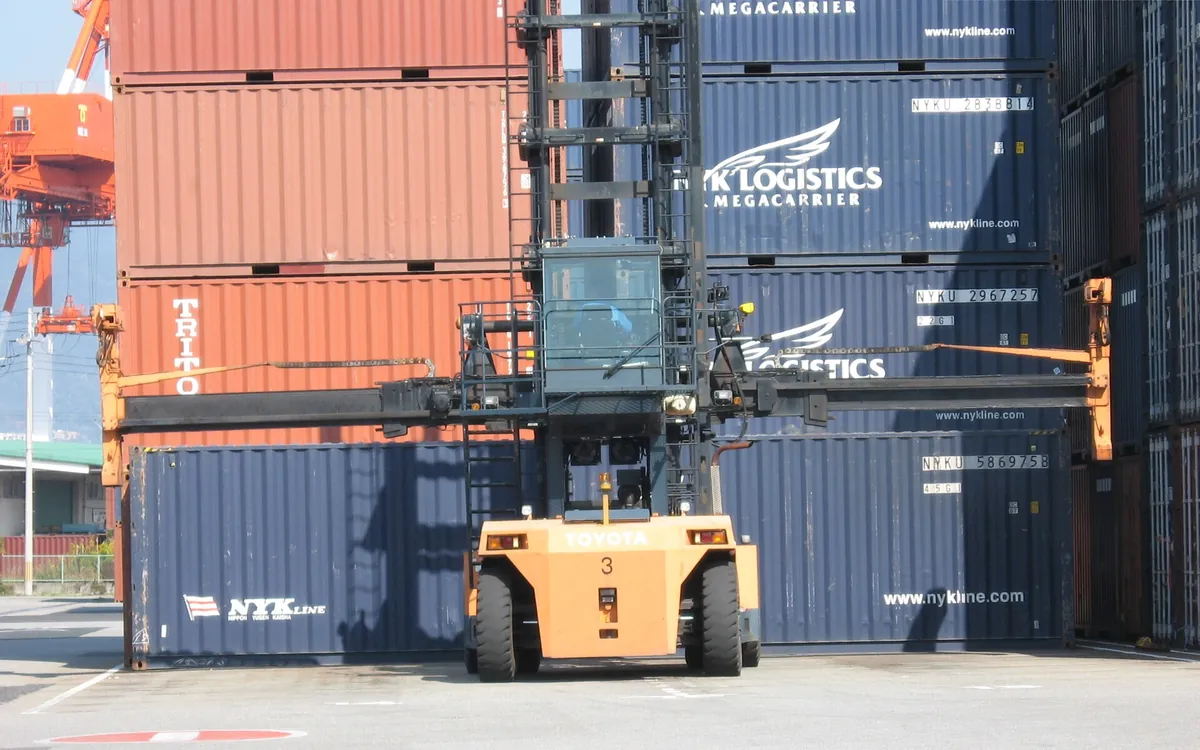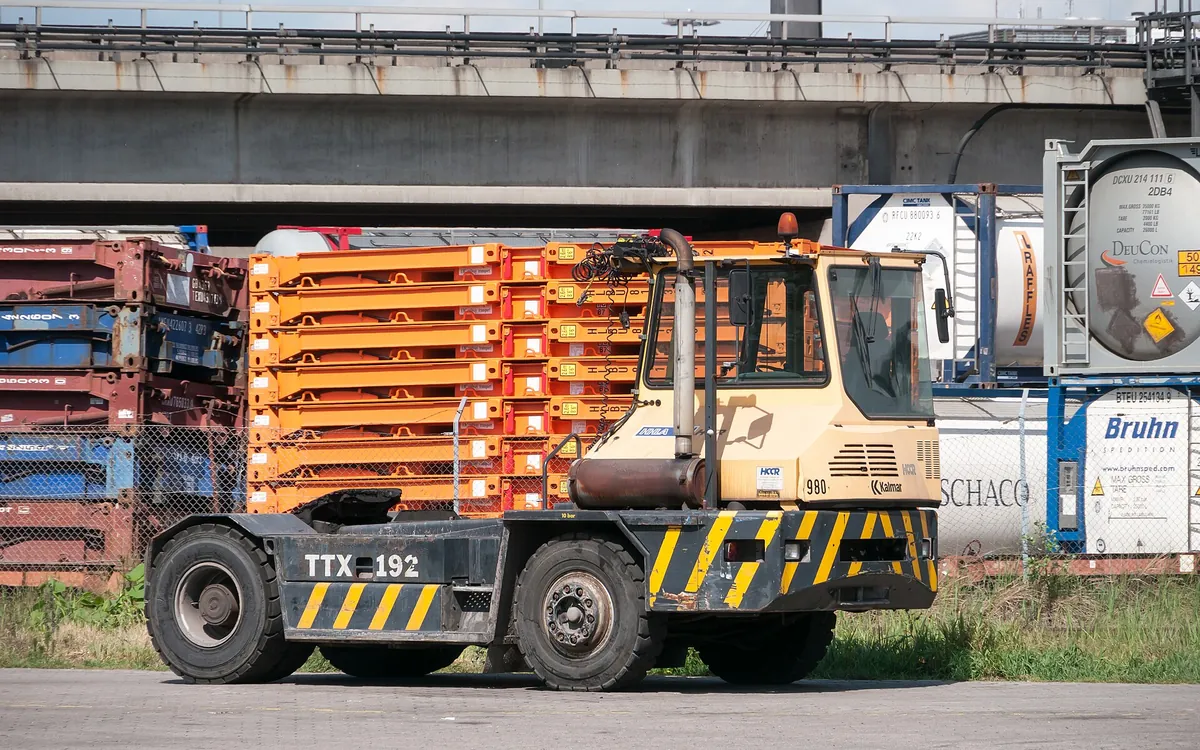
Short tractor with a lifting fifth wheel that shunts trailers and terminal chassis inside a terminal. Not road legal in most ports.
What a terminal tractor is
In the UK it is also known as a terminal lorry or terminal truck; in the US the list of names is long, including yard truck, shunt truck, spotter truck and yard goat. Whatever the name, the job is to shuttle trailers over short distances, much as a shunting locomotive moves railcars.
Kalmar, which has built terminal tractors since 1958, reports more than 80,000 shunt trucks delivered. In container terminals with RTG or RMG yards, they are the usual link between quay and stack.
How it works
The design differs from a road tractor in several ways: a one-person cab offset beside the engine, a full-height rear door so the driver can reach the trailer connections, a very short wheelbase with a solid rear axle and an automatic transmission. The lifting fifth wheel raises the trailer, typically by about 380 mm with around 32 t of hydraulic lift.
Off-road models top out at about 40 km/h. In container terminals they pull terminal chassis between STS cranes and the yard; at RoRo berths they push trailers onto ships.
Sizes and key figures
Kalmar Ottawa's T2 EV range covers gross combination weights from 81,000 lb to 195,000 lb (36.7 to 88.5 t). Distribution models are rated 81,000 or 110,000 lb GCW with 50,000 lb lift capacity; container terminal models are rated 150,000 lb GCW with 60,000 lb lift and 195,000 lb GCW with 70,000 lb lift. Wheelbases run from 126 to 136 inches.
Some models are DOT approved for limited road use at restricted speed in certain US markets, but most terminal tractors are off-road vehicles that stay inside the site.
Axles scale with duty: T2 EV front axles are rated 20,000 or 24,000 lb, and rear drive axles up to 83,000 lb.
Where it is used
Terminal tractors work in container terminals, RoRo and ferry ports, intermodal rail yards, distribution centres and large factories. In ports they carry containers on chassis or cassettes; in logistics they reposition trailers between doors and parking.
Any cargo that moves on a trailer passes through their hands, from containers to swap bodies and RoRo units. Freight rates for cargo through these terminals can be compared at rates.navo24.com.
Electric and automated tractors
Because duty cycles are short and predictable, terminal tractors were among the first heavy vehicles to go electric. Wikipedia lists Terberg, Kalmar, Volvo, MAN, Renault and Orange EV among the makers, and names Orange EV as one of the largest suppliers of zero-emission terminal trucks in the United States. The Kalmar Ottawa T2 EV offers 105, 140 or 210 kWh lithium-ion packs, DC fast charging up to 122 kW through CCS1 plugs, and a thermal management system for operation from -22 to 122 degrees F.
Battery warranties are part of the comparison: Kalmar Ottawa gives 6 years on the batteries, with first life defined as 80% capacity remaining, and 3 years or 6,500 hours on major electric components. The thermal system holds the battery core at 77 to 86 degrees F.
How to choose, pros and limits
Choose GCW and fifth-wheel lift from the heaviest trailer or chassis combination you move, and axle type (4x2 or 4x4) from ramps and ground conditions. RoRo work needs more traction than flat yard work.
Tractors are cheap and flexible, and a fleet can be sized up or down easily. The limit is that they cannot lift a container themselves: every box still needs a crane or stacker at each end of the trip.
Variants
Questions shippers ask
Is a terminal tractor road legal?
Most are not. Some models are approved for limited road use at restricted speed in certain markets.
How much can a terminal tractor pull?
Kalmar Ottawa models are rated from 81,000 to 195,000 lb gross combination weight.
Why does it have a lifting fifth wheel?
Lifting the trailer lets the driver move it without raising the landing legs, saving time on every move.