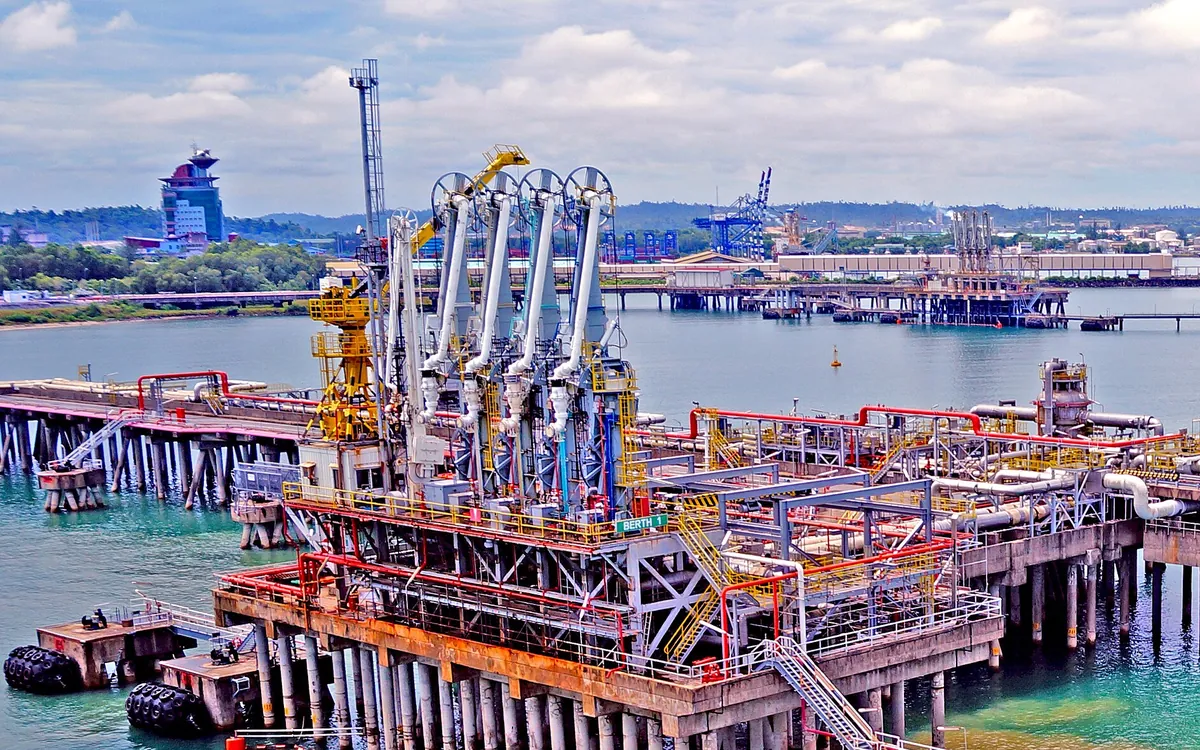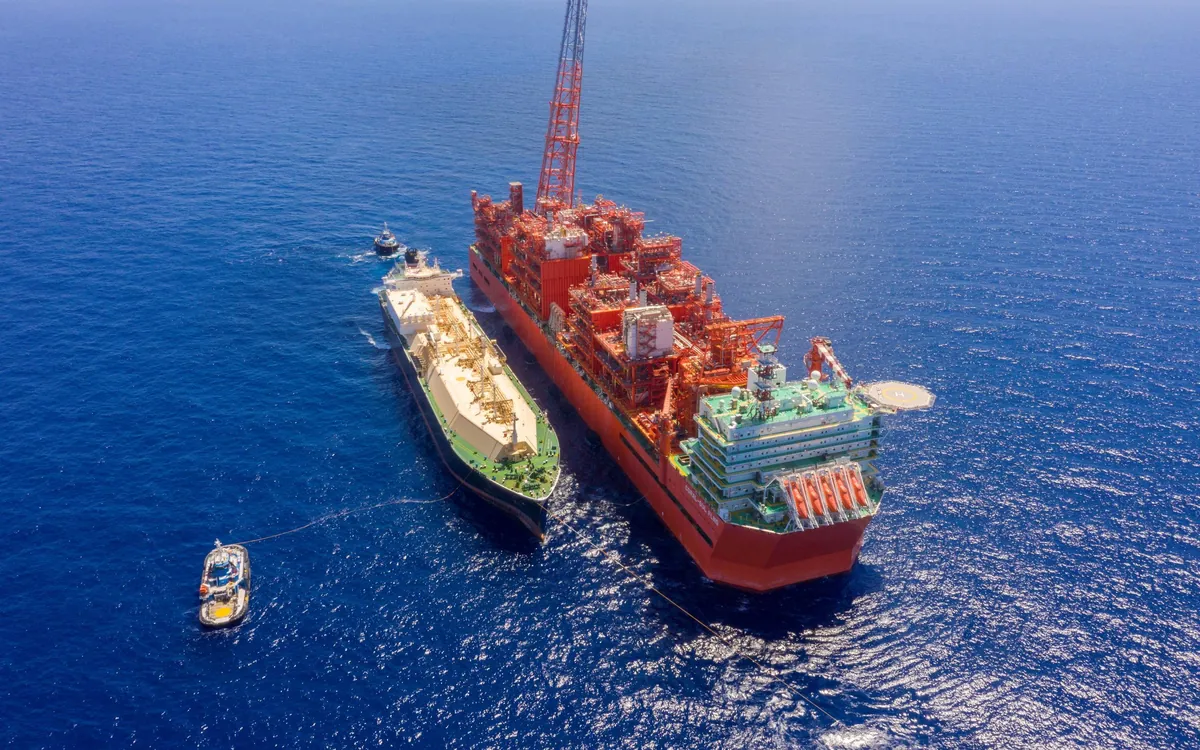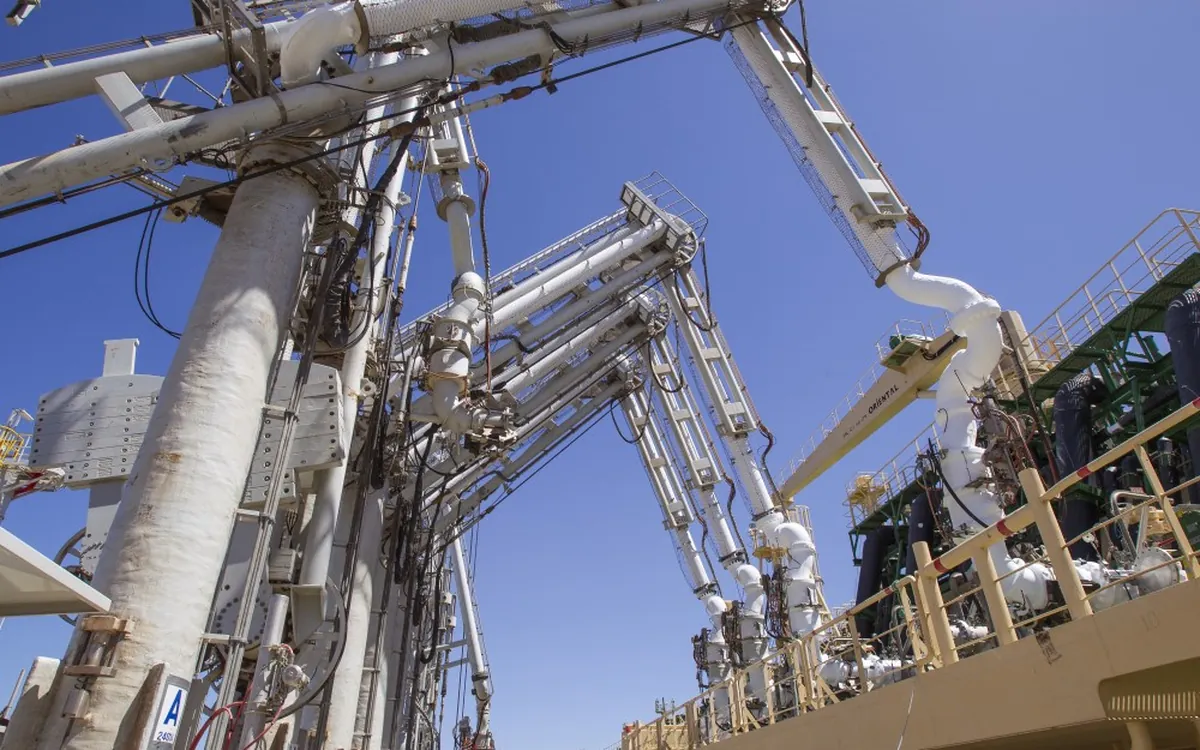
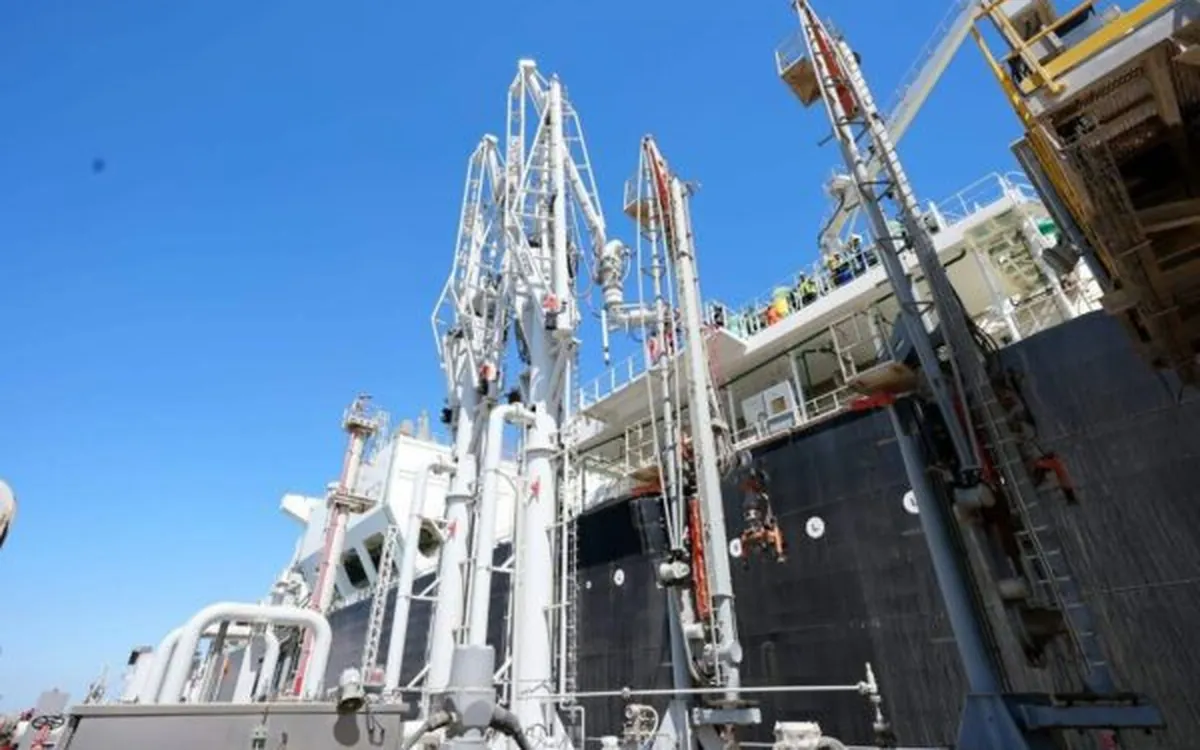
Rigid arm that sends regasified natural gas from a floating storage and regasification unit (FSRU) into the onshore grid. Built for gas pressure rather than a cold liquid.
What a high-pressure gas arm is
An FSRU (floating storage and regasification unit) is a ship that stores LNG and turns it back into gas on board. It lets a country import LNG without building a land-based regasification plant. The gas leaves the FSRU at high pressure and must reach the grid through a connection that tolerates the movement of the moored vessel.
Technip Energies calls its version the HPNG (high-pressure natural gas) marine loading arm. It is a rigid, counterweighted arm like an oil or LNG arm, but its pipe, swivels and couplers are rated for high gas pressure.
The first conversion of an LNG carrier into an FSRU was done in 2007 at the Keppel shipyard in Singapore, using a Moss-type carrier owned by Golar LNG. Converted and newbuilt FSRUs have since become a common route for new import markets, and each one at a jetty needs a high-pressure link to shore.
How it works
The arm stands on the jetty and connects to the FSRU's high-pressure gas manifold through a quick connect/disconnect coupler (QC/DC). Swivel joints follow the ship's motion. An emergency release system (ERS) shuts both sides and separates the arm if the FSRU moves too far.
Technip Energies designs the ERS and QC/DC in house. Its high-duty swivel joints have three redundant sealing levels, which lowers maintenance and keeps the arm available for continuous gas send-out.
Sizes and key figures
Technip Energies offers HPNG arms in 12" diameter with two design pressure classes, ANSI 600 and ANSI 900. Its brochure lists two 12" HPNG arms delivered for the LNG import terminal of Gas Natural Açu (GNA) at Porto do Açu in Brazil, part of a 3 GW LNG-to-power project.
An FSRU berth often has LNG arms as well, so LNG carriers can transfer cargo to the FSRU or the FSRU can be resupplied.
Where it is used
HPNG arms are used at FSRU jetties, both at new import terminals and at power projects where the gas feeds a power plant directly. FSRUs suit markets that need gas quickly or temporarily, and the high-pressure arm is the link to the onshore pipeline.
Because the FSRU stays at the berth for long periods, the arm is connected far less often than an LNG arm on an export jetty. Its design is driven by continuous service, pressure and fatigue rather than by fast connection cycles.
The rest of the terminal can be small: a jetty, the arms, a metering station and a pipeline to the grid or the power plant. Freight rates for cargo through these terminals can be compared at rates.navo24.com.
Reliability and operations
An FSRU sends gas out continuously, often for months, so the arm's seals and swivels are designed for long service. Technip Energies uses tri-redundant dynamic sealing in its swivel joints to reduce maintenance and keep the arm available.
The arm is part of the terminal's safety system. Technip Energies offers an integrated control system and emergency shutdown (ESD) with SIL 2 capability, and its Constant Position and Management System (CPMS) watches the arm position. If the FSRU moves beyond the safe envelope, the ESD stops the flow and the ERS separates the arm.
Inspection is done during short planned stops. Technip Energies offers preventive maintenance inspections and remote inspection with drones (remotely piloted aircraft), which reduces time spent working at height on the jetty.
How to choose, strengths and limits
Choose the pressure class from the grid's operating pressure and the FSRU's send-out pressure. Size the arm for the peak send-out flow, and set its envelope for the berth's tide and the FSRU's draught range.
A rigid arm gives a fixed, monitored connection with emergency release and a long service life. It needs a jetty and a sheltered berth, and the pressure class must be fixed early because it sets the wall thickness, flanges and swivels of the whole arm.
Variants
Questions shippers ask
What is a high-pressure gas arm used for?
It carries regasified natural gas from an FSRU into the onshore pipeline grid.
What pressure classes do HPNG arms come in?
Technip Energies offers ANSI 600 and ANSI 900 design pressure classes, in 12" diameter.
How is it different from an LNG loading arm?
An LNG arm handles cryogenic liquid at low pressure. An HPNG arm handles gas at ambient temperature and high pressure, so swivels and seals are designed for pressure.
Is an HPNG arm the same as an LNG arm?
No. An LNG arm carries liquid at about -162 °C in stainless steel. An HPNG arm carries gas at ambient temperature but at high pressure, so it is built to ANSI 600 or ANSI 900 pressure classes.