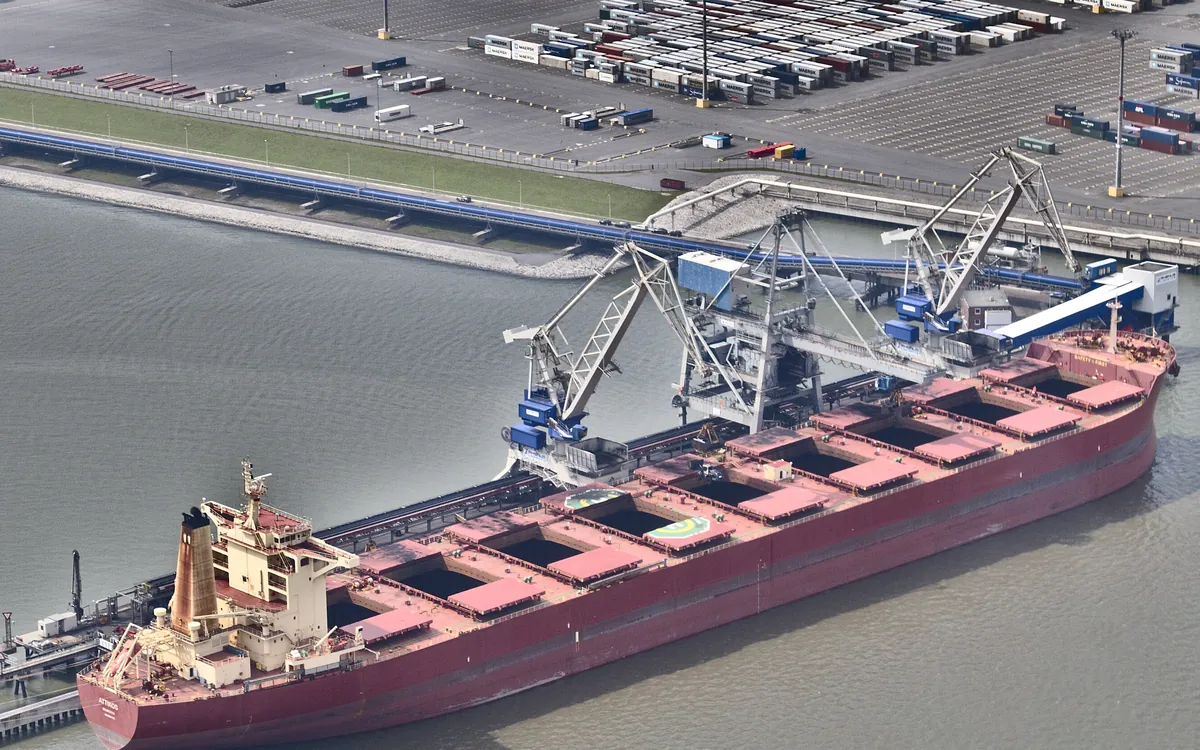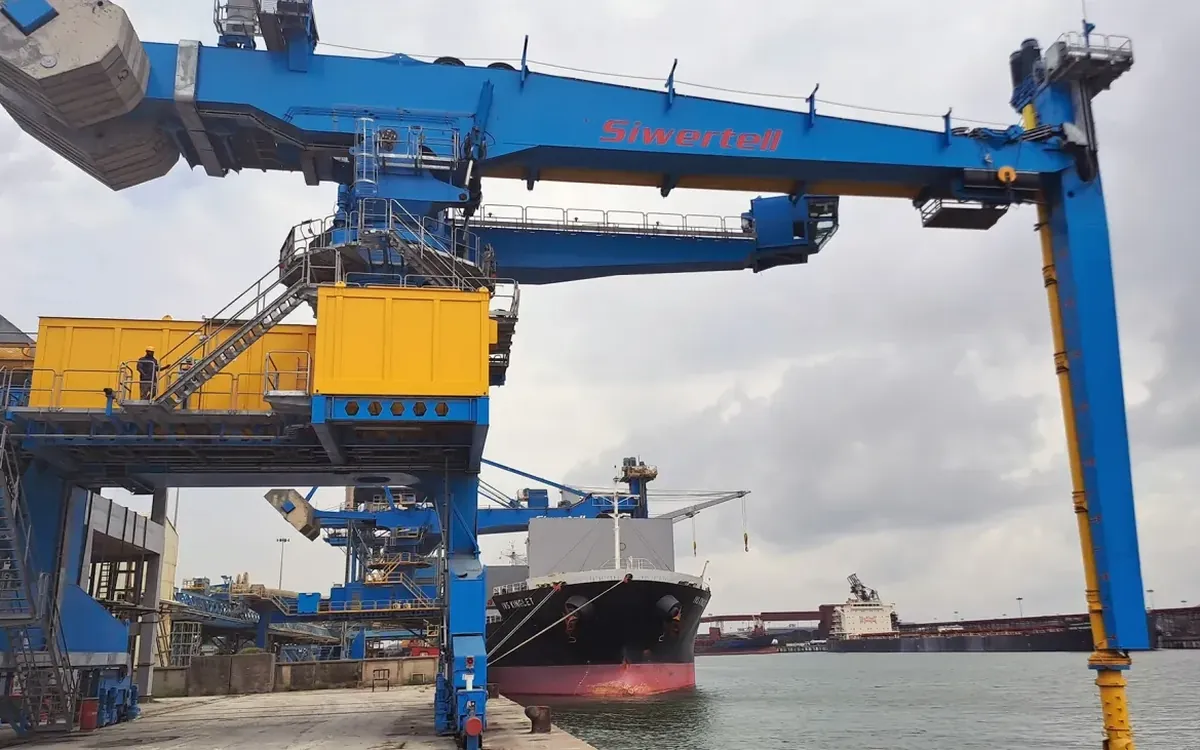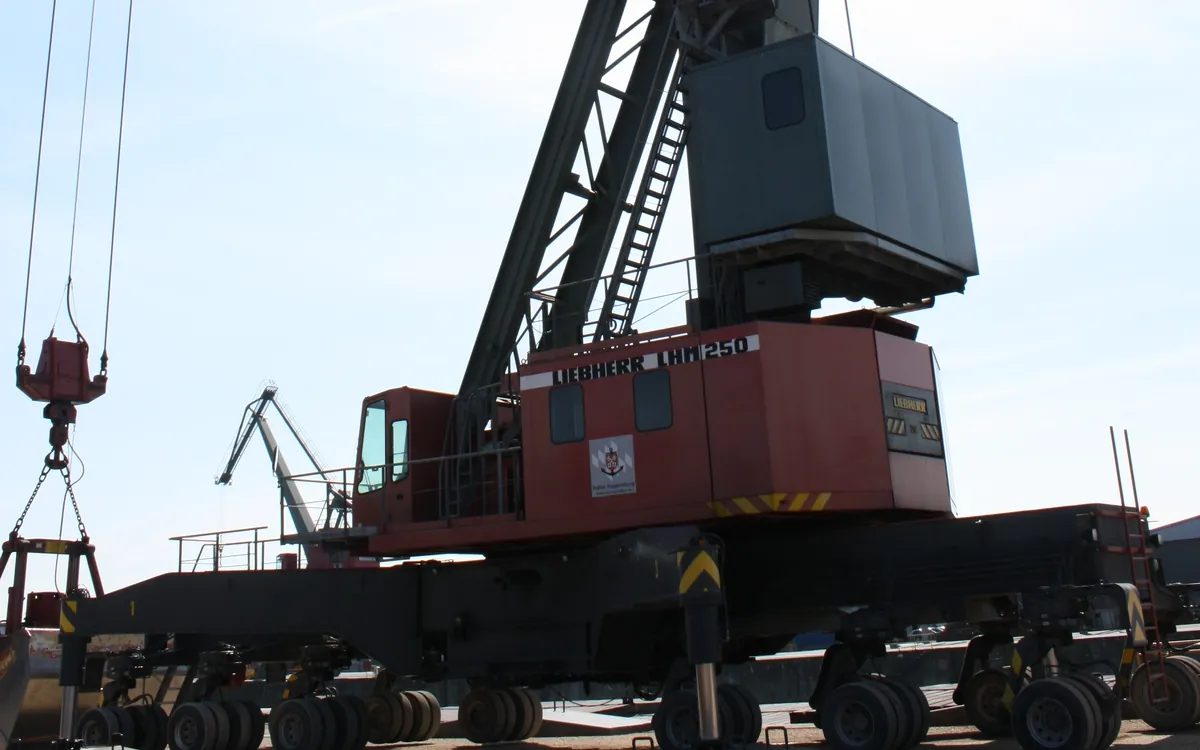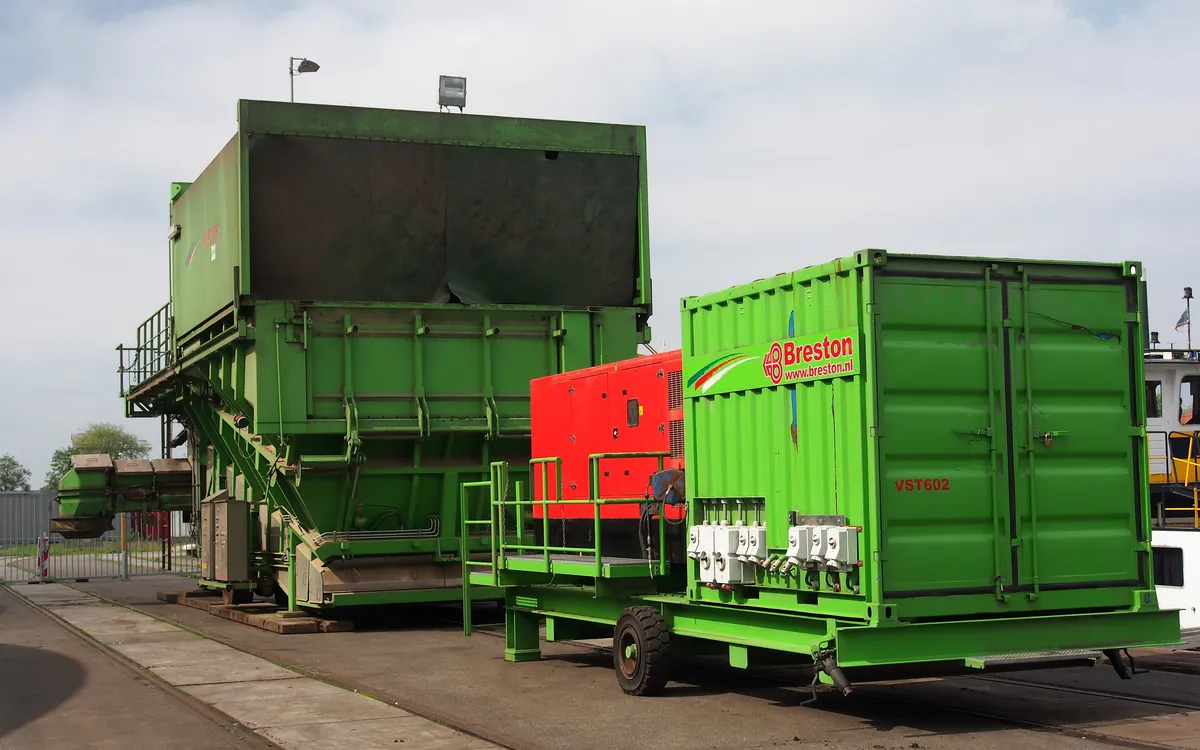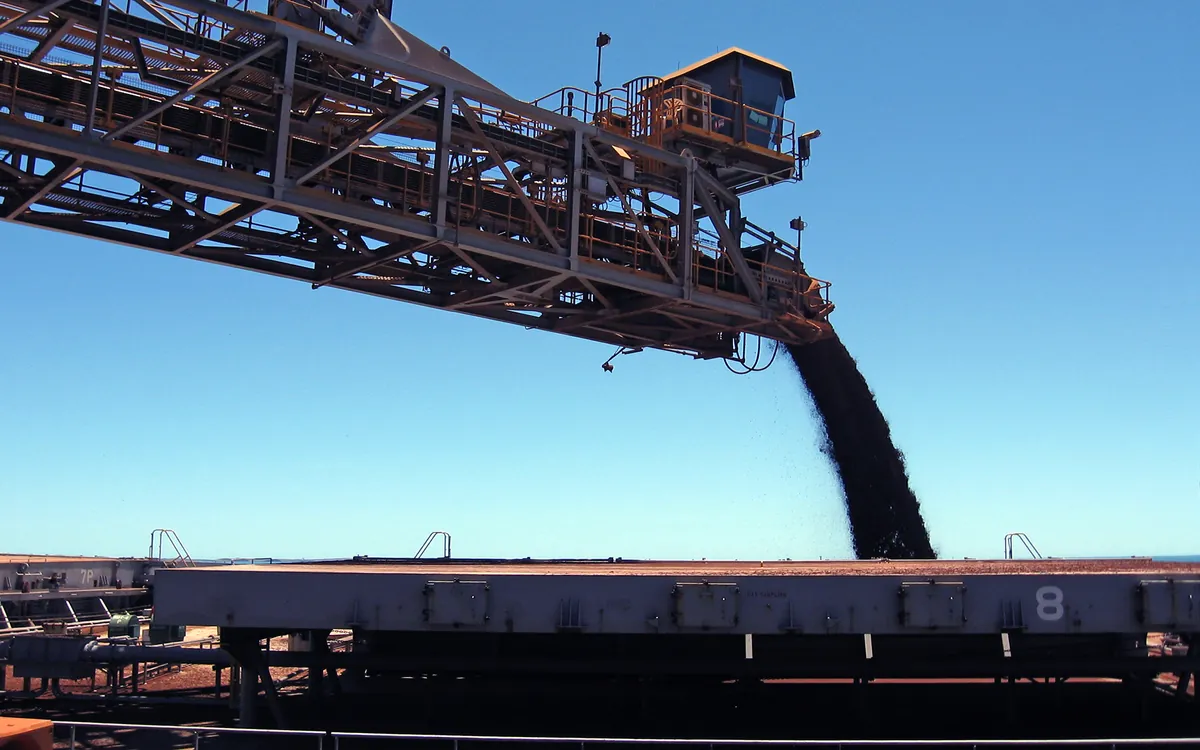
Takes bulk off the yard conveyor, carries it out over the hatch and trims the cargo through a telescopic chute. Fixed types travel on rails or slew from a pivot; mobile radial telescopic loaders run on wheels or tracks.
What a shiploader is
A shiploader loads bulk solids such as iron ore, coal, fertiliser, grain and bagged goods continuously onto ships. It stands on a quay or jetty and is usually engineered for one project, taking into account the port layout, the material, the loading rate, the ship types and the budget.
There are two main families: stationary loaders, and mobile loaders that move along the berth so the ship does not have to be shifted from hatch to hatch.
How it works
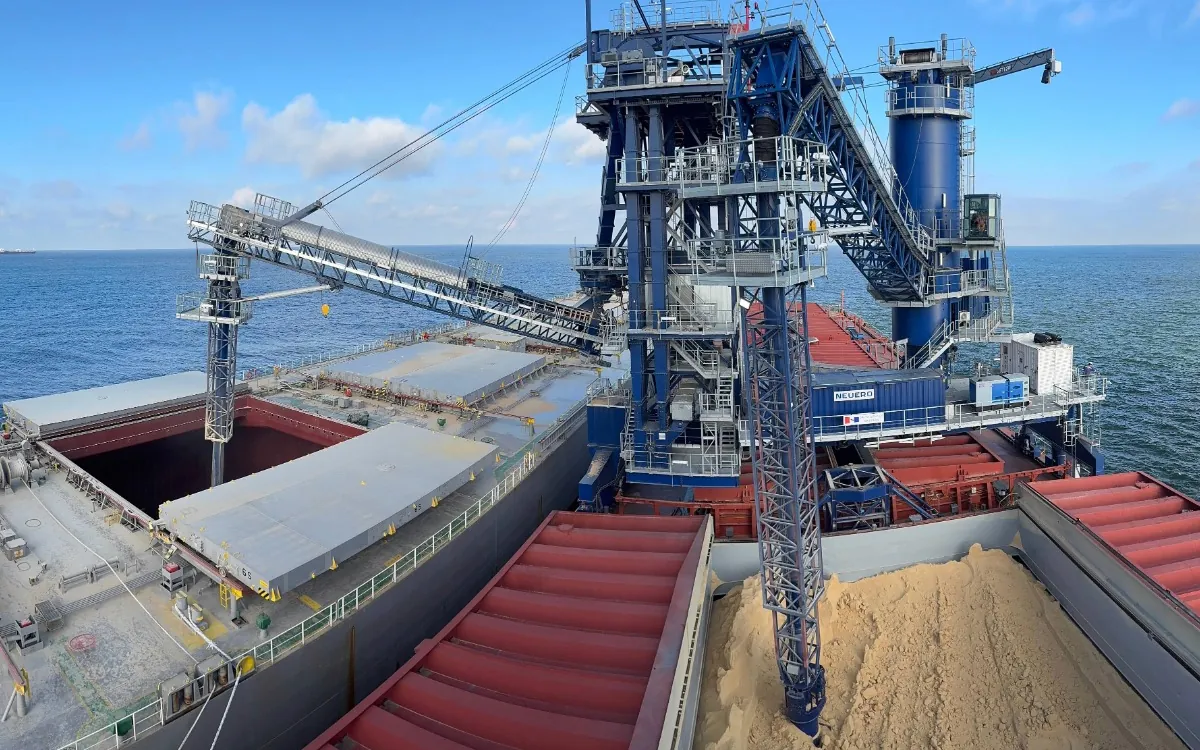
Material arrives on a belt conveyor from the stockyard. The loader carries it out along a boom over the hatch, and a chute at the end drops it into the hold. Telescopic or cascade chutes reduce the drop height to limit dust and breakage, and trimming spouts throw the cargo into the corners so the ship is loaded evenly.
Depending on design, the boom can slew, luff and telescope. Telestack's radial telescopic loaders combine slewing and telescoping so the operator can trim three hatches from one feed-in position, which cuts the time spent moving between hatches.
Telestack offers driven wheels with in-line, parallel and radial travel modes, crawler tracks for harsh ground, and rail mounting. Dust and trimming options include telescopic and cascade chutes, 360 degree trimmer chutes, rubber sock chutes, telescopic dust covers and water suppression, and the telescopic boom can retract to pass quay infrastructure.
Types and key figures
Stationary loaders include slewing loaders on a fixed pivot and linear or radial types at jetties. Rail-travelling loaders run along the full wharf on rails, which adds the cost of the track. Wheel-mounted loaders move freely along the quay and can leave the berth when not in use.
Telestack's mobile radial telescopic loaders reach rates up to 3,000 t/h and load vessels up to Panamax size, on driven wheels, tracks or rails. Large fixed loaders at dedicated ore and coal terminals are built for higher rates and larger ships, but their figures are project-specific.
Wikipedia sums up the trade-off between the mobile types: a rail-travelling loader is limited to the track along the wharf and needs rails bought and installed, while a wheel-mounted loader reaches every hold without moving the ship and without rails.
Where it is used and what cargo
Shiploaders serve export terminals for iron ore, coal, bauxite, grain, fertiliser, cement, aggregates, wood pellets and similar materials. Mobile units also load barges, coasters and Handysize to Panamax ships at multipurpose ports, and are used on construction and land reclamation projects.
Telestack references include a fertiliser system built from a radial telescopic conveyor, a mobile hopper feeder and a series of 30 m mobile link conveyors, and two radial telescopic loaders filling Handymax vessels at 1,500 t/h. Freight rates for cargo through these terminals can be compared at rates.navo24.com.
Dust, energy and automation
Dust control is the main environmental issue. Typical measures are covered conveyors, sealed transfer points, telescopic or cascade chutes, extraction units and water sprays. Electric drives are standard, so emissions at the berth come mostly from dust rather than exhaust.
Mobile loaders add one more option: when idle they can be driven off the berth, so the quay stays free for other cargo.
How to choose, pros and limits
Key questions are the target loading rate, the largest ship, tidal range and air draft, the material's dust and flow behaviour, and whether the berth also handles other cargo. A fixed rail-mounted loader suits a dedicated high-volume terminal. A mobile loader suits multipurpose berths, lower volumes or temporary projects.
Shiploaders only load. Import cargo needs grab or continuous unloaders, so mixed berths often need both types of machine.
Variants
Questions shippers ask
What is the difference between a shiploader and an unloader?
A shiploader puts bulk cargo into a ship from a conveyor; an unloader takes it out of the hold with a grab, screw or bucket chain.
How fast can a shiploader load?
Mobile radial telescopic units reach up to 3,000 t/h; fixed loaders at large export terminals are designed per project.
Why use a telescopic chute?
It lowers the discharge point close to the cargo pile, reducing dust and material degradation.