





















Maersk’s third-quarter report for 2017 gave the financial impact of one malware attack as USD 250-300 million, the vast majority of it in Maersk Line. Shipping industry risks with published numbers differ in how much notice a shipper gets. Piracy, counted by the ICC International Maritime Bureau for 2025, and a malware attack come with no scheduled date, while a labor contract expiry and a fuel rule arrive on a known one.
Piracy: where the 2025 incidents happened and what the 2026 report changed
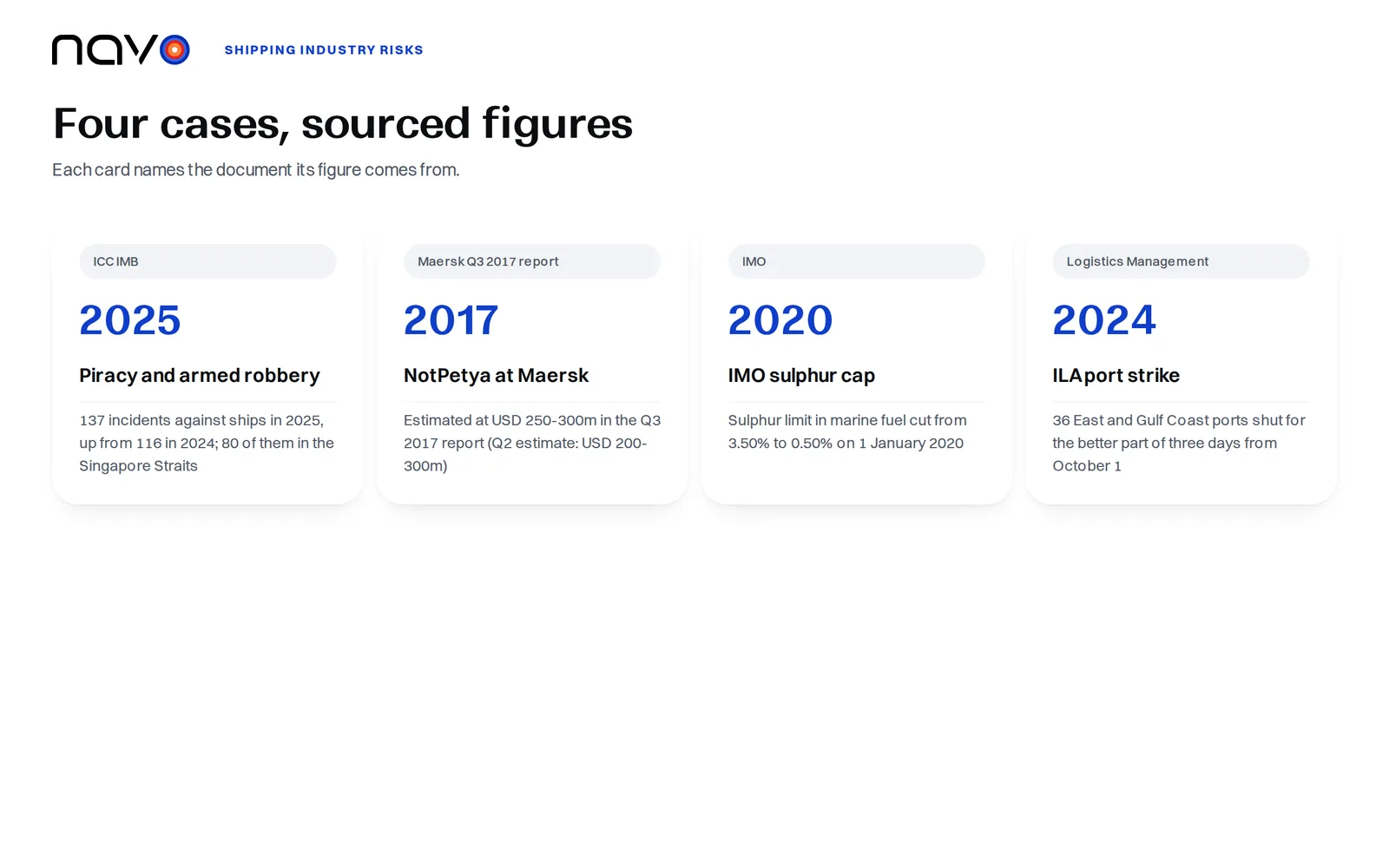
The ICC International Maritime Bureau counted 137 piracy and armed robbery incidents against ships in 2025, against 116 in 2024 and 120 in 2023. Vessels were boarded in 121 cases, and four were hijacked.
Somalia was a small part of that. The IMB recorded five Somali piracy incidents in 2025, and three of the four hijacked vessels worldwide were off Somalia: two fishing vessels and a dhow. The bureau adds that some hijackings of dhows and fishing vessels may have gone unreported, and warns masters against complacency. Most of the 2025 incidents came from the Singapore Straits, with 80 against 43 in 2024, more than 58 percent of the global total. In the Singapore Straits the IMB also reports that 21 large vessels over 100,000 DWT were targeted, including two crude oil tankers over 300,000 DWT, with 19 of these successfully boarded.
The IMB calls the Straits incidents low level and opportunistic, yet guns were reported 27 times, up from eight, and 14 crew were taken hostage. The Gulf of Guinea had fewer incidents, 21, but four of them ended with 23 crew kidnapped.
In the last two quarters of 2025 the IMB reports a noticeable decline in the Straits, after Indonesian Marine Police apprehended two gangs in July. The General Warning it first issued in December 2019 is still valid.
In a read of Navo container tracking on November 20, 2026, 353 of 4,824 tracked containers had Singapore in their route. Of the 1,127 still moving, 142 routed through it, and 124 of those had already passed. Eighteen were still ahead.
The IMB’s January to September 2026 report looks different. It counts 51 incidents in nine months against 116 a year earlier, the lowest reported figures since 1992, with 13 in the Singapore Straits against 73. Somali pirates were responsible for all eight hijackings and for 94% of crew taken hostage. The IMB acknowledges an uptick in Somali piracy. It notes that vessels following BMP recommended practices have deterred attackers from taking control. The Straits count fell by 60 between the two reporting periods. The periods differ in length: three vessels were hijacked off Somalia in the full year 2025, eight hijackings were attributed to Somali pirates in nine months of 2026, and the 2026 count includes a tanker hijacked at a Yemen anchorage that then sailed to Somalia.
Where parties incorporate it, the BIMCO war risks clause for time charters, CONWARTIME 2025, sets out who pays the extra insurance when a charter runs into piracy and other war risks. It names acts of piracy among the War Risks. The vessel need not proceed to or through an area that the Master or the Owners reasonably judge to be exposed, and when it does go, the charterers reimburse the owners’ additional war risk premiums and any additional kidnap and ransom insurance. The clause sits between owner and charterer and does not set a cargo owner’s terms.
Malware: what NotPetya cost Maersk
Maersk’s second-quarter interim report dates the hit to Tuesday 27 June 2017. Many global companies were caught by the malware, later known as NotPetya, which spread through MeDoc, a Ukrainian accounting program used to file tax returns. The CEO said it mainly hit Maersk Line, APM Terminals and Damco. Volumes suffered for a couple of weeks in July. The August report gave USD 200-300 million, mostly lost revenue in July, with the vast majority in Maersk Line. Transport & Logistics still held its guidance of underlying profit above USD 1bn for the year.
The range narrowed in the third-quarter report of November 7, 2017, where Maersk gave the financial impact as USD 250-300 million and lowered Transport & Logistics guidance to an underlying profit around USD 1bn. The report says the vast majority of the impact relates to temporary lost business in July and August. Maersk Line volumes fell 2.5% in the quarter against Q3 2016, and unit cost rose 3.9% at fixed bunker prices, which the company ties to the recovery after the attack. Maersk expected no more impact in Q4. The 2017 annual report describes the loss as covering lost revenue, IT restoration costs and extraordinary operating costs, among other things, and adds that operations in transport and logistics were disrupted, with unwarranted impact on customers.
Shipping industry risks that came with a date: strikes and fuel rules
The previous six-year contract between the International Longshoremen’s Association and the United States Maritime Alliance expired at 12:01 AM ET on October 1, 2024. Logistics Management reported that 36 East and Gulf Coast ports were shut for the better part of three days. The sides then announced a tentative agreement on wages. The Master Contract was extended to January 15, 2025 while talks on the rest continued. Wage terms were not disclosed. The article cites a Wall Street Journal report that USMX had offered a 62% wage increase over six years.
The USMX release of March 11, 2025 announced the signed Master Contract extension, effective October 1, 2024 through September 30, 2030. ILA President Daggett was quoted in it calling the deal a record-setting 62 percent increase in wages.
The fuel rule had a fixed date: IMO 2020 cut the sulphur limit in marine fuel from 3.50% to 0.50% outside emission control areas on 1 January 2020. Inside emission control areas it was already 0.10%. A MARPOL amendment adopted in 2018 prohibits carrying non-compliant fuel unless the ship has a scrubber, and ships had to meet the limit with compliant fuel or an exhaust gas cleaning system, which flag States accept as an alternative means.
Frequently asked questions
How far from shore can Somali pirates attack a ship?
The IMB says past incidents have been recorded over 1000 nautical miles from the Somali coast. It also advises vessels crossing these waters to follow the latest Best Management Practices.
Does the 0.50% sulphur limit apply to small ships?
IMO says the MARPOL regulations apply to all ships, and ships of every size must use fuel oil that meets the 0.50% limit. Only ships of 400 gross tonnage and above on voyages to ports under other Parties' jurisdiction need an International Air Pollution Prevention Certificate.
Should a master report a piracy incident that ended without a loss?
The IMB asks masters to report all incidents immediately when they occur, because timely reports let others in the area take precautions.