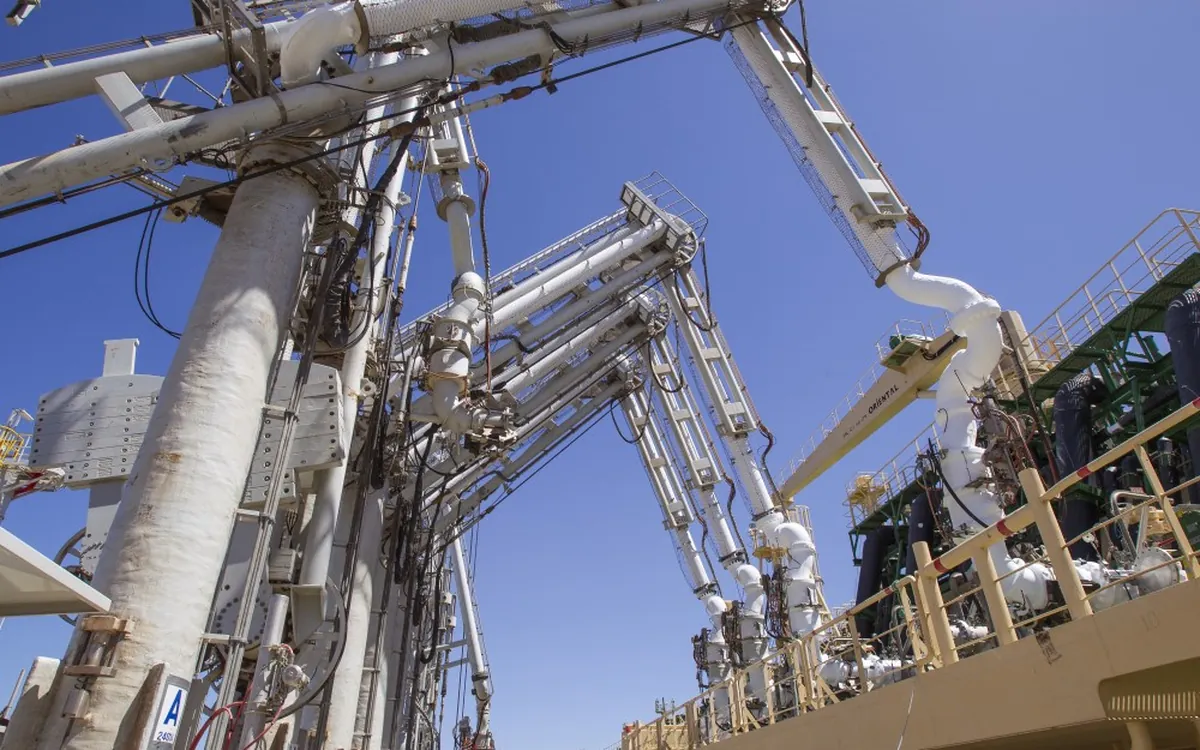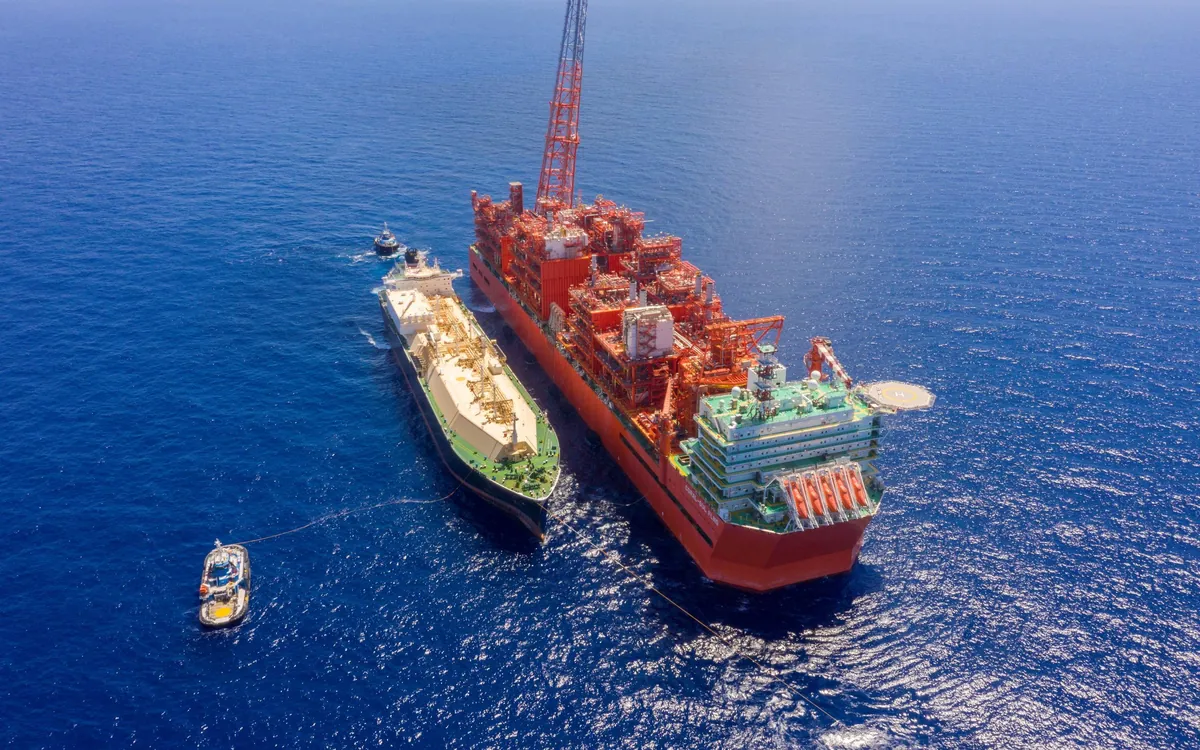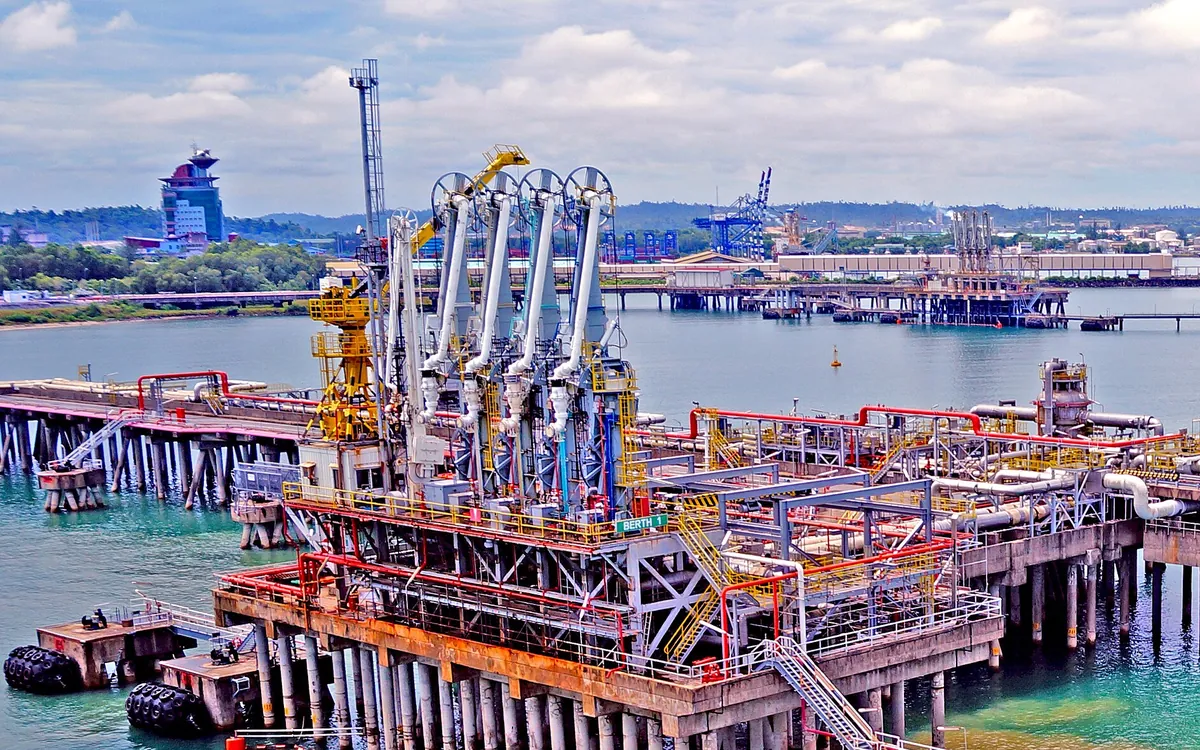
Stainless steel loading arm for liquefied gas at cryogenic temperature. An LNG berth runs several liquid arms plus a vapour return arm, each with a cryogenic emergency release system.
What a cryogenic loading arm is
LNG is natural gas cooled to about -162 °C so it becomes liquid. Moving it between ship and shore needs a connection that stays tight and flexible at that temperature. Carbon steel becomes brittle when that cold, so cryogenic arms use stainless steel throughout the product path.
Emco Wheaton, used as the reference here, built its first cryogenic marine loading arm in 1976. Its arms are designed and tested to ISO 16904, the standard for LNG transfer arms at conventional onshore terminals.
How it works
The arm is a counterweighted structure on a riser. Emco Wheaton uses a double counterweight with a rigid link pantograph to balance the inboard and outboard pipes. Cryogenic swivel joints let the arm follow the ship's movement. A quick connect/disconnect coupler (QC/DC) clamps onto the ship's manifold flange.
Each arm carries a cryogenic emergency release system (ERS): two valves with a release coupler between them. If the ship moves beyond the safe envelope, the valves close and the coupler opens, separating the arm with minimal spillage. A position monitoring system watches the arm's envelope and triggers alarms before release.
During transfer, liquid arms carry LNG and a separate arm returns the boil-off and displaced vapour from the ship's tanks to the shore.
Technip Energies builds its LNG arms on the DCMA-S (Double Counterweight Marine Arm Structure) and offers emergency shutdown (ESD) systems with SIL 2 capability, linked to the ship's and the terminal's own shutdown systems.
Sizes and key figures
Emco Wheaton supplies cryogenic arms from 6" to 20" in 304L or 316L stainless steel, rated to -196 °C. A 16" LNG arm it supplied to the Altamira LNG terminal in Mexico in 2004 is still in service.
Technip Energies, another major maker, also offers 20" full-bore LNG arms. For the Al Zour LNG import terminal in Kuwait it delivered two sets of four 20" full-bore arms, and for Sinopec Tianjin LNG in China nine arms in two phases.
Where it is used and what cargo
Cryogenic arms are installed at LNG export and import terminals, small-scale and bunkering jetties, and ethylene terminals. Emco Wheaton lists LNG, liquid hydrogen and ethylene, and the card lists ammonia, which is also carried refrigerated. Liquid hydrogen at about -253 °C is colder than the -196 °C rating, so LH2 arms are a separate development the maker reports for 2022 to 2024.
Terminals often add heating, insulation and vapour return lines, and linings for specific products. Freight rates for cargo through these terminals can be compared at rates.navo24.com.
Small-scale terminals and bunkering berths use smaller arms, because the ships and transfer rates are smaller. Technip Energies lists a dedicated loading system for LNG bunkering next to its large terminal arms.
Safety and new energy cargoes
Safety systems on LNG arms are SIL rated, and the ERS and QC/DC are tested and approved for cryogenic conditions. Seals can be replaced in place, which cuts downtime.
Growth in LNG bunkering and in ammonia and hydrogen as fuels is creating demand for smaller arms and new cryogenic designs.
Emco Wheaton states that its cryogenic arms are designed and tested to ISO 16904. The same arm family handles ethylene and liquid hydrogen, which matters for terminals that plan to add new low-carbon cargoes later.
How to choose, strengths and limits
Arm size and number follow from the ship sizes and target transfer rate. The envelope must cover tide, draught and drift. Specify ERS, QC/DC, position monitoring and the vapour return arm as one system.
Rigid arms give a proven, monitored connection with fast emergency release. They need a fixed jetty and cannot follow large motions, which is why offshore and ship-to-ship LNG transfer uses specialised arm systems.
Ask the maker for references at similar terminals, the spare parts plan for swivels and seals, and how long a seal change takes, since a berth that cannot load ships quickly loses cargo slots.
Variants
Questions shippers ask
What temperature do LNG loading arms work at?
LNG is handled at about -162 °C. Emco Wheaton rates its cryogenic arms down to -196 °C.
What material are cryogenic loading arms made of?
Stainless steel, 304L or 316L, because carbon steel turns brittle at cryogenic temperatures.
Why does an LNG berth have a vapour arm?
The vapour return arm takes displaced vapour and boil-off from the ship's tanks back to shore while liquid flows through the other arms.
What standard applies to LNG loading arms?
ISO 16904 covers the design and testing of LNG transfer arms for conventional onshore terminals.