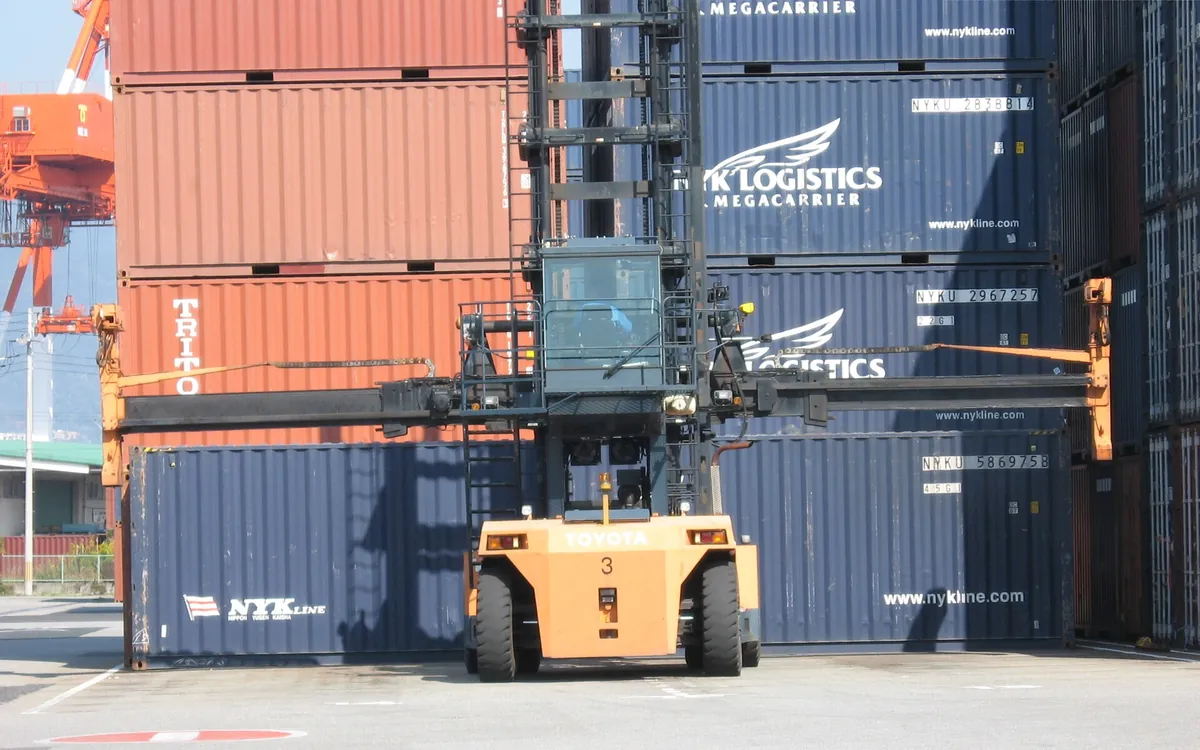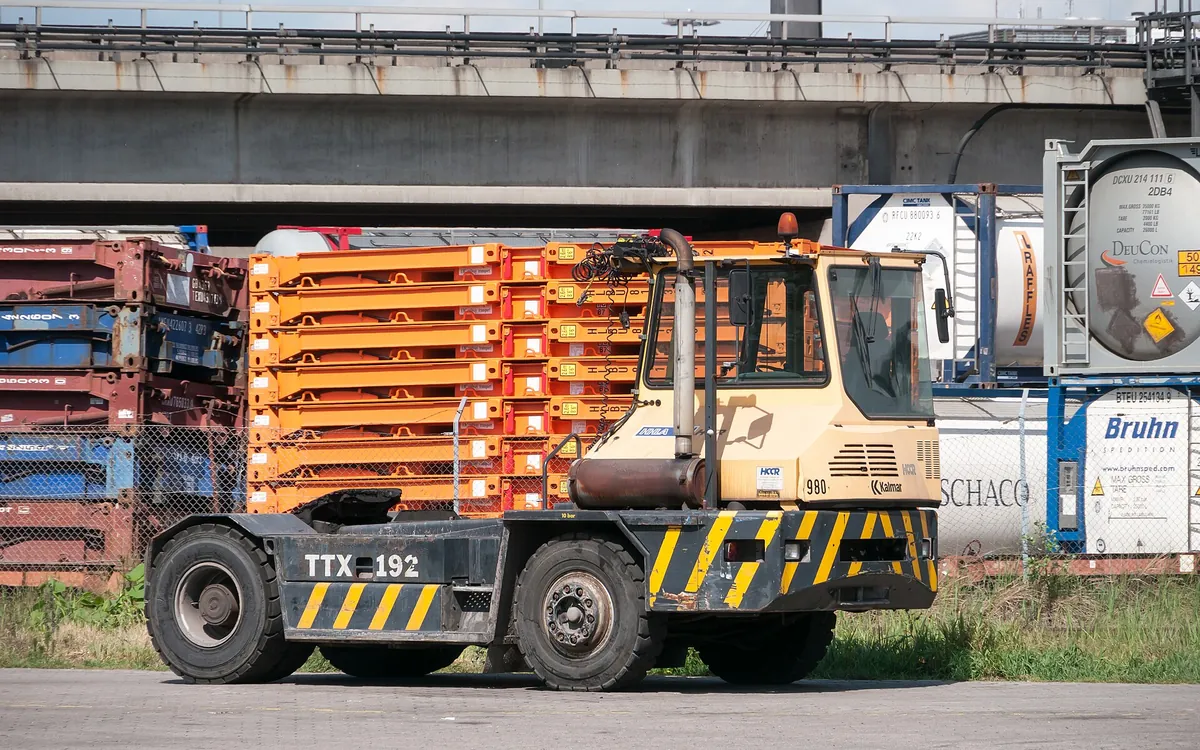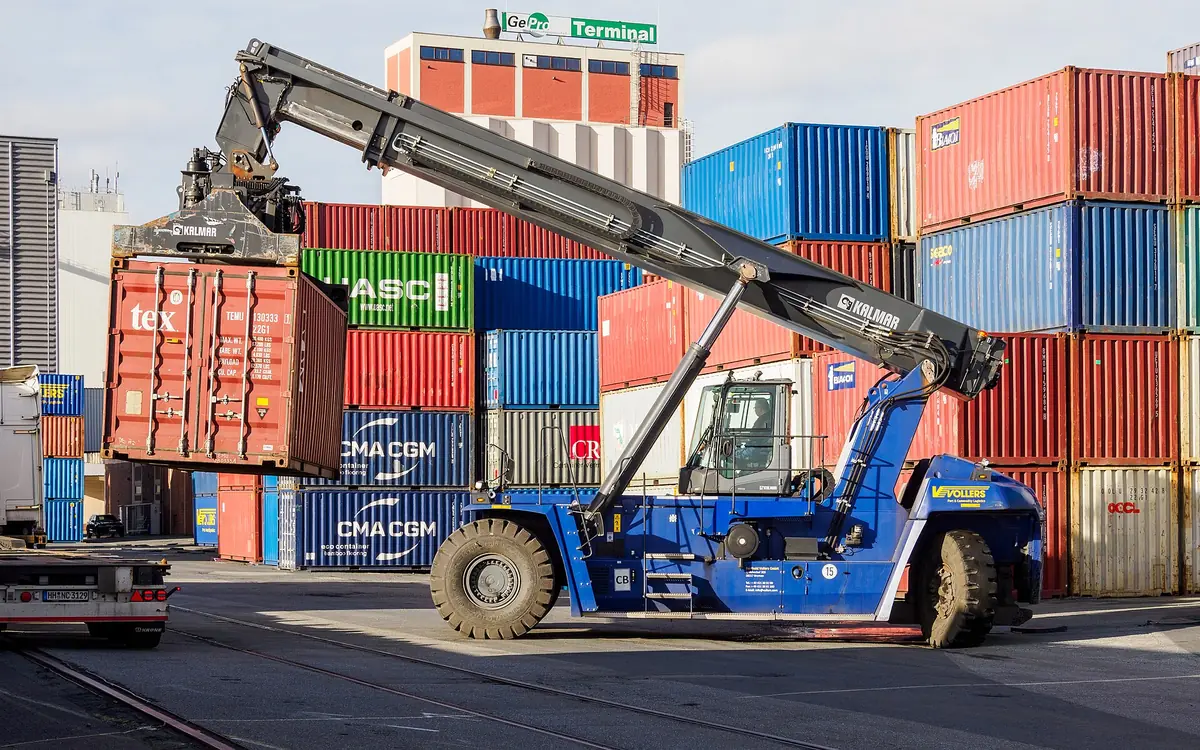
Counterbalanced truck with a telescopic boom. Picks containers from the top and can reach over the first rows of a stack.
What a reach stacker is
A reach stacker moves containers over short distances and piles them in blocks. The boom pivots at the rear of the machine and telescopes forward over the front axle, with a spreader that can rotate to line up with the container.
Compared with a forklift it stacks higher and reaches into the second row, so blocks can be kept up to four rows deep. That flexibility is why it has gained ground in most container markets.
How it works
The machine lifts by raising and extending the boom, while a heavy counterweight at the rear balances the load. Rated capacity falls as the boom reaches further, so a machine rated at 45 t in the first row lifts less in the second and third rows.
Attachments change the job. A top-lift spreader handles containers, a bottom-lift frame takes trailers and swap bodies by their grappler pockets, and hooks or tool carriers turn the machine into a heavy lifter.
Service access is part of the design. On the Kalmar Gloria range all major service points can be reached from the ground, and the CAN-bus electrical system locates faults and switches to backup wires and connectors before they stop the machine.
Sizes and key figures
The Kalmar DRG420-450 range lifts up to 45,000 kg and stacks containers up to 6 high and 4 rows deep, on wheelbases of 6,000 to 7,500 mm. Kalmar's barge handler version keeps 27 t of capacity in the 4th row with a negative lift down into a barge.
Special models go much further: Kalmar's lift-hook reach stacker handles loads up to 130 t for steel and wind components, and its tool-carrier version lifts 65 t.
The intermodal Kalmar DRG450C lifts up to 45 t, handles laden truck trailers and can work on the second rail line, so a train can be loaded without crossing the first track.
Where it is used
Reach stackers work in small and medium container terminals, inland and rail terminals, empty and full depots and multipurpose ports. Intermodal models can lift trailers and reach the second rail track. Barge handlers lower boxes into a vessel below quay level.
They are often the first container machine a port buys, and large terminals keep a few for special jobs such as out-of-gauge cargo or the container freight station. Freight rates for cargo through these terminals can be compared at rates.navo24.com.
Electric and lower-emission models
Diesel remains common, but battery-electric reach stackers are now in series production. Kalmar's ERG450 produces no exhaust emissions at the point of use, and has fewer moving and mechanical parts to service. Kalmar has also built a version in which almost half of the steel is SSAB green steel, cutting the carbon embedded in manufacturing.
Kalmar's other suggestions apply to diesel fleets too: eco driving training, a tyre pressure monitoring system and long-life hydraulic oil.
Kalmar's Battery Monitoring System tracks voltage, temperature, coolant and current flow, and the whole high-voltage system shuts down automatically if a connection is interrupted.
How to choose, pros and limits
The deciding questions are the heaviest box at the furthest row, the stacking height needed, the ground bearing capacity and whether trailers or barges must be handled. A reach stacker is flexible, quick to deploy and needs no rails or fixed power.
The limits are high axle loads on the pavement, wide aisles between blocks, and lower productivity and density than gantry cranes once volume grows. For empties only, a lighter empty container handler is usually cheaper to run.
Variants
Questions shippers ask
How many rows can a reach stacker reach?
It can work the first row and reach into the rows behind, with lower capacity each row back. Kalmar quotes stacking up to 4 rows deep.
How heavy a container can a reach stacker lift?
Standard container models lift up to about 45 t in the first row.
Reach stacker or straddle carrier?
A reach stacker is cheaper and more flexible for low volumes; a straddle carrier is faster and works better at high throughput.