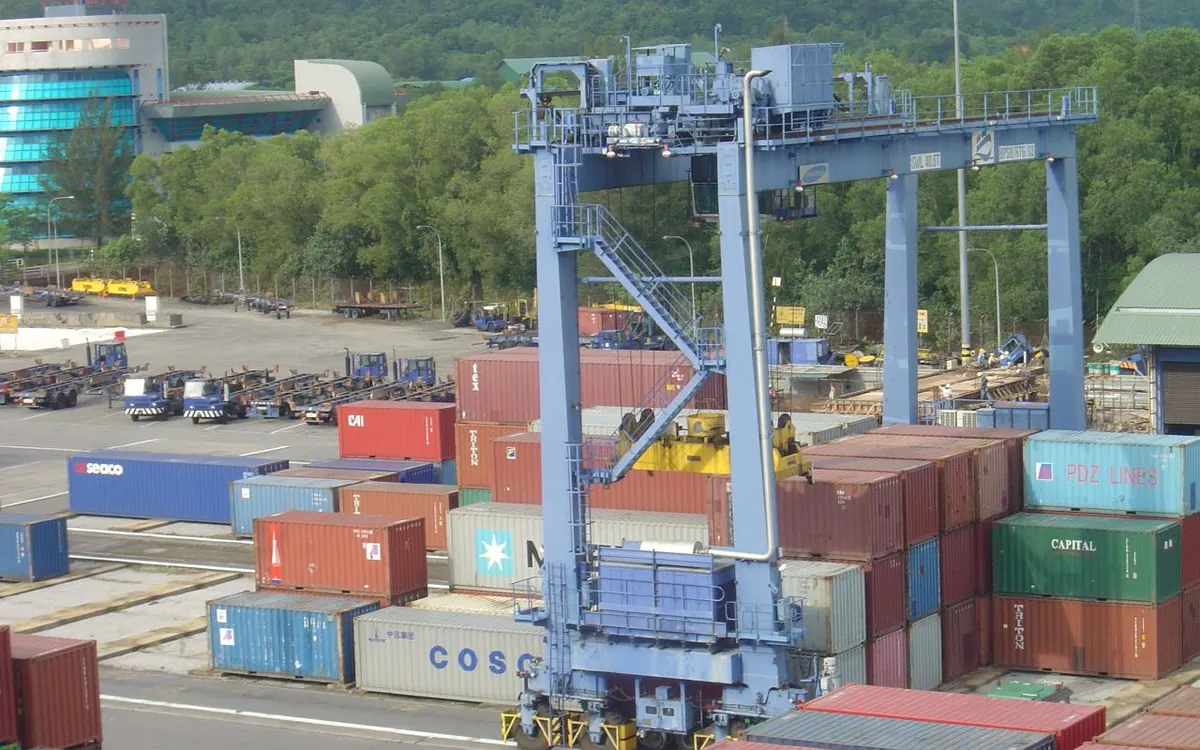
Stacks containers in yard blocks several rows wide, with a truck lane under the legs. On tyres, so it can change blocks.
What an RTG is
An RTG, sometimes called a transtainer, is a wheeled gantry crane used to ground and stack intermodal containers. Import boxes wait in its block until a road truck collects them; export boxes wait until they are called to the ship. One lane under the crane is kept free for trucks or terminal tractors.
It is the most common yard crane in manually operated terminals, because a fleet of RTGs can be redistributed between blocks as the workload shifts.
How it works
A double-girder steel frame sits on four bogies. The trolley runs across the span carrying the headblock and spreader, and the bogies drive along the block. To change blocks, the wheels turn 90 degrees and the crane drives across to the next runway.
Spreaders handle single 20 ft and 40 ft boxes, twin 20 ft lifts or piggyback units. Konecranes' Active Load Control stops sway and lets the operator fine-position the box by up to plus or minus 250 mm in four directions without moving the gantry or trolley.
Sizes and key figures
RTG size is described by width in container rows plus the truck lane, and by height as 1-over-n, meaning it can carry one box over a stack n high. Konecranes builds from 5 rows plus lane (span 19.4 to 21.4 m) to 10 rows plus lane (33.4 to 35.4 m), and from 1-over-3 (lift height 12.34 m) to 1-over-6 (21.0 m).
Rated capacity is 40 or 50 long tons under the spreader. Konecranes lists lifting speed of 31 m/min with full load and 62 m/min empty, trolley travel up to 82 m/min, gantry travel up to 135 m/min and productivity of 40 or more containers per hour with Active Load Control.
The machine sits on either 16 wheels (tyres 14.00 x 24) or 8 wheels, with half of the wheels driven in both layouts. The wheel count sets the load on the runway.
Where it is used
RTGs work the stacking yards of container terminals of almost every size, from feeder ports to large hubs, and also rail and inland terminals. They handle full and empty dry boxes and, in blocks fitted with power points, reefers. Wikipedia notes RTGs are also used outside ports, for example in bridge building and assembling large components.
Compared with straddle carriers they give higher stacking density, and compared with rail-mounted cranes they keep the yard flexible. Freight rates for cargo through these terminals can be compared at rates.navo24.com.
Power, emissions and automation
A classic RTG carries a diesel generator, typically of 100 to 600 kW. Because there is no grid to take braking energy, older units burn lowered-load energy in resistor banks, and Wikipedia cites consumption of up to about 38 litres of diesel per hour per crane.
Electrification has spread since electric RTGs entered service in Shenzhen in 2008. Konecranes offers cable reel (1 to 10 kV) and busbar (460 to 500 V) feeds, hybrid packs, battery packs and a fuel-saver diesel. An electrified block cuts local emissions but ties the crane more closely to its lanes.
Automation is also moving into RTG yards. Konecranes cranes come ready for remote operation, with options such as DGPS auto-steering that keeps the crane within plus or minus 100 mm of its path, auto-positioning, stack collision prevention and truck-lift prevention.
How to choose, pros and limits
Width and height follow the yard plan: wider blocks and taller stacks raise density but lengthen each cycle and increase rehandles when a box near the bottom is needed. The yard surface must carry the wheel loads, and runways need at least about 1.5 m width per Konecranes' recommendation.
The main advantages are flexibility and lower civil works than a rail-mounted crane. The limits are diesel use on non-electrified units, slower gantry travel than a straddle carrier, and the need for a separate horizontal transport fleet between quay and yard.
Variants
Questions shippers ask
What does 1-over-5 mean?
The crane can lift one container over a stack five high, so it stores six-high stacks minus working space. Konecranes gives 18.1 m lift height for 1-over-5.
How many rows does an RTG span?
Commonly 5 to 8 rows plus one truck lane; Konecranes builds up to 10 rows plus lane.
What is the difference between an RTG and an RMG?
The RTG runs on tyres and can change blocks; the RMG runs on fixed rails, usually with wider spans and easier automation.
Are RTGs electric?
Many still use diesel generators, but cable reel, busbar, hybrid and battery versions are widely available.