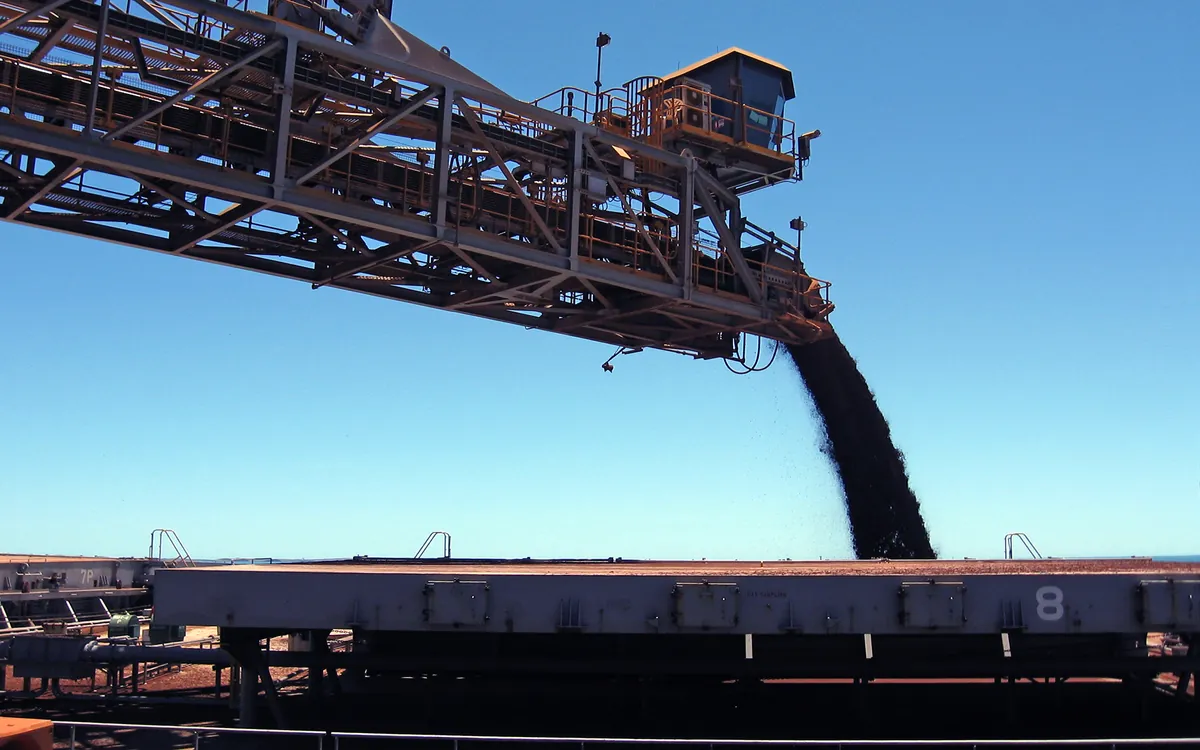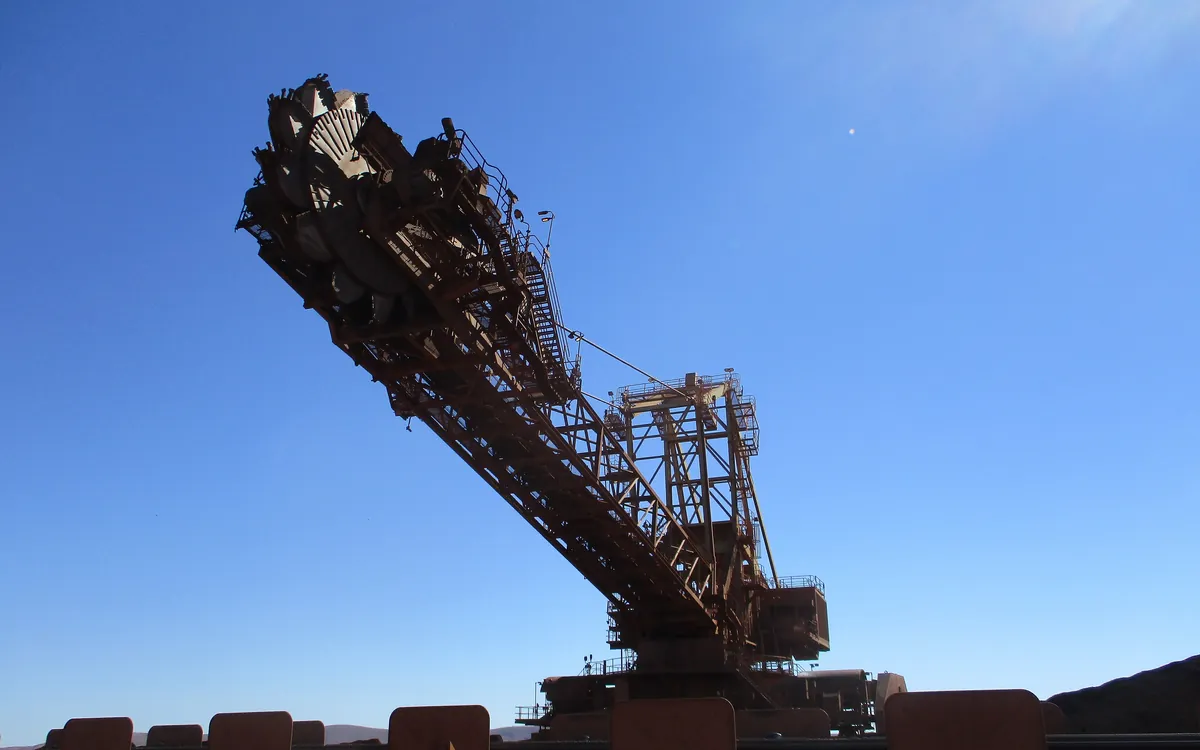
Rail-mounted machine that cuts into the stockpile with a rotating bucket wheel on a slewing boom and drops the material onto the yard conveyor. Combined stacker-reclaimers also build the piles.
What a reclaimer does
In a bulk terminal, stackers build stockpiles from incoming trains, trucks or ships, and reclaimers recover the material to send it on, usually to the shiploader or to a plant. A bucket-wheel reclaimer is one of several machine types for that job. Others use scraper chains or rotating drums.
Reclaimers are volumetric machines. They are rated in cubic metres per hour, and that figure is converted into tonnes per hour using the bulk density of the material. They usually travel on rails between stockpiles and take electric power through a trailing cable.
How it works
The bucket wheel sits at the end of a boom. As it turns, each bucket cuts a slice from the face of the pile and empties onto a belt conveyor running along the boom. That belt feeds the yard conveyor through the machine's centre.
A boom-type reclaimer moves in three ways: it travels along the rail, luffs its boom up and down, and slews the boom from side to side. Slewing across the pile face while stepping forward lets the wheel take the stockpile down in benches.
TAKRAF uses two boom layouts. For low or medium flow rates and short booms, the bucket-wheel boom and counterweight boom are combined in a fixed rocker, which has fewer pivot joints. For higher rates and longer booms, it prefers a pantograph arrangement, which keeps the machine steadier and safer against tipping when boom loads shift.
Sizes and key figures
TAKRAF lists reclaiming capacities from 500 to 20,000 t/h, rail gauges from 6 to 20 m and boom lengths from 25 to 60 m. The spread is wide because the same type serves a small cement works and a large iron ore export yard.
Boom-type machines are meant for medium to very high flow rates. For higher flow rates or larger particle sizes in bridge machines, TAKRAF mounts the bridge through the bucket wheel, which improves power transmission between trolley and bridge.
Where it is used and what cargo
TAKRAF's references include bucket-wheel reclaimers for iron ore in South Africa, boom-type machines in Australia and North America, and a bridge reclaimer for limestone in India. Typical materials are iron ore, coal, limestone and other minerals stored in long open stockpiles.
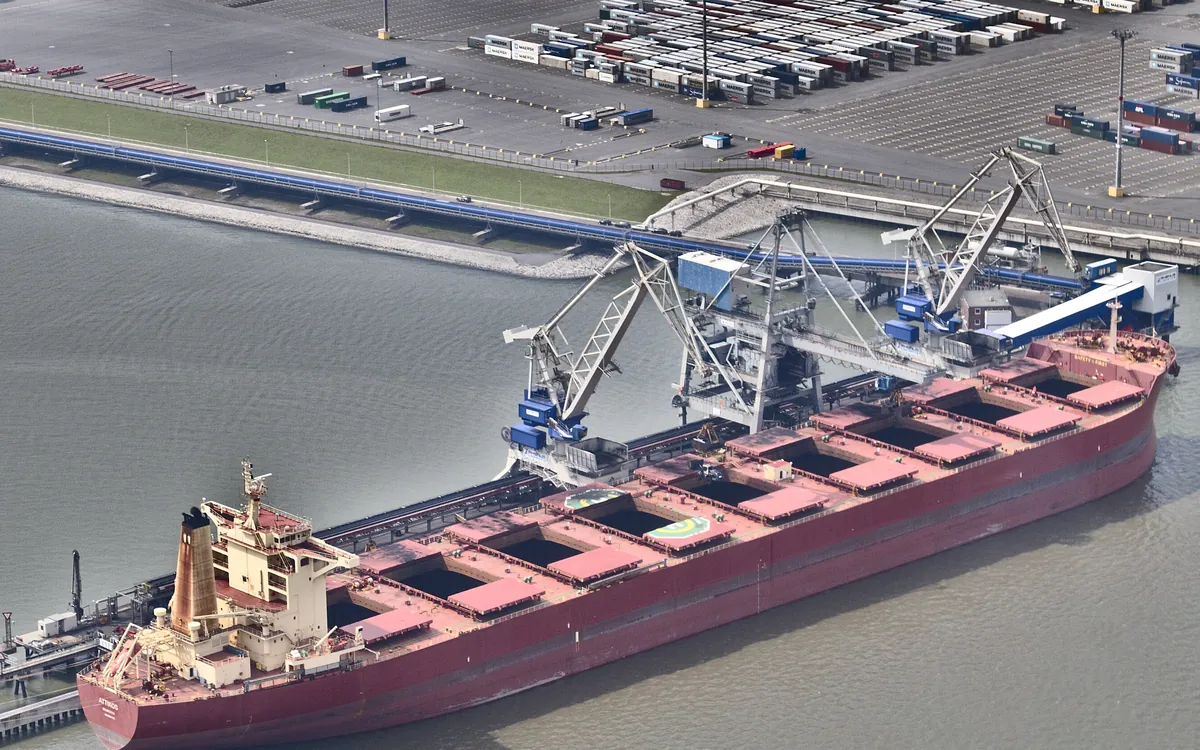
At a port the reclaimer usually sits between the stockyard and the shiploader. Its rate has to match the loading rate the berth sells, so large export terminals often run several reclaimers in parallel. Freight rates for cargo through these terminals can be compared at rates.navo24.com.
Blending and automation
Bridge-type reclaimers span the whole pile and blend the material as they reclaim it, because they cut across the full cross section. TAKRAF offers bridge machines with two bucket-wheel trolleys, each with its own drive, and drum reclaimers whose buckets take thin layers from the full face of the pile. Rakes with prongs or scraper rods loosen the face so material flows into the buckets.
Early stackers and reclaimers were operated manually. Modern machines are usually automated, with stacking and reclaiming parameters set remotely. Reclaiming is harder to automate than stacking, because detecting the pile edge reliably depends on the weather and the material. TAKRAF offers stockyard automation as part of its design scope.
How to choose, strengths and limits
The choice depends on flow rate, boom length and whether the material needs blending. A boom-type bucket-wheel machine gives high rates and works long piles on either side of the rail. A bridge or drum reclaimer gives better homogenisation, which matters for raw materials feeding a plant.
Combined stacker-reclaimers save a machine and a rail track but cannot stack and reclaim at the same time. All rail-mounted machines need a fixed yard layout, foundations and power supply, so they suit long-term, high-volume terminals rather than flexible multipurpose quays.
Variants
Questions shippers ask
What capacity does a bucket-wheel reclaimer have?
TAKRAF builds them for 500 to 20,000 t/h. The actual rate depends on boom length, wheel size and the bulk density of the material.
What is the difference between a stacker and a reclaimer?
A stacker builds stockpiles from the incoming conveyor. A reclaimer recovers material from the piles and sends it out. A combined stacker-reclaimer does both, but not at the same time.
Why are reclaimers rated in cubic metres per hour?
The buckets remove a volume of material. The tonnage depends on the bulk density of what is being reclaimed, so t/h is derived from m³/h.
Can reclaimers run automatically?
Modern machines are usually automated with remotely set parameters. Reclaiming is harder to automate than stacking because pile edges are difficult to detect in changing conditions.