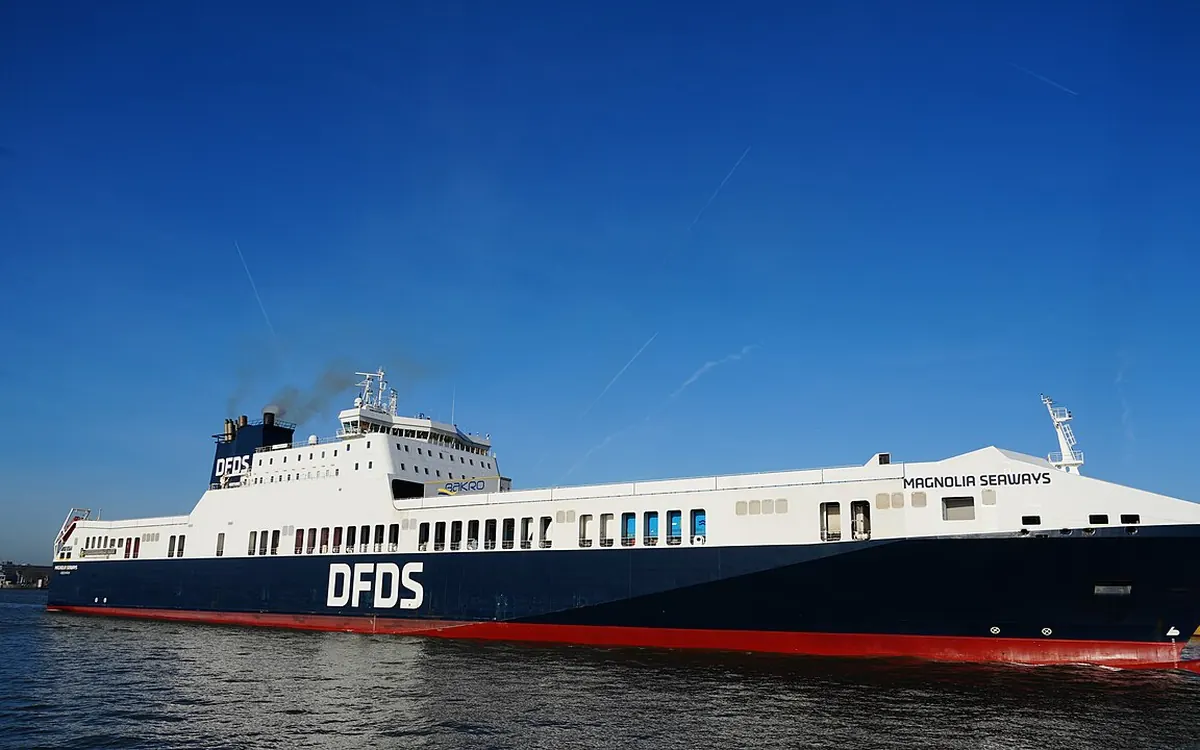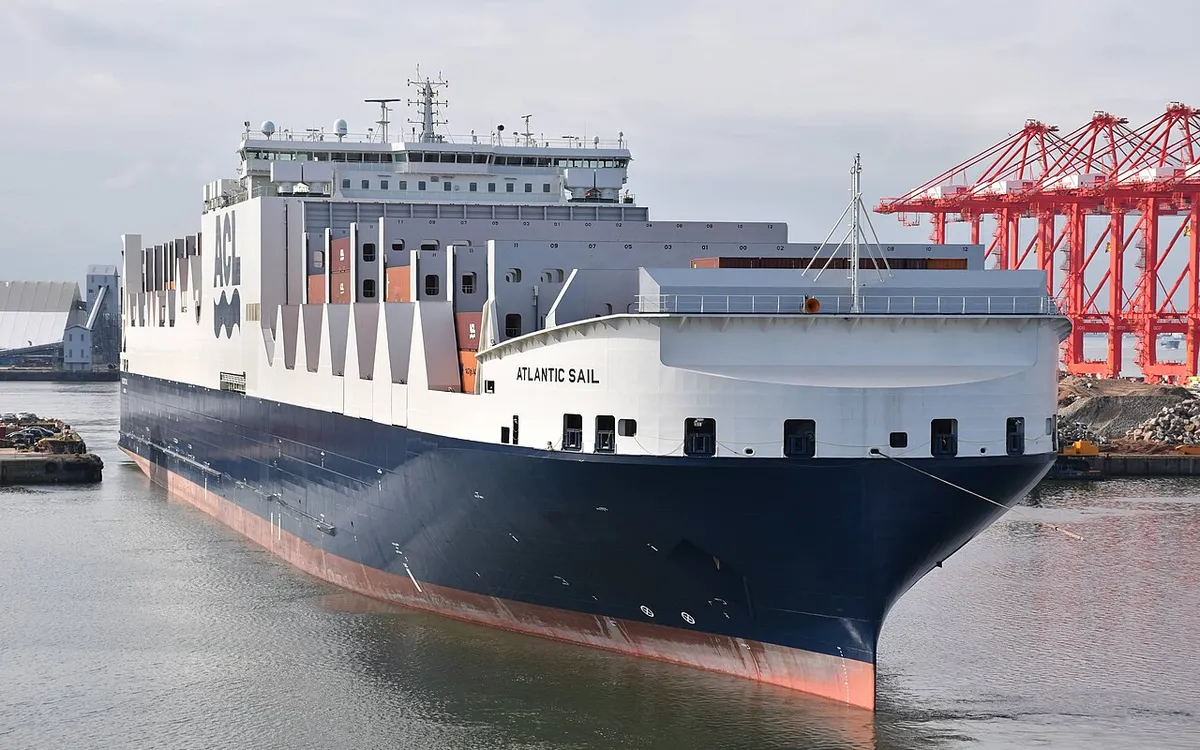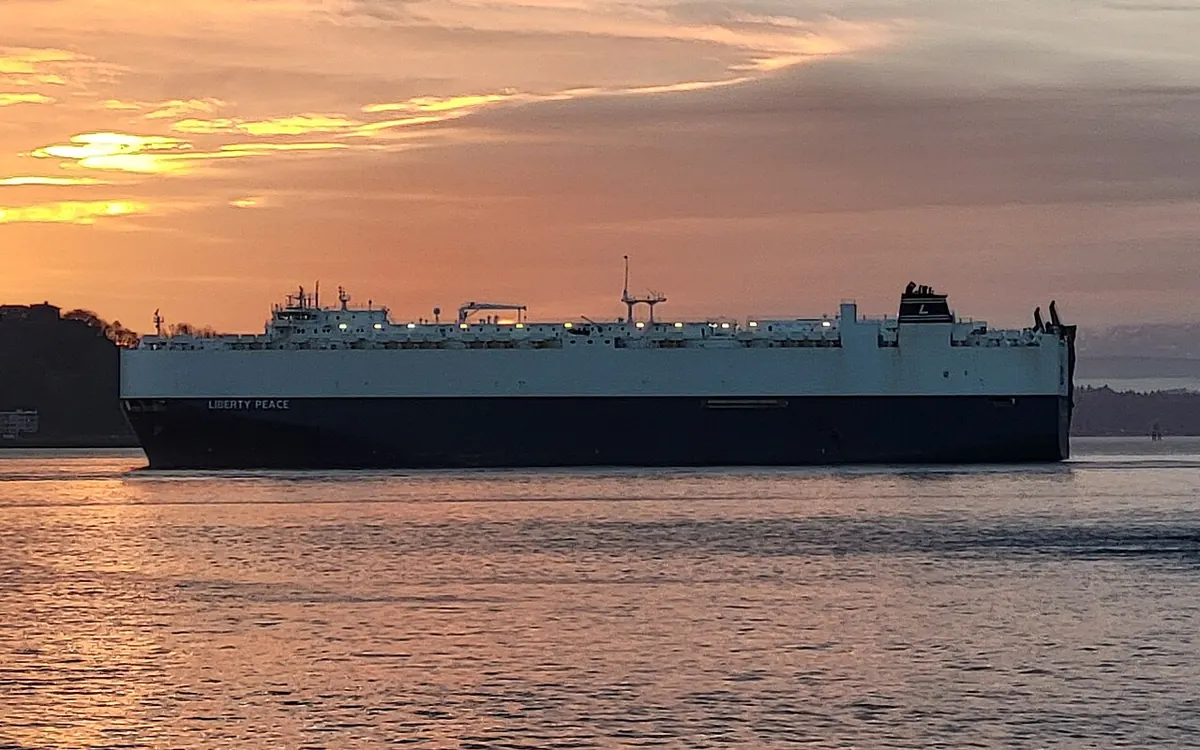
A Ro-Ro built for new vehicles. The pure car and truck carrier (PCTC) has liftable decks for taller units and stronger decks for high-and-heavy cargo; a 6,500-unit car ship can have 12 decks.
What a car carrier is
A PCC is a Ro-Ro ship designed to carry large numbers of new cars. Its close cousin, the PCTC, adds liftable decks for taller units and heavier decks for high-and-heavy cargo such as trucks and machinery. Larger ships are sometimes called LCTC.
Both have a box-shaped superstructure that runs the full length and breadth of the hull and fully encloses the cargo. The high enclosed sides help seaworthiness: in 2006 the car carrier Cougar Ace listed 60 degrees to port but did not sink, because water could not get in.
How vehicles are loaded
Vehicles are driven aboard by drivers over a stern ramp and a side ramp, which allows two streams of loading at once. Inside, internal ramps lead to the decks, and the vehicles are lashed in place. Ships carry extensive automatic fire control systems.
Cargo other than cars also moves this way: trucks, heavy machinery, tracked units, Mafi roll trailers and loose static items that are towed aboard. Cargo must be secured, because shifting units can make the ship list, as happened to Modern Express off France in 2016.
Decks, capacity and units
A 6,500-unit car ship can have 12 decks. On some of them, liftable panels change the clearance from 1.7 m to 6.7 m, and three decks can take units of up to 136 t (150 short tons). Raising decks for tall cargo lowers the total number of cars on board.
Capacity is quoted in car equivalent units (CEU) or in RT43 units. The RT43 unit is based on a 1966 Toyota Corona, the first mass-produced car shipped on specialised car carriers: about 4 m of lane for a 1.5 m wide car. Typical speed is 16 knots at eco speed and more than 19 knots at full speed.
Largest ships today
As of May 2026 the largest LCTC is Glovis Leader, of about 10,800 units. The Höegh Aurora class, planned as twelve ships, carries 9,100 CEU each. In China, MARIC is developing a 12,800 CEU design that received Approval in Principle from Lloyd's Register in June 2024.
Carmakers also own ships: BYD runs purpose-built Ro-Ro ships such as the 69,500 GT BYD Hefei for its electric vehicles. Auriga Leader of NYK, built in 2008 for 6,200 cars, was the first partially solar-powered ship.
History
The first ships fitted for large numbers of cars came in the early 1960s. They still had their own loading gear and hanging decks, and Volkswagen chartered them to ship cars to the US and Canada. Car exports grew fast in the 1970s.
In 1970 K Line built Toyota Maru No. 10, Japan's first pure car carrier, and in 1973 European Highway, then the largest PCC with room for 4,200 cars. Before such ships, cars were lifted into holds with fuel tanks emptied and batteries disconnected, a slow process that often damaged them.
What a shipper should know
Car carrier freight is usually quoted per unit or by the size of the unit. Give the length, width, height and weight of each unit, and say whether it runs under its own power or must be towed.
Tall or heavy units need a PCTC with liftable or strengthened decks, so check deck height and deck load before booking. Ask the port rules on battery charge and fuel level for electric and combustion vehicles, and whether non-running units are accepted.
Variants
Size classes
All size classes and canal limits
Questions shippers ask
What is the difference between a PCC and a PCTC?
A PCTC has liftable decks for taller vehicles and stronger decks for trucks and machinery. A PCC is built mainly for cars.
What does CEU mean?
Car equivalent unit, the standard way to state a car carrier's capacity. The related RT43 unit is based on a 1966 Toyota Corona.
Can a car carrier take heavy machinery?
Yes, a PCTC can. On some ships three decks take units of up to 136 t, and liftable panels give up to 6.7 m clearance.
How many cars does the largest car carrier hold?
Glovis Leader, the largest as of May 2026, has about 10,800 units of capacity.