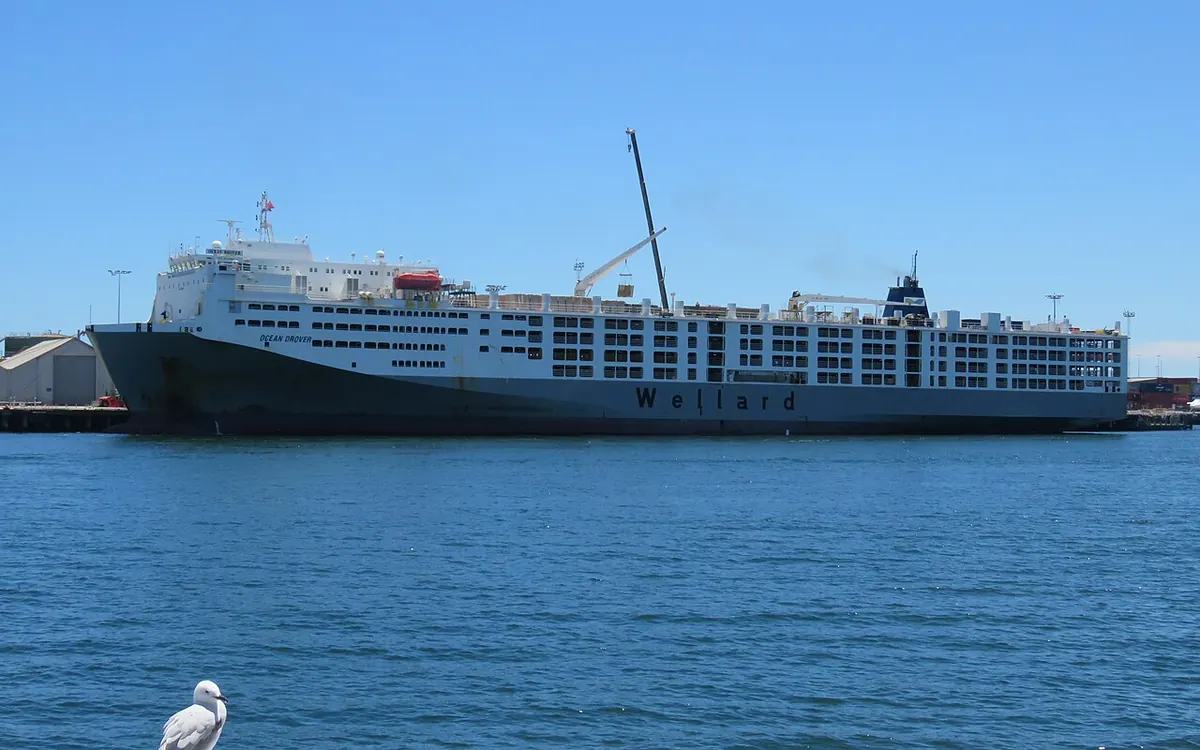
Large ship for the live export of sheep, cattle and goats, built new or converted from a container ship. Pens sit on open decks or inside closed holds; ventilation is the key design factor.
What a livestock carrier is
Livestock carriers carry live animals in pens on several decks. Most are purpose built or converted from container ships. Sheep and cattle make up most cargoes, but horses, camels, deer, goats and ostriches are also carried.
Voyages last from three days to three or four weeks, and longer if disease is suspected. On short sea routes, ferries carry animals in trucks instead. Specialised live-fish carriers serve fish farms.
Open and closed designs
Open carriers keep pens on open decks with natural and mechanical ventilation. Following winds can stall the airflow, and in the tropics a ventilation failure can kill animals within two to three hours.
Closed carriers keep stock in holds and internal decks. Mechanical ventilation must deliver a minimum number of air changes per hour, with backup systems and auxiliary power kept apart from the main engine room. This gives the animals and their feed and water shelter from bad weather.
Capacity and supplies
A common size carries 30,000 to 40,000 sheep or 3,000 to 4,000 cattle. A few sheep carriers held 130,000 sheep, and in 2008 the Stella Deneb loaded over 23,000 cattle. Space per head is regulated by animal size and weight.
Cattle need at least 40 litres of water per head per day and sheep at least 4 litres. Modern ships make up to 600 tonnes of fresh water a day by evaporators or reverse osmosis. Fodder of at least 2% of body weight per day must be carried for the longest voyage plus reserves.
Trades and crew
In the late twentieth century the main route ran from Australia and New Zealand to the Middle East. Ship size grew in those decades to gain economies of scale, but bigger ships also need bigger port facilities to load and discharge animals.
Livestock carriers carry more crew than cargo ships of a similar size. Experienced stockmen are essential, and their number depends on the number of animals, the pen layout and how far feeding and watering are automated.
Safety and regulation
In 2020 livestock carriers were assessed as twice as likely as other cargo ships to be declared an economic loss. A 2025 review found the fleet old: of 117 ships, only 24 were built after 2000.
Australia regulates the ships under AMSA Marine Order 43. Animal welfare groups criticise the trade. Four Paws has called for an EU ban, and Mercy for Animals points to extreme stress and physical suffering.
What to know when booking
Space is set by regulation per animal size and weight, so give the carrier head count, species and average weight. Confirm that fodder and water capacity cover the maximum voyage length plus reserves.
Ask whether the ship is open or closed, what backup ventilation it has, and how many stockmen will travel. Check that both ports have facilities to load and discharge the number of animals planned.
Variants
Questions shippers ask
How many animals does a livestock carrier take?
A common ship carries 30,000 to 40,000 sheep or 3,000 to 4,000 cattle. Space per head is set by regulation according to size and weight.
How long are livestock voyages?
From three days to three or four weeks, longer if disease is suspected on board.
What is the difference between open and closed carriers?
Open carriers have pens on open decks. Closed carriers keep animals in holds with mechanical ventilation and backup power.
How much water and feed must be carried?
At least 40 litres per head of cattle and 4 litres per sheep per day, plus fodder of 2% of body weight a day for the longest voyage and reserves.