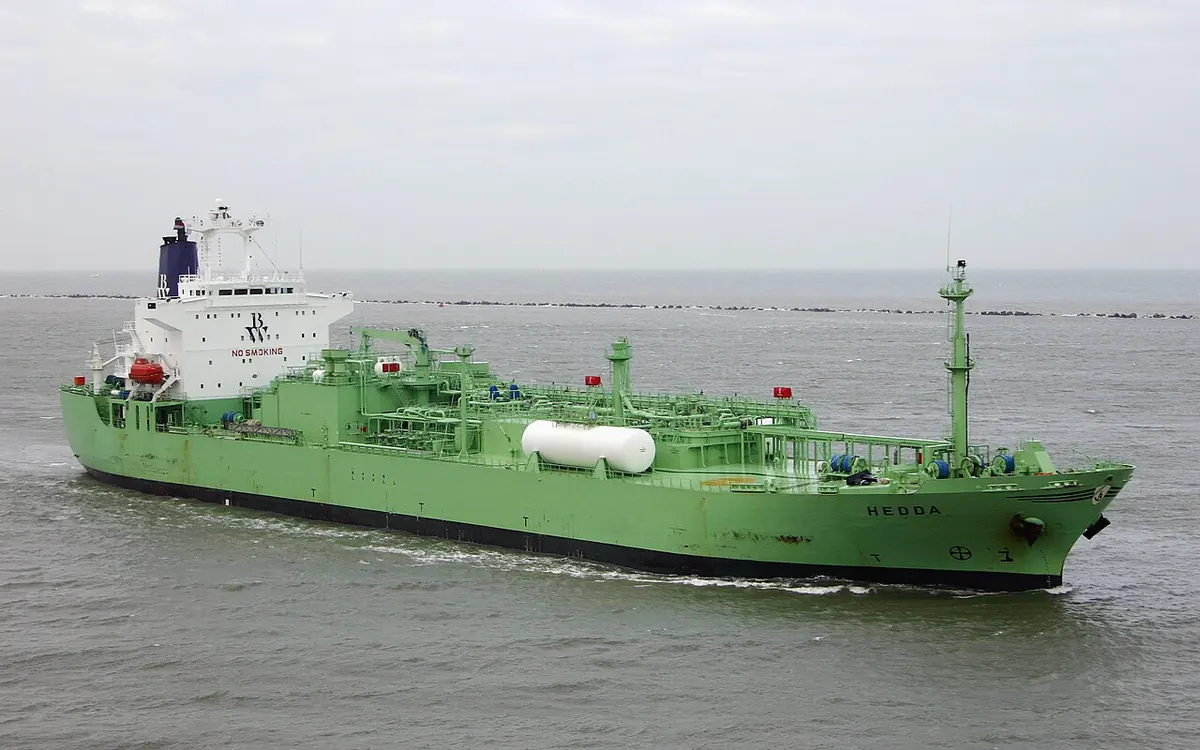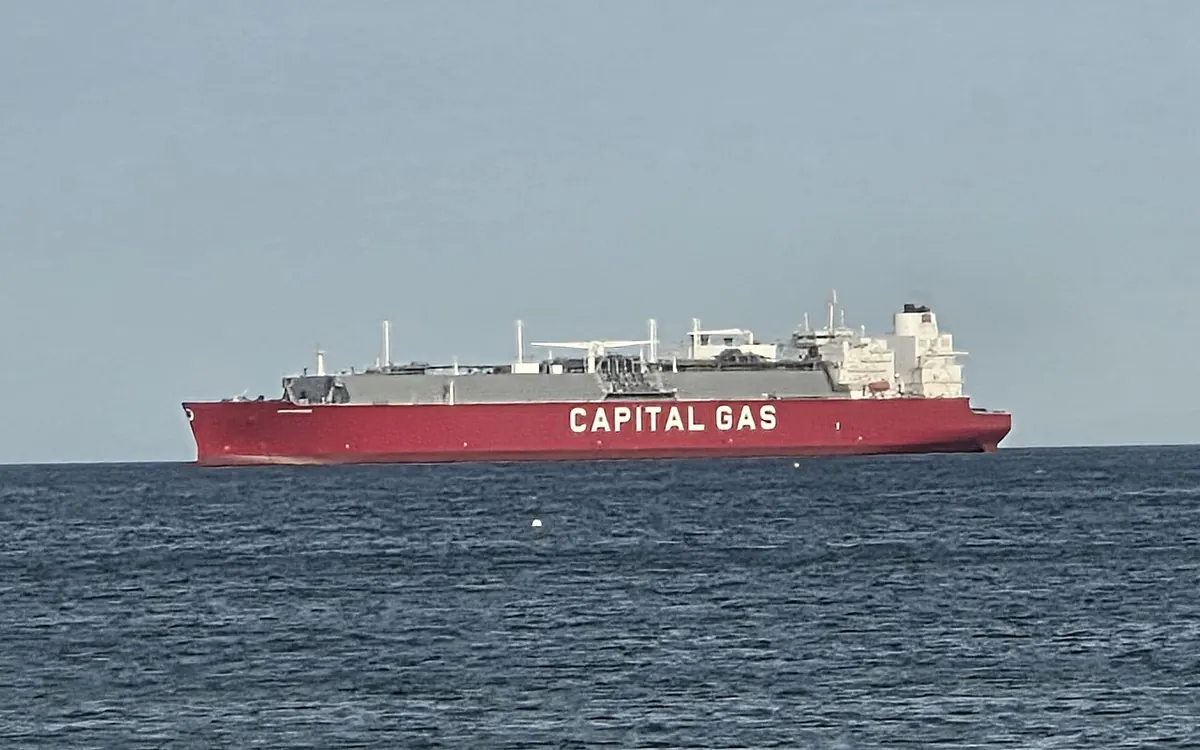
Natural gas is carried as a liquid at about -162 °C, which shrinks it about 600 times, in insulated membrane or spherical (Moss) tanks.
What an LNG carrier is
An LNG carrier is a tank ship for liquefied natural gas. The gas is carried at around -162 °C in heavily insulated membrane or spherical tanks. Cooling it to a liquid cuts its volume about 600 times, which makes long sea transport practical, for example supplying Asia and Europe from producing regions.
Most modern LNG carriers burn the gas they carry as fuel, and a gas combustion unit often handles extra vapour. The fleet has grown fast: 439 ships at the end of 2016, about 550 at the end of 2018 and 772 active in 2023, a figure that includes floating storage units.
Tanks and cargo handling
A typical LNG carrier has four to six tanks along the centre line, surrounded by ballast tanks, cofferdams and voids, which gives a double hull design. Each tank usually has three submerged pumps: two main cargo pumps and a smaller spray pump used for cooling tanks, fuel supply and stripping.
Tank systems include Moss spherical tanks and membrane designs. Mark III uses a 1.2 mm corrugated stainless steel membrane, while GT96 uses Invar, a metal that barely contracts in cold. Tanks normally work at up to 22 kPa. Before a first load, tanks are inerted to below 4% oxygen, then gassed up and cooled down in port.
Sizes and dimensions
The first purpose built ships of 1964 carried 27,000 m³. Ships later reached about 143,000 m³ and then 170,000 m³. Small scale LNG carriers are those below 40,000 m³, sized for each project.
Q-Flex and Q-Max ships hold 210,000 to 266,000 m³. A Q-Max is 345 m long, 53.8 m wide and 34.7 m high, with a draft of about 12 m., and its gross tonnage is about 163,000.
Cargo, boil-off and trades
No insulation is perfect, so some cargo boils off every day, typically 0.1% to 0.25% depending on insulation and weather. On a 20 day voyage 2% to 6% of the cargo may be lost. Ships either burn this gas, or reliquefy it, as Q-Max ships do.
The US export boom after 2016 and the 2022 invasion of Ukraine raised demand for LNG shipping, and US shipments to Europe more than doubled in 2022. The icebreaking carrier Christophe de Margerie, 172,600 m³, sailed from Norway to South Korea by the Northern Sea Route.
History and notable ships
The first oceangoing LNG carrier, Methane Pioneer, a converted standard cargo ship, sailed from Louisiana to the UK in January 1959 with 5,500 m³. Methane Princess and Methane Progress followed in 1964 for the Algerian trade.
Qatargas launched the Q-Flex and Q-Max classes from 2005. Fourteen Q-Max ships were delivered from 2008 to 2010 by South Korean yards. The first, Mozah, delivered 266,000 m³ to Bilbao in January 2009. About two thirds of the world fleet has been built in South Korea, and building one ship can take 30 months.
What a shipper should know when booking
LNG cargoes are quoted in cubic metres. Check that the terminal can take the ship's size: Q-Max ships were designed around the largest size able to dock at Qatar's LNG terminals. Agree how boil-off is handled, because it changes the volume delivered.
Ask about the fuel mode. A ship can keep tank pressure high to cut boil-off and burn more oil, or burn more gas and deliver colder cargo, which many ports prefer. Charters can run for years, with 5 year contracts in the market.
Variants
Size classes
All size classes and canal limits
Questions shippers ask
Why is natural gas shipped as a liquid?
At about -162 °C the gas becomes a liquid about 600 times smaller in volume, so one ship can carry far more energy.
What is the difference between Moss and membrane ships?
Moss ships carry LNG in independent spherical tanks. Membrane ships use thin metal membranes backed by insulation and the hull structure.
How much cargo is lost to boil-off?
Typically 0.1% to 0.25% a day, so a 20 day voyage may lose 2% to 6% unless the ship reliquefies the gas.
How big is a Q-Max?
345 m long and 53.8 m wide with about 12 m draft, carrying 266,000 m³ of LNG.