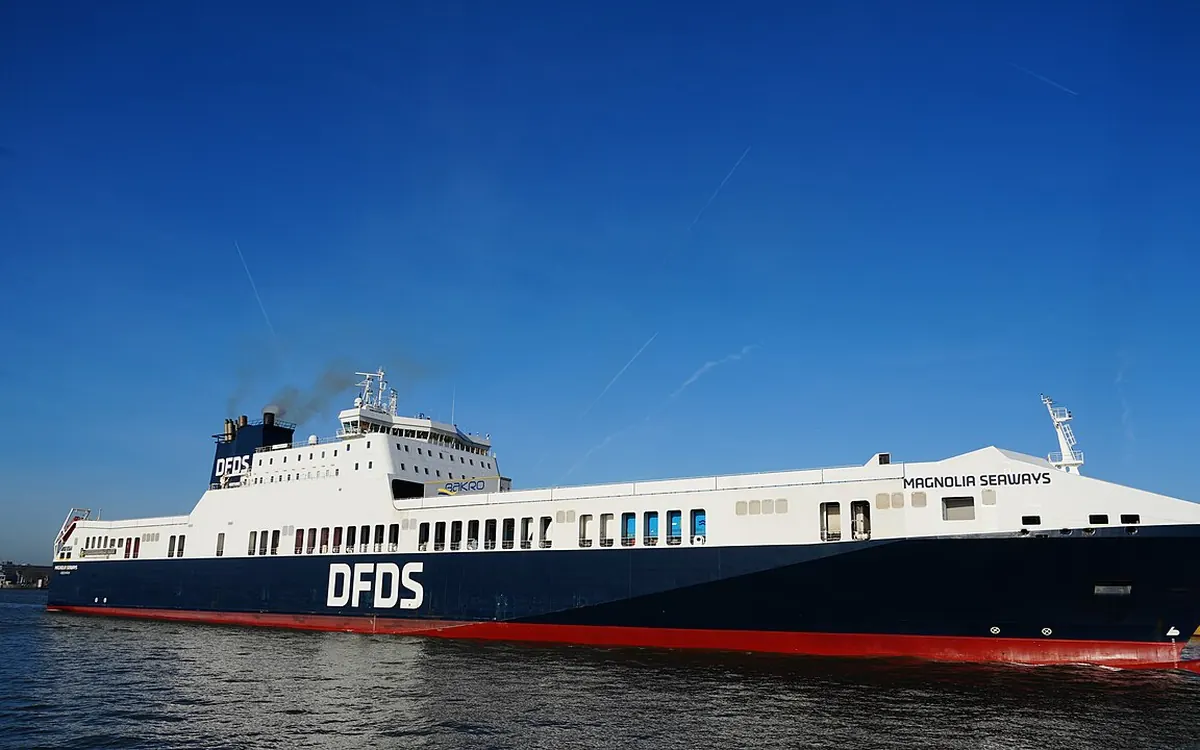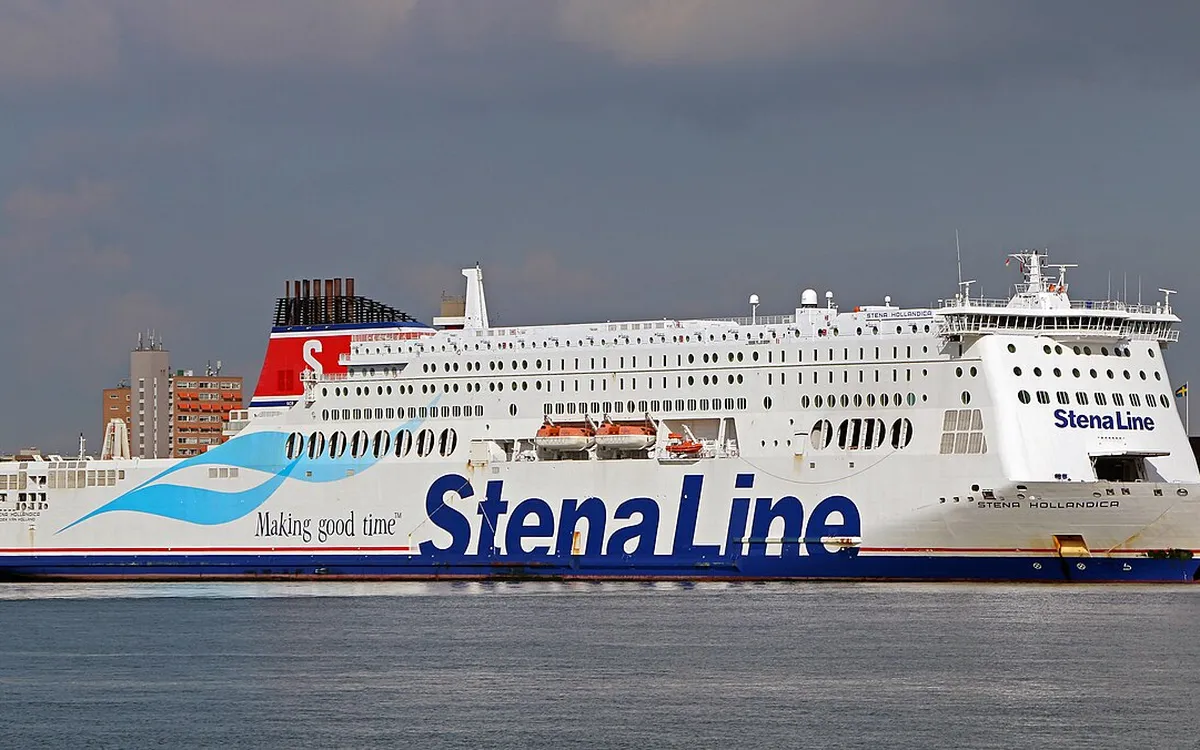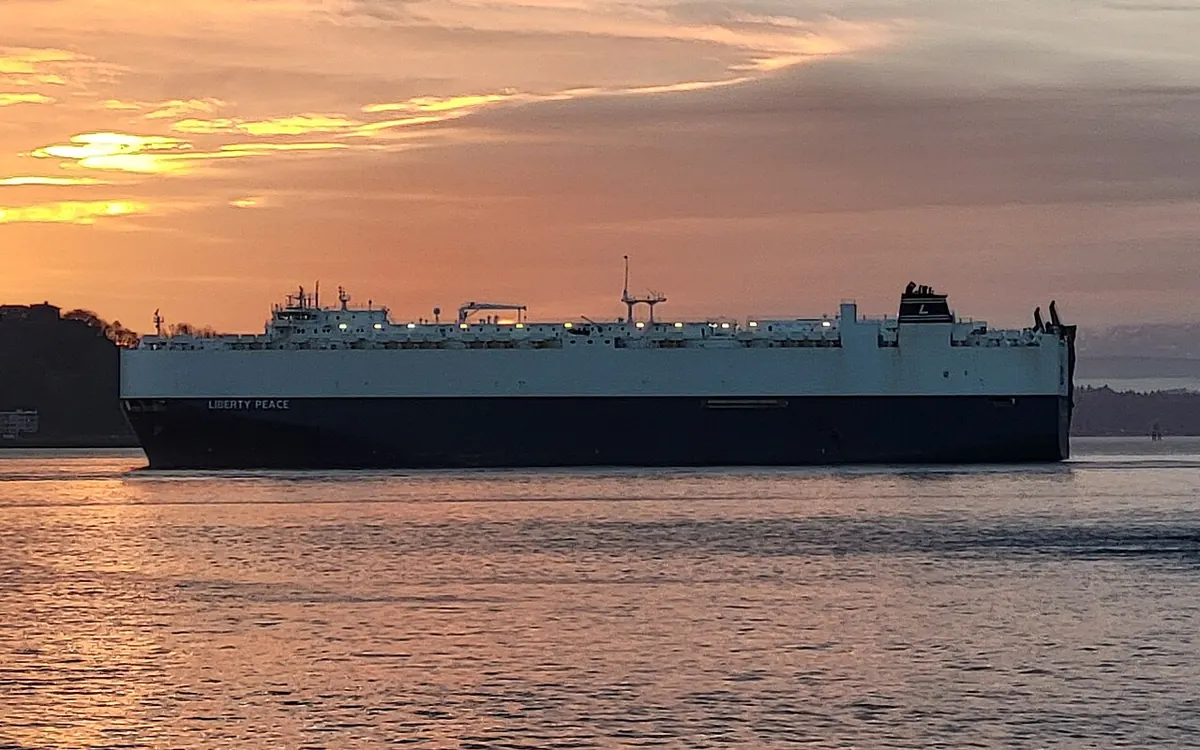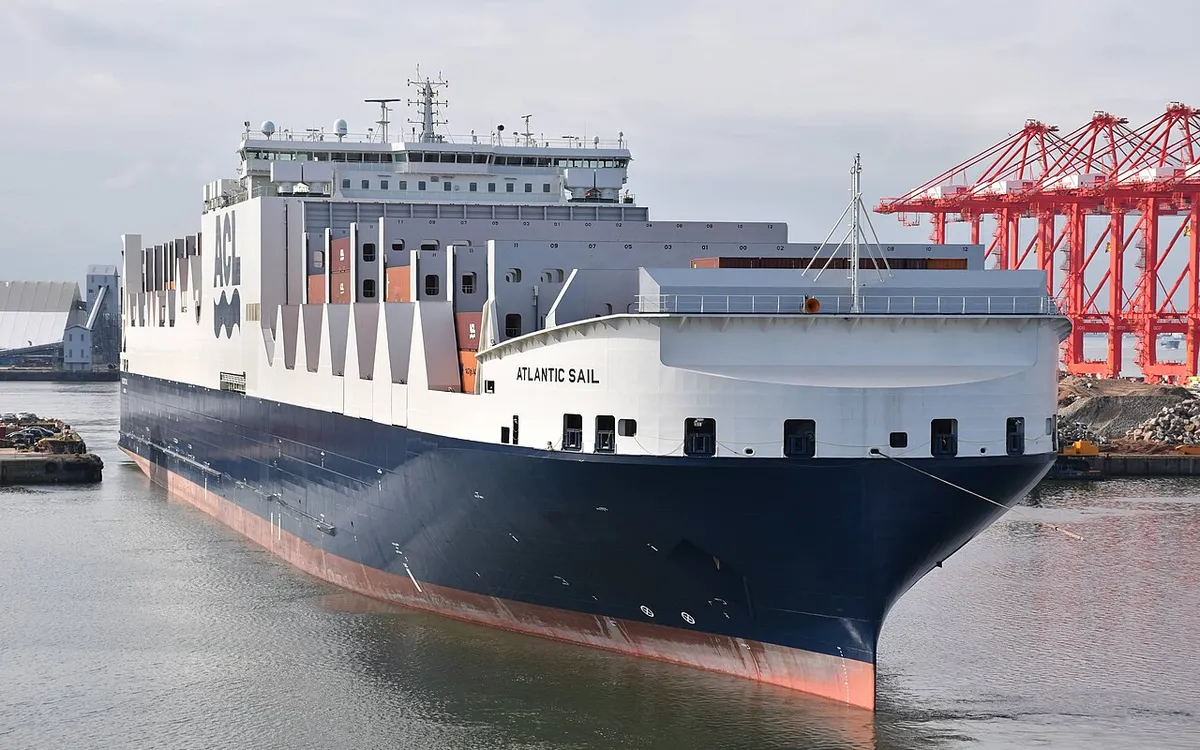
A hybrid of a Ro-Ro and a container ship: vehicle decks inside the hull, containers stacked on top or in cells. Carries containers, heavy equipment, oversized cargo and cars on one sailing. Atlantic Container Line's G4 class (296 m) has 5,270 lane metres on seven Ro-Ro decks and 3,807 TEU.
What a ConRo ship is
A ConRo, also called RoCon, is a hybrid of a Ro-Ro ship and a container ship. In the usual layout the area below deck stores vehicles, containers are stacked on the top decks, and the superstructure sits aft.
This mix lets one ship carry containers, heavy equipment, oversized cargo and cars together. For a shipper it means that a machine too big for a container can travel on the same vessel and schedule as the containers carrying its spare parts.
How cargo is handled
Containers are lifted on and off by shore cranes, as on a normal container ship. Rolling cargo drives up a ramp into the Ro-Ro decks. Units that cannot drive, including break-bulk, travel on Mafi roll trailers that are towed aboard.
Separate internal ramp systems keep cars apart from other vehicles, roll trailers and break-bulk cargo. This lowers the risk of damage to new cars and lets the crew work different decks at the same time during a port call.
Size and capacity: the G4 class
The largest ConRo design in the world is the G4 class of Atlantic Container Line. Each ship is 296 m long, 37.6 m wide and draws 11.6 m, with 100,430 GT and 49,600 DWT. Seven Ro-Ro decks give 5,270 lane metres and 28,900 m² of space, and the ship also takes 3,807 TEU.
Power comes from a Wärtsilä RT-flex68D eight-cylinder engine of 22,000 kW, giving a service speed of up to 19.25 knots. Two bow thrusters and one stern thruster help in port. The G4 has no bulbous bow; a vertical stem was chosen because it is more efficient across a wide range of loads and sea states.
An unusual layout
The G4 class breaks the normal ConRo pattern. Containers fill the forward part of the hull through its whole depth, the Ro-Ro garage sits mainly amidships in and below the superstructure, and at the stern containers are stacked above deck with Ro-Ro space and machinery below.
According to the design, this arrangement gives more cargo capacity and needs less ballast. It is slightly larger than the G3 class built in the 1980s, but carries much more cargo.
History of the G4 ships
International Maritime Advisors finished the basic G4 plans in 2008, and Knud E. Hansen adapted them to the owner's specification. Hudong-Zhonghua Shipbuilding won the contract for five ships in July 2012 and cut steel for the first in September 2013.
The ships are named Atlantic Star, Atlantic Sail, Atlantic Sea, Atlantic Sky and Atlantic Sun. Atlantic Star was delivered in October 2015 and the other four in 2016. After entry into service, faulty license-built components had to be replaced in drydock.
What a shipper should know
Containers on a ConRo are booked like any container freight, per box. Rolling and oversized cargo is booked on the Ro-Ro decks, usually measured by length, width, height and weight or by lane metres. Give full dimensions and say whether the unit drives, is towed, or needs a roll trailer.
ConRo services are few and run on fixed routes, so check the sailing schedule early. Ask about deck height and deck load where the unit is tall or heavy, and whether the terminal at destination can receive Ro-Ro cargo as well as containers.
Variants
Size classes
All size classes and canal limits
Questions shippers ask
What is the difference between ConRo and Ro-Ro?
A Ro-Ro carries only rolling cargo. A ConRo adds container capacity, either stacked on deck or in cells, so both types of cargo travel on one ship.
How many containers does a ConRo carry?
It depends on the ship. The G4 class, the largest ConRo design, takes 3,807 TEU plus 5,270 lane metres of Ro-Ro cargo.
Can I ship a machine that does not fit in a container?
Yes. Oversized units drive or are towed into the Ro-Ro decks, often on a Mafi roll trailer.
How is cargo kept apart on board?
Separate internal ramps segregate cars from other vehicles, roll trailers and break-bulk cargo.