





















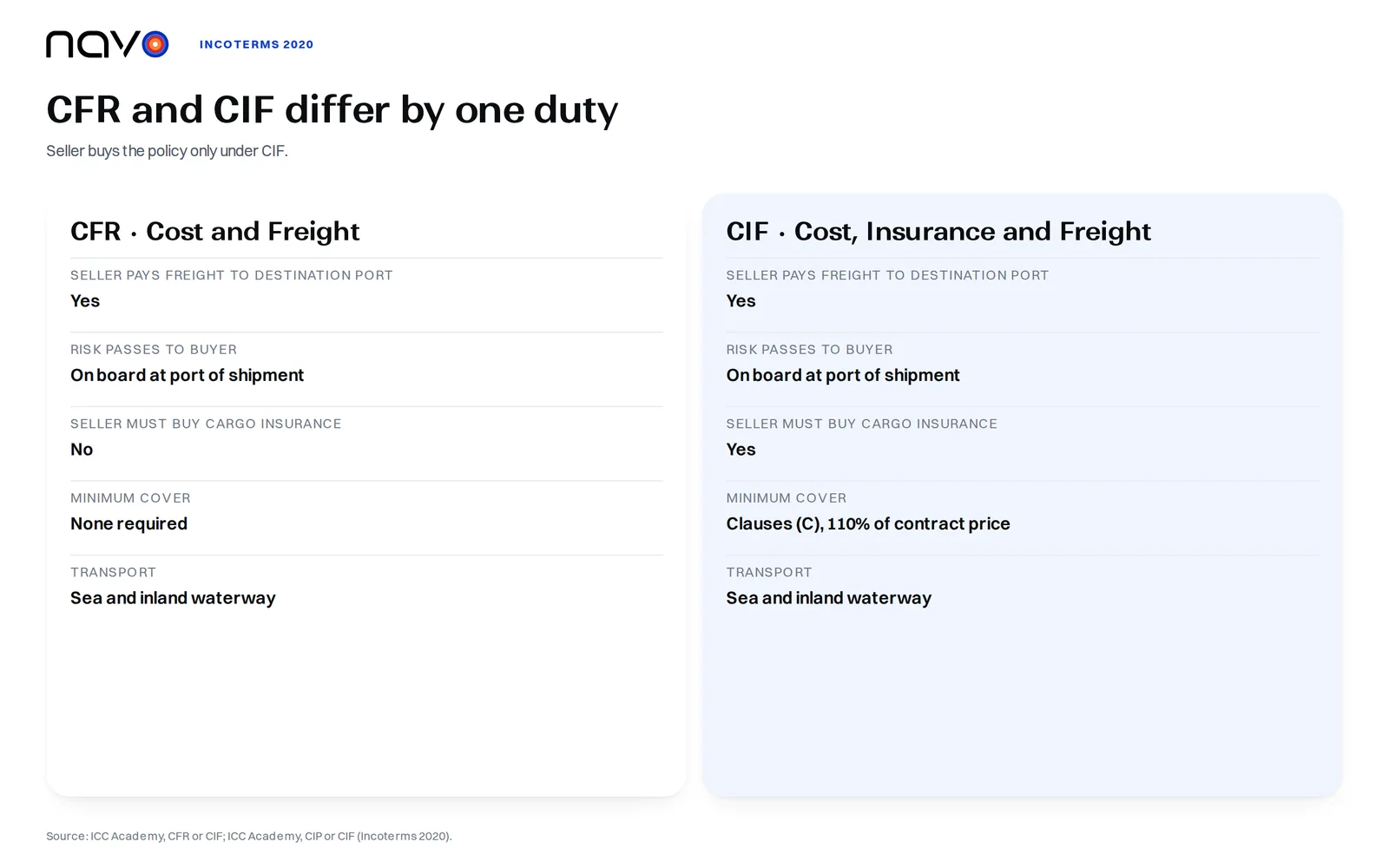
A CFR quote names the seller as the party who pays freight to the destination port. ICC Academy’s comparison of CFR and CIF has the seller bearing cost and freight to the port of destination, for sea and inland waterway transport only. Risk is a separate question, and under both terms it passes to the buyer once the goods are on board at the port of shipment. The CIF vs CFR choice comes down to a single duty, the cargo policy. If the seller should arrange it, quote CIF. If you hold your own cover, CFR avoids paying for a second policy.
26 March 2024: a ship loses power
The Dali lost power and hit the Francis Scott Key Bridge at Baltimore. Six men died, and the ship stayed jammed in the wreckage, the Baltimore Sun reports.
Once a CFR or CIF seller has loaded the goods, the transit risk is the buyer’s. Someone ought to hold a policy. Of these two terms, only CIF obliges the seller to buy one. Under CFR the seller owes no insurance and, at the buyer’s request, risk and cost, only the information the buyer needs to buy it, as a side-by-side of the two terms sets out. Under CIF the seller must, unless otherwise agreed, buy it, on at least Institute Cargo Clauses (C), for at least 110% of the contract price in the contract currency, from delivery to at least the named port of destination.
April 2024: what general average asks of cargo owners
In April 2024 the owners of the Dali declared general average, according to a Maritime Law Association of Australia and New Zealand newsletter. Cargo owners can be asked to share the cost of huge salvage efforts with the ship owner, as the Sun explained. On 21 June 2024 the adjuster set the Dali rate at 55%, and according to the newsletter owners had to contribute 55% of their cargo’s value to retrieve it.
The sharing is slow. In April 2024 Quadrant Chambers barrister James Turner KC told Lloyd’s List, in a copy on Kuehne+Nagel’s site that an average adjuster would need several years in most cases to work out each owner’s share, and that cargo owners would be asked for a bond before their cargo is released. Lloyd’s List thought it likely that a guarantee would come from cargo insurers, of which there will be far fewer than cargo owners, for the 9,900 teu ship.
The sources do not say which Incoterm stood behind any container on the Dali. Avalon Risk Management said in an advisory of 4 April 2024, before the declaration, that if general average is declared, claims should go to the insurer of the cargo, and that without cargo insurance shippers will need to post cash security to retrieve their cargo. Under CFR no one is obliged to insure, and the buyer, who carries the risk from loading, usually arranges the cargo insurance.
The policy’s level matters too. Clauses (C) is the minimum cover in the words of ICC Academy. Incoterms 2020 raised CIP to Clauses (A) and left CIF at (C).
What the freight quotes leave out
On 16 November 2026 a 40HC pull from Shanghai on Navo’s rates API returned 32 quotes to Los Angeles between USD 6,215 and 15,114 (25 live and 7 indicative, as the API labels them), and 29 to Rotterdam between USD 2,560 and 6,000 (22 live and 7 indicative). Most are port-to-port ocean freight, with local charges not included. They are an input to a CFR price, not the price itself. Scopes differ: some quotes add destination charges or door delivery. In each pull a quote note says insurance is excluded. A CIF price for the same lane adds a policy insuring at least 110% of the contract price.
Containers add a caveat. ICC’s sample flowchart, which it calls only a starting point, sends containerized or multimodal shipments to CPT or CIP, and keeps CFR and CIF for traditional commodities lifted on board a ship. For boxed cargo, ask whether CIP fits the deal better.
For a CIF vs CFR decision, start from ocean freight rates on Asia-origin lanes, then read what standard cargo clauses say about delays before you decide what the policy has to answer for.
Write the rule with the named port and the version, for example “CIF Rotterdam, Incoterms 2020”. Ask for the certificate before the vessel leaves, then track the container to the discharge port.
Frequently asked questions
What proof of insurance does a CIF seller owe the buyer?
The CIF seller gives the buyer the policy or a certificate. The buyer needs that document to claim, so as a practical step check that it names the right currency, the 110% sum and the voyage before the vessel leaves.
Can a CIF buyer ask the seller for wider cover than Clauses (C)?
Yes, where the cover is available. A comparison of the two terms says that at the buyer's request and cost the seller adds wider cover such as Clauses (A) or (B), or war or strikes cover. A separate explainer advises that parties who want a higher level than Clauses (C) write it into the sales contract, so agree it there before shipment.
What is the practical gap between Clauses (C) and Clauses (A)?
A 2024 academic review of insurance in Incoterms 2020 explains that Clauses (A) cover loss or damage from all risks unless an exclusion applies, while (B) and (C) cover only damage caused by listed perils, with (C) having the shorter list. Under (A) the insured only has to show that the loss came from an insured risk. Under (B) or (C) the insured has to prove which named peril caused it.