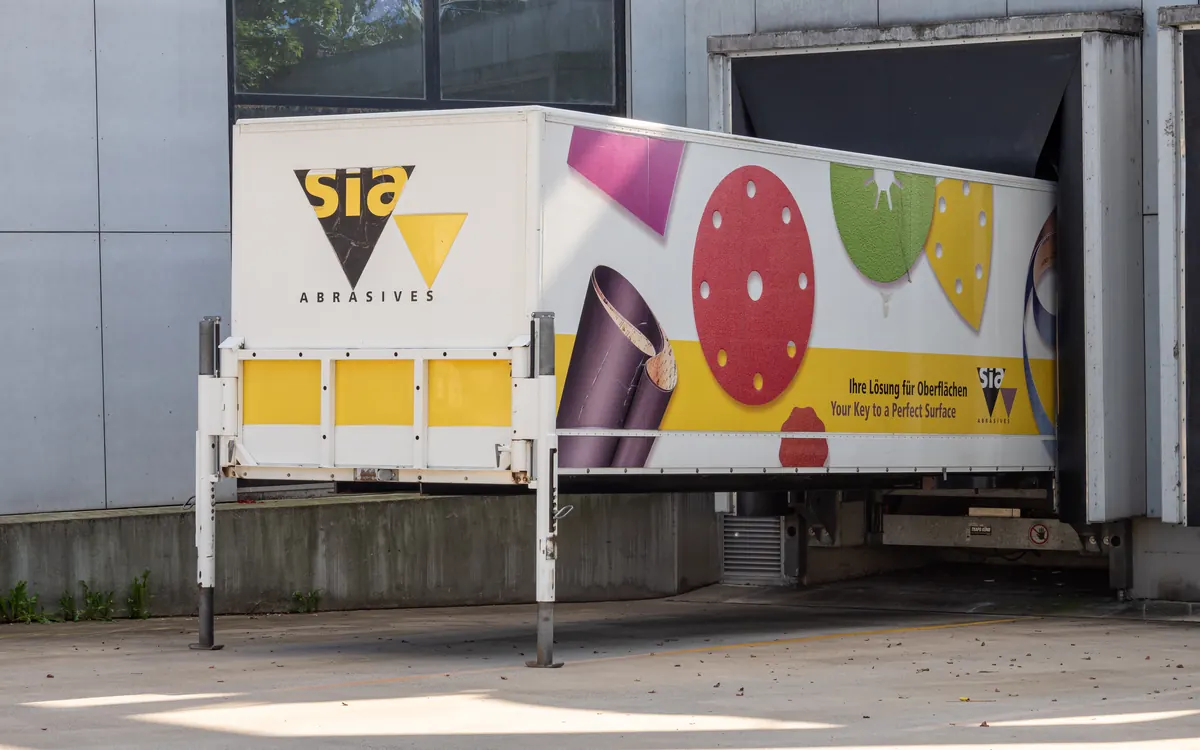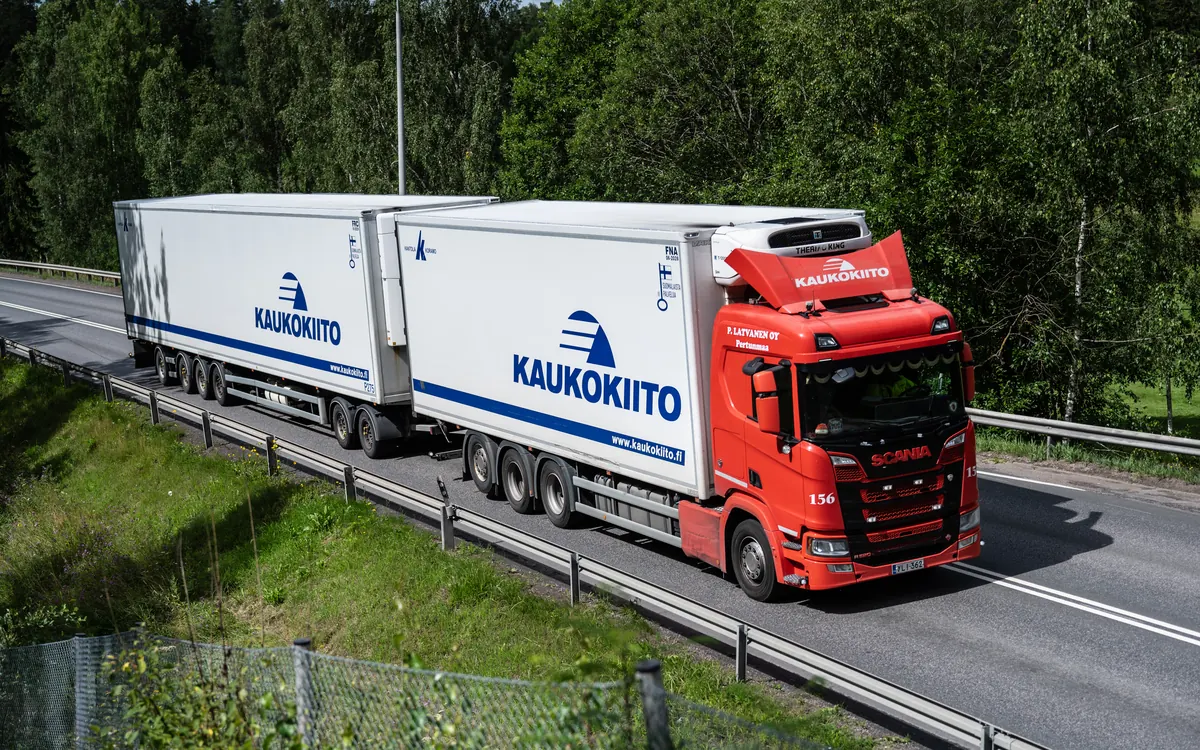
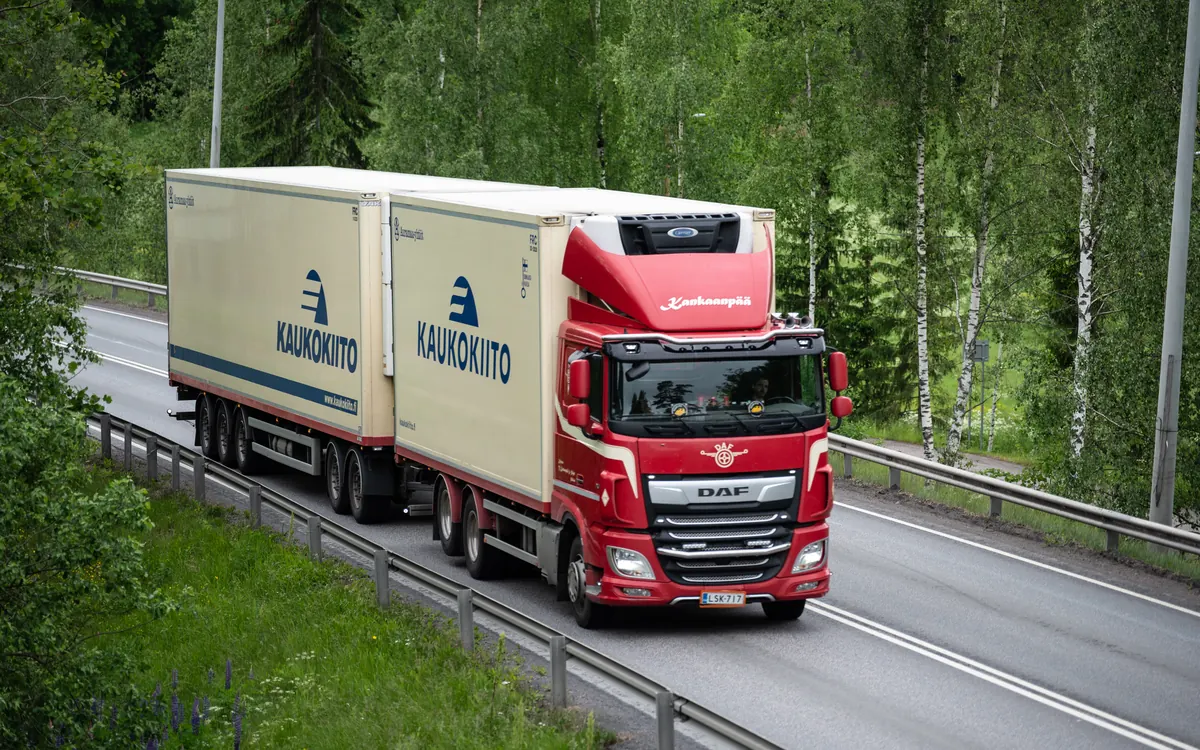
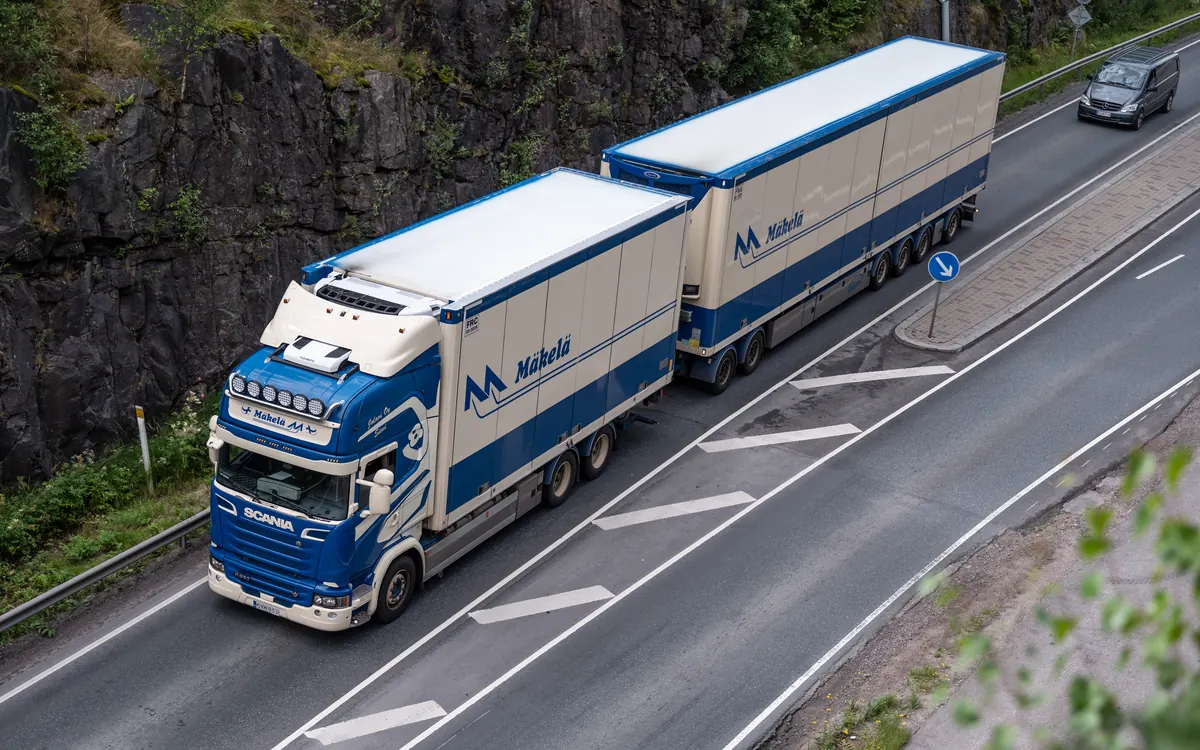
Longer combination built from standard modules: a truck carrying a 7.82 m swap body that tows a 13.6 m semi-trailer on a dolly, or a tractor and semi-trailer with an extra trailer. Up to 25.25 m and, where allowed, 60 t. Germany admits it at 44 t (Lang-Lkw).
What it is
The EuroCombi, also called the European Modular System (EMS), Ecocombi, Megaliner, or in Germany Lang-Lkw, links existing modules into one longer vehicle. Under Directive 96/53/EC member states may allow such combinations. Finland and Sweden have used them since 1970, at up to 60 t.
Because the modules are standard, the semi-trailers, swap bodies and trailers are the same units used in normal 16.50 m articulated and 18.75 m road train operation.
Common combinations
The most common layout in Europe is a rigid truck with a fixed body or swap body that tows a semi-trailer on an air-suspended dolly. It drives and manoeuvres much like an 18.75 m road train and has the best driving stability of the variants.
The second most common is a standard 16.5 m tractor and semi-trailer with a rigid drawbar tandem trailer coupled to the rear of the semi-trailer, which needs only small changes to existing equipment. A third layout, the B-Double, is a tractor with two semi-trailers.
Weights and where it may run
Outside Sweden and Finland the EuroCombi may only run on specific roads in other EU countries. Denmark allows 25.25 m combinations on selected routes, and the Netherlands ran a large trial. Germany has allowed limited approvals on defined routes since 2017, with a positive list of roads; the extended semi-trailer (Lang-Lkw Typ 1) may use all roads in Baden-Württemberg and Bremen since 2019.
In Germany the maximum gross weight is 44 t, the same as a normal articulated truck, so the gain is volume rather than payload. Cross-border Lang-Lkw traffic with the Netherlands was agreed in 2021, and with Denmark from 4 December 2023.
Rules for drivers and vehicles
Operating conditions in trials have included at least five years of truck driving experience, no accidents, no overtaking and no leaving the approved routes. In the Dutch trial the vehicles needed length marking at the rear, closed side guards, reflective contour strips and blind spot mirrors or cameras. New German Lang-Lkw registered from 1 July 2020 need a turning assistant.
When to book it
A EuroCombi suits regular, high-volume flows of light or bulky goods between points on approved routes, for example between hubs. It does not fit one-off loads to addresses off the network. Check with the carrier that both the loading and unloading points can be reached on permitted roads. Road rates for this equipment can be compared at rates.navo24.com.
Variants
Questions shippers ask
How much more can a EuroCombi carry?
In Germany the gross weight stays at 44 t, so the gain is loading volume. In Sweden and Finland combinations of up to 60 t run.
Can a EuroCombi deliver to any address?
No. It may only use approved routes in most countries, so both ends of the trip must be reachable on them.
Can it carry standard semi-trailers and swap bodies?
Yes. It is built from standard modules such as 13.6 m semi-trailers and 7.82 m swap bodies.