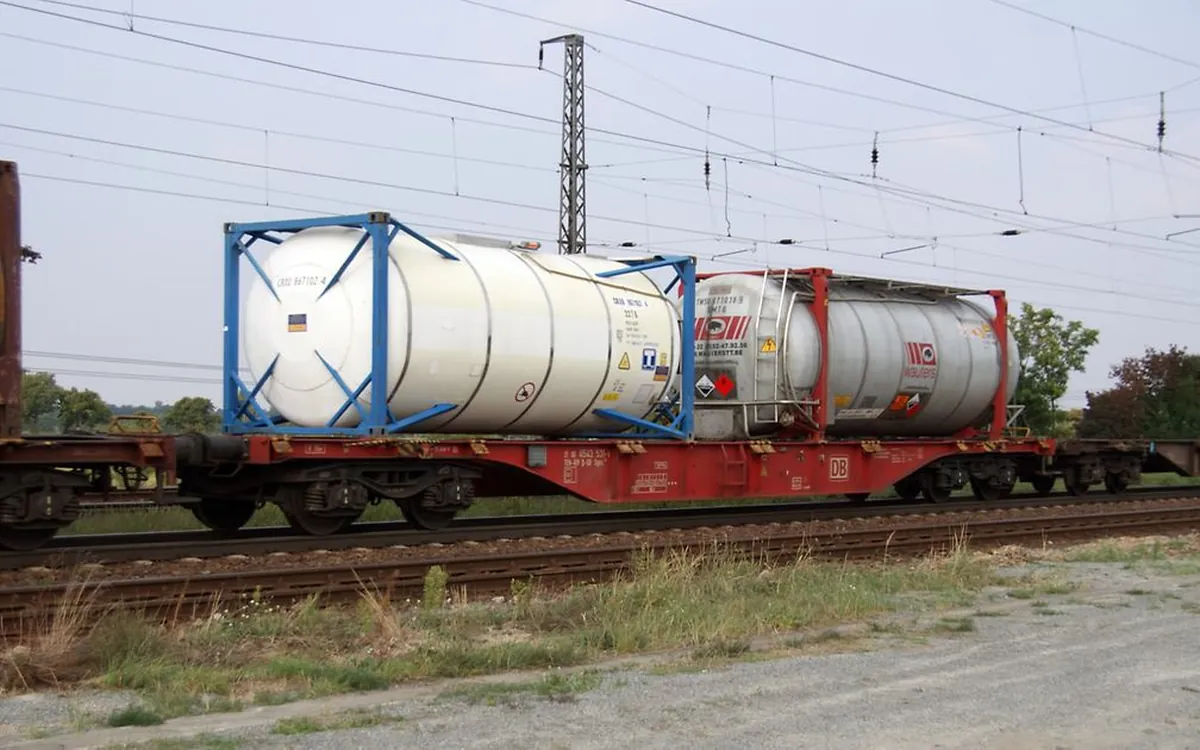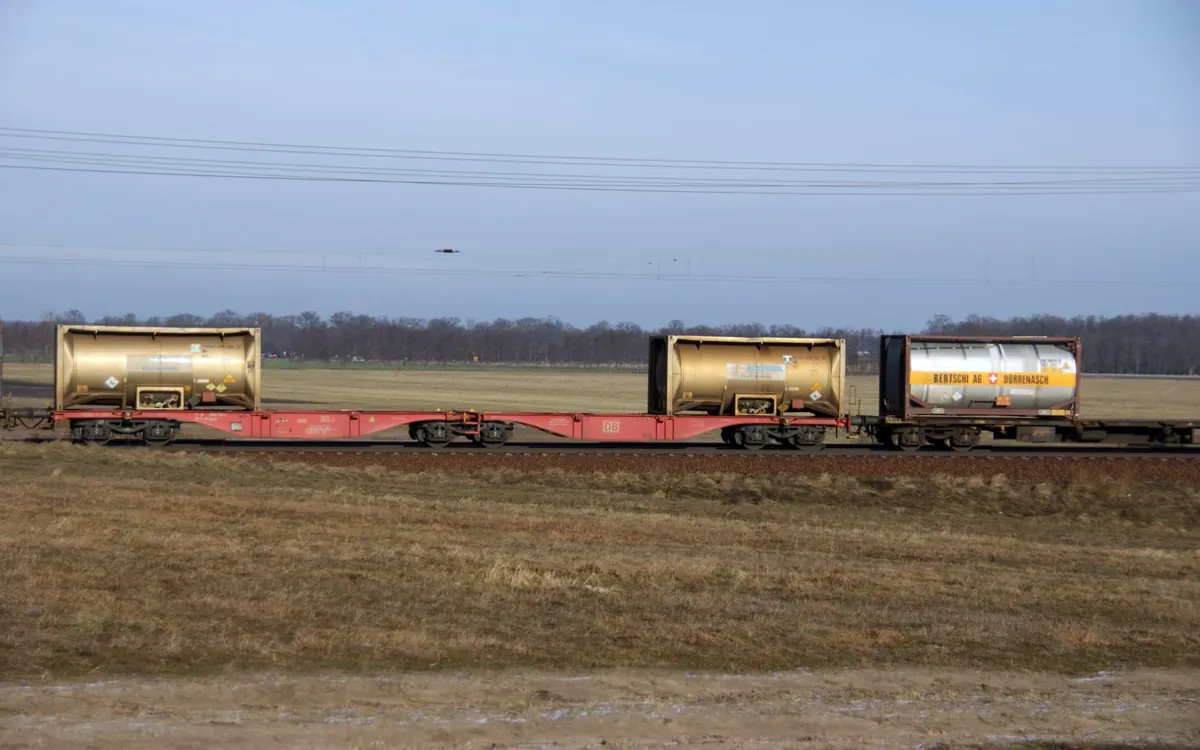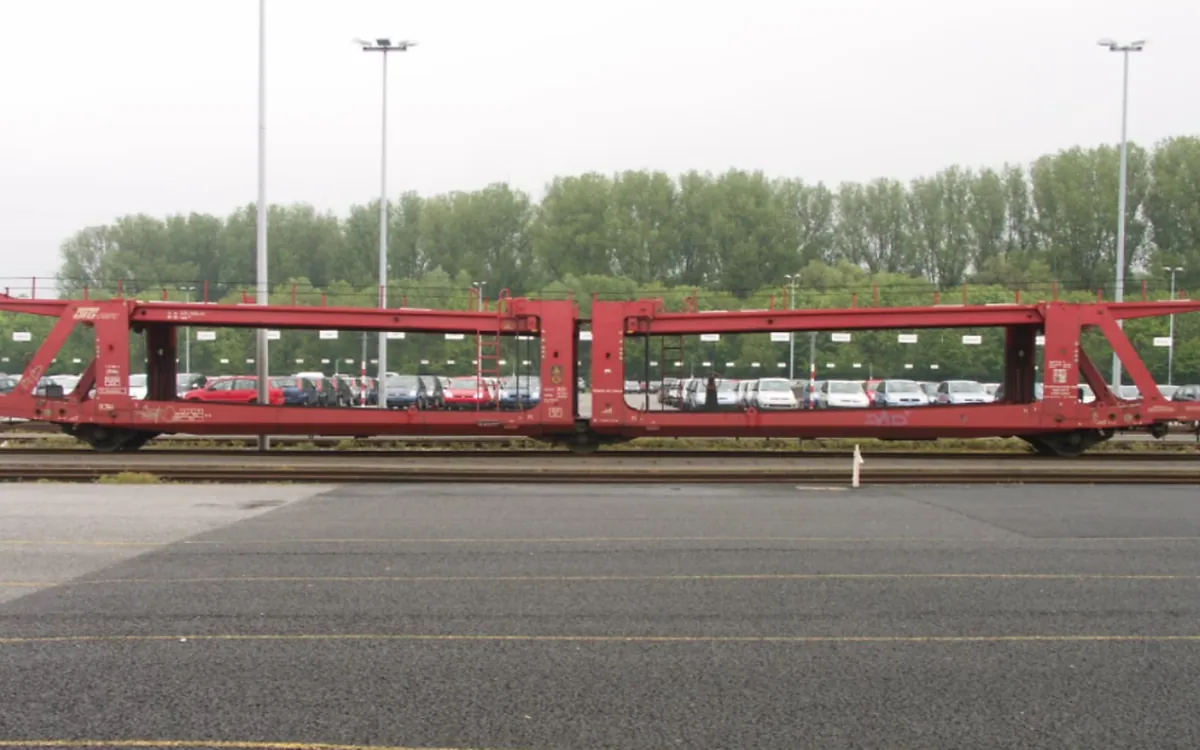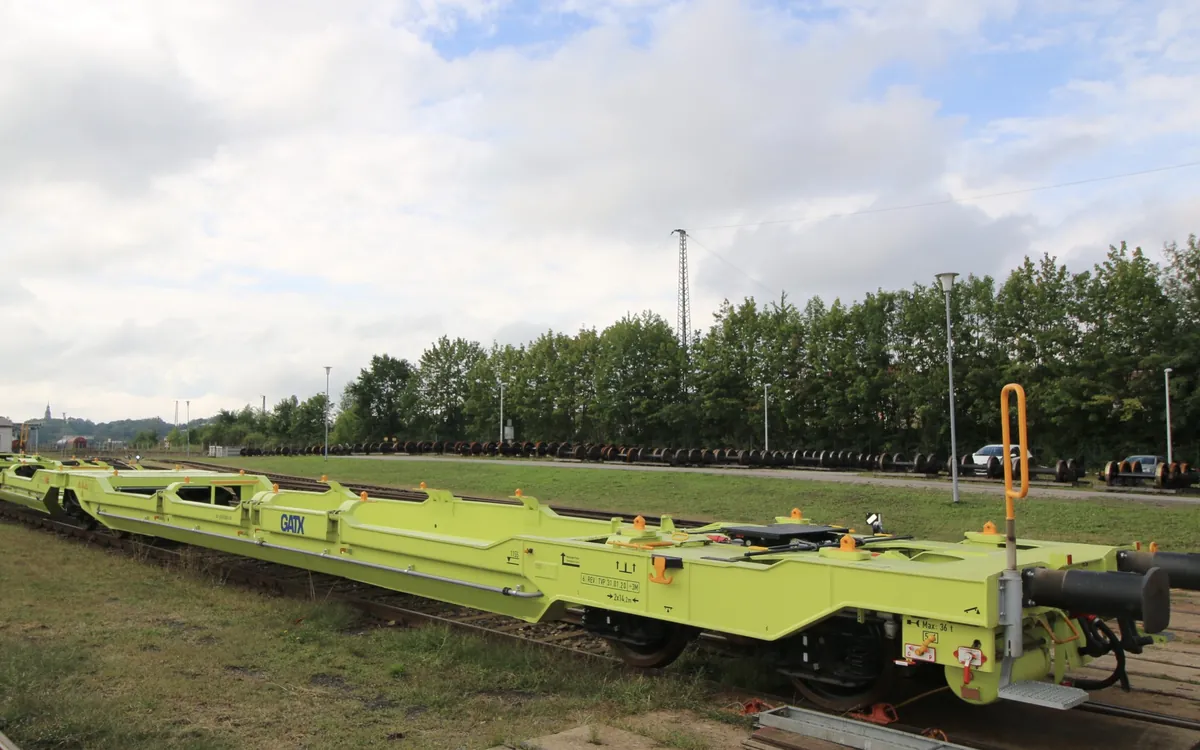
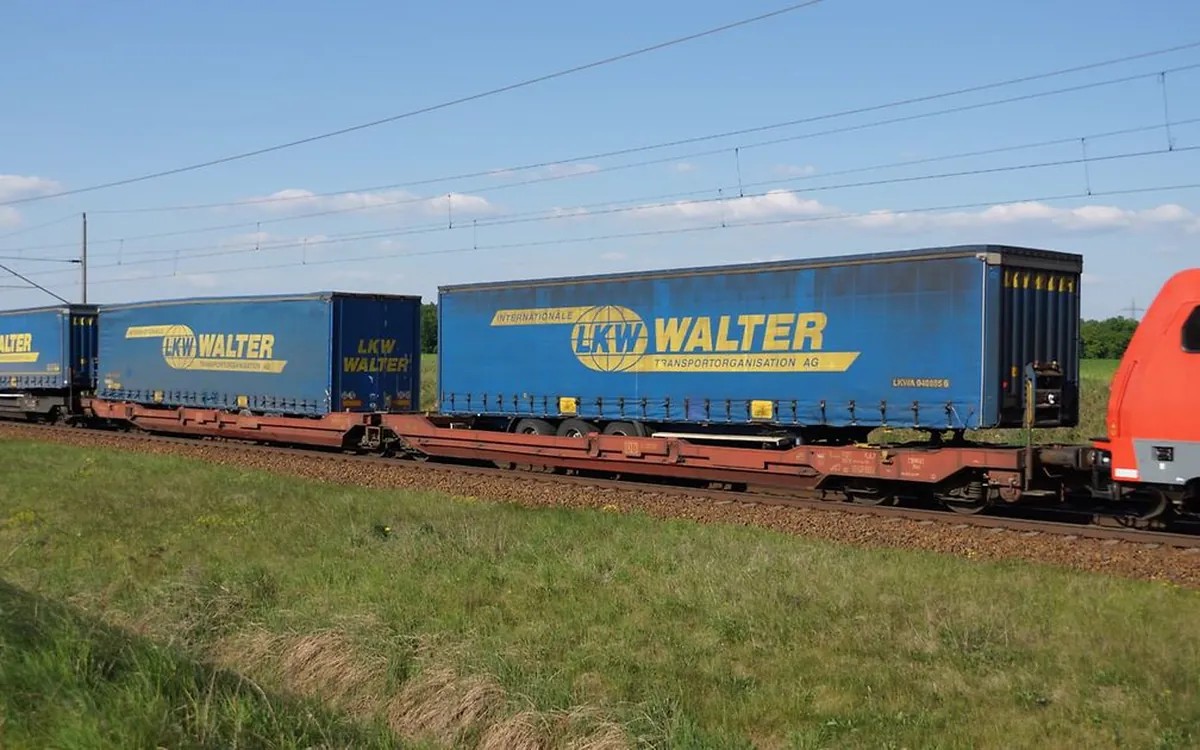
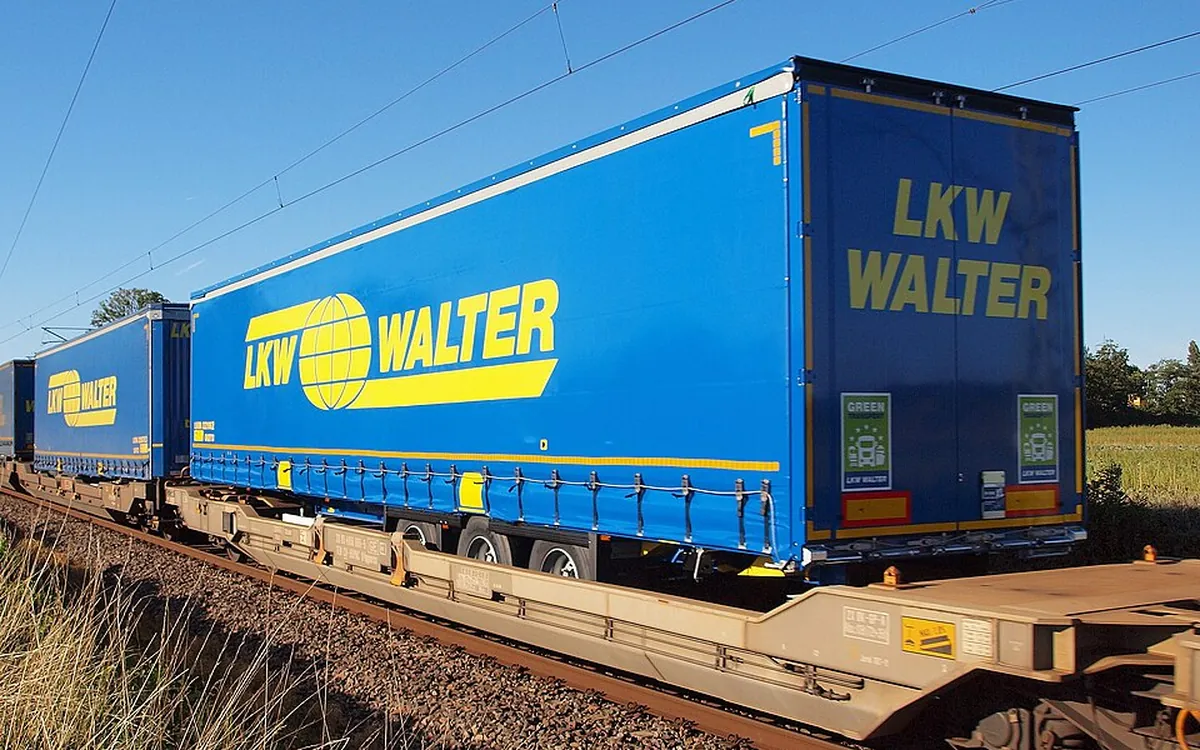
Wagon with a low "pocket" between the bogies that takes the wheels of a craneable semi-trailer, lifted on by gantry crane. Also carries swap bodies and containers. The T3 (Sdgmns) replaced the T1, which became too short and too light for modern trailers. T3000 is the articulated double version.
What a pocket wagon is
Pocket wagons are flat wagons with bogies of the special class S. Between the narrow outer side beams and the bogies sits a lowered pocket for the semi-trailer's wheels and running gear. The pocket floor is today only 270 mm above the rail, so a trailer fits inside the loading gauge.
Together with container wagons and the low-floor wagons of the rolling highway, pocket wagons form the fleet of European combined transport. The first wagons were built in Germany in 1972 and 1973.
How trailers are loaded
The trailer does not drive on. A gantry crane or mobile loader grips it at its gripping edges and lowers it into the wagon. Its kingpin locks into a support frame (the stand), which takes the front of the trailer. Only codified semi-trailers approved for rail can be loaded; the requirements are set in EN 13044-3, and the approval is marked on both sides of the trailer.
Before loading, the rear underrun protection must be raised and air suspension vented. Current stands support three standard fifth-wheel heights: 88 cm, 98 cm and 113 cm. Hinged spigots on the side beams let the same wagon carry containers and swap bodies, so it need not run empty.
Dimensions and capacity
The T1 of 1973 measured 16.44 m over buffers with a load limit of 33 t. Both proved too small for larger trailers. The T3, built from 1984, is 18.34 m long, almost 2 m more, with a load limit of 59 t at launch and 69 t on series from the 1990s. Its tare rose to 21 t. The T3 can carry very heavy trailers but not mega trailers.
Hupac's T4.2 takes trailers up to 2.77 m inside height and 2.60 m wide, at 20.2 t tare and a 69.8 t load limit. The T5 and the articulated T3000 also take mega trailers with 3 m inside height.
Where pocket wagons run
Pocket wagons serve trailer and container traffic across Europe. The T3000e is the industry standard; by December 2021 Tatravagónka Poprad had built about 1,660 units, and large fleets run with DB Cargo, Hupac, TX Logistik, Rail Cargo Austria and Kombiverkehr.
In the rail accident on the Great Belt Bridge in Denmark, storm gusts hit a train of pocket wagons and a lightly loaded semi-trailer came out of position into the path of an oncoming passenger train. The Danish investigators found that a stand had not been properly locked. Wagon lessors such as VTG and GATX then introduced sensor systems with a display that shows whether a trailer is locked in its stand.
Class letters and variants
S is a special flat wagon with bogies. d means fitted for road vehicles on one level, g or gg for containers up to or over 60 ft, m and mm shorter loading lengths, n a higher load limit, r an articulated wagon and s or ss 100 or 120 km/h. Yellow triangles with a black P (trailers) or C (containers) mark the wagon's suitability.
T1 (Sdkms 707) was the first standard type. T3 (Sdgmns 743) replaced it. T4.0 to T4.2 and T5 are Hupac designs. T2000 and T3000e (Sdggmrss 736 and 738) are articulated double pocket wagons.
Booking trailer traffic
Make sure your trailers are craneable and codified for rail, and check their inside height: mega trailers need T5 or T3000 wagons. Tell the operator the trailer length, weight and stand height. For return loads, a pocket wagon can take containers or swap bodies instead.
Variants
Questions shippers ask
Can any semi-trailer go on a pocket wagon?
No. Only codified, craneable trailers approved for rail can be loaded, because they are lifted on by crane.
Can a T3 carry mega trailers?
No. The T3 carries very heavy trailers but not mega trailers; those need a T5 or T3000 type.
Can pocket wagons carry containers?
Yes. Hinged spigots let them carry containers and swap bodies, which avoids empty runs.
What does the P on a pocket wagon mean?
A yellow triangle with a black P marks a wagon suitable for semi-trailers; a C marks suitability for containers.