

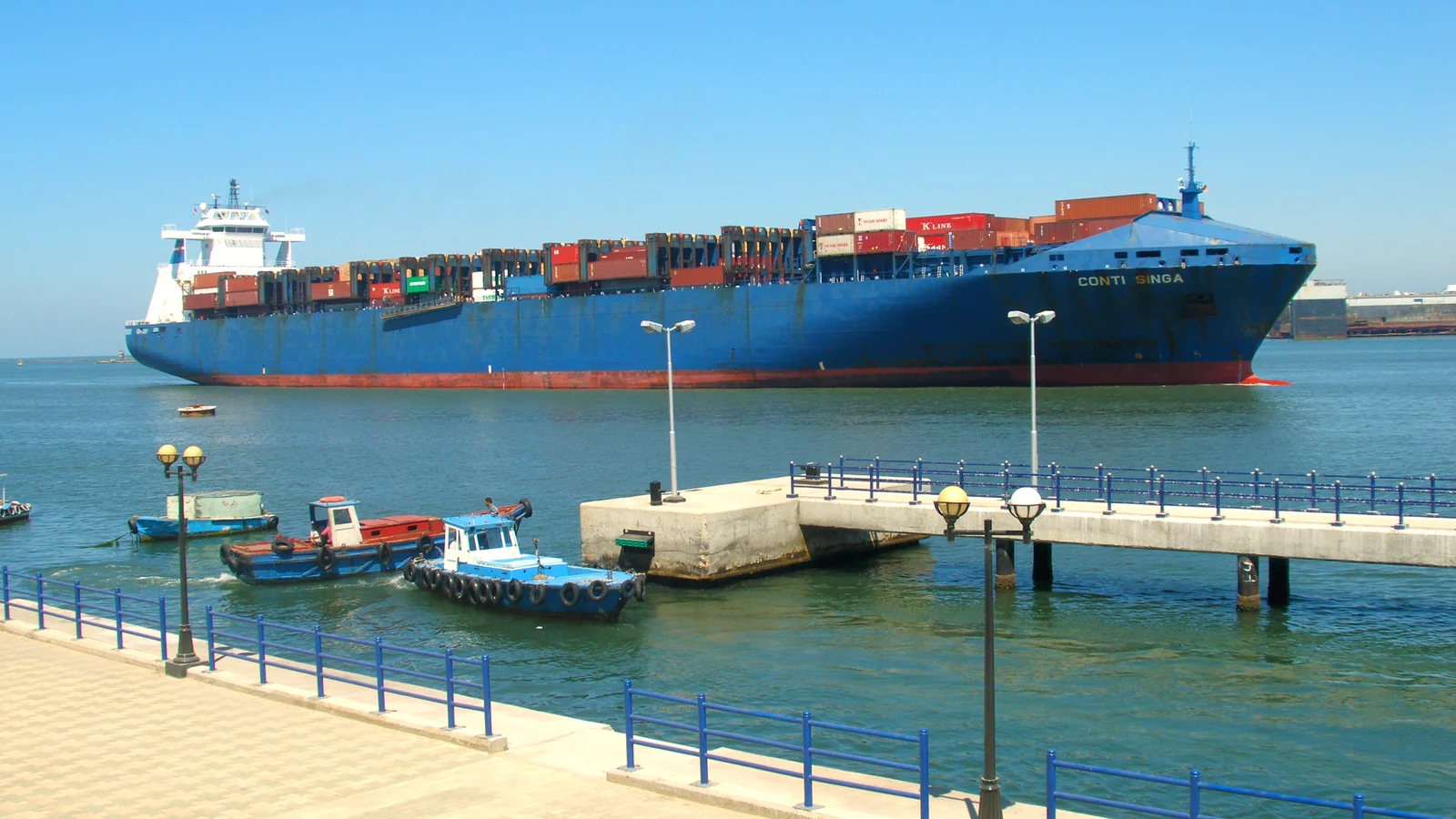
“When a string switches, a Suez arrival lands up to 14 days early while Cape tonnage is still at sea on the old schedule.” Xeneta wrote that in a Far East to Europe report, quoted by Seatrade Maritime News. That sentence covers most of what the Suez Canal return means for container shipping this autumn, and the Suez Canal return is arriving in North Europe faster than yards can absorb it. The shorter route is the carrier’s decision, and the early arrival lands on whoever has a truck, a warehouse slot and a customer date built around the old ETA.
Per Xeneta’s figures, Yantian to Rotterdam averaged 41 days on nine services sailing via the Cape, and 27 days for a single vessel that went through Bab el Mandeb and Suez. The Suez figure comes from a single vessel.
How far the return has gone
BIMCO’s chief shipping analyst Niels Rasmussen is quoted by WorldCargo News on 14 October. Weekly container capacity through the canal averaged 753,000 TEU in the first two weeks of October, against 1,457,000 TEU in the same weeks of 2023, per Clarksons Research. It is the first time since the Houthi attacks began that transits passed half of the pre-disruption level. Of all capacity routed through either the canal or the Cape, 36% used the canal, against 80% before the attacks.
So Red Sea container routing is a mixed network today. Drewry’s base case, reported by The Loadstar, has Suez transits reaching 80% of pre-diversion levels by February 2027 and holding there through its forecast horizon, because carriers want to keep the Cape as an option. Zencargo’s 6 October update lists CMA CGM’s OCR, Gemini’s NE4 and AE5 and Premier’s FE1 as officially returning to Suez, other services using the canal case by case, and Evergreen entirely on the Cape. A later piece citing Röhlig says some Evergreen routings had returned, so that list dates quickly. The October note from Cory Brothers says Hapag-Lloyd treats each transit as subject to a security review, so a service on Suez today can revert to the Cape at short notice.
A ship that arrives early meets a yard that was not waiting for it
Sea-Intelligence called this the “Double Influx” problem in a January analysis reported by The Loadstar. Its wording was conditional on a full-scale return: faster Suez ships catch the tail of the Cape fleet, and the overlap “will likely exceed terminal handling capabilities” at hubs like Antwerp and Rotterdam. The return so far is partial, and Xeneta’s Peter Sand already calls the outcome certain. He told Seatrade that congestion “is certain to happen as the phased transition develops” and that it is naive to think carriers can prevent vessel bunching, because services are planned around key hubs. Maersk moved the first discharge call of its AE19 loop from Tanger Med to Port Said to spread the load.
The yards were not empty to begin with. Zencargo has some Rotterdam yards 85% to 90% full, with 14-day dwell times, while the port clears backlogs from early September strikes. Cory Brothers describes it differently: vessels waiting around 1.4 days to berth at Rotterdam and Antwerp, and barge waits of 56 hours at Rotterdam because of low Rhine water. Zencargo puts Antwerp vessel waits at seven days. The two are different dates and different measures, 6 October against a later October note, so the terminal’s own figure is the one to ask for.
Hapag-Lloyd chief executive Rolf Habben Jansen placed the weak point where shippers sit. Splash247 quotes him on a return to Suez routings: “The real problem will be the capacity of our customers to pull inventory from the terminal yards.”
The days saved at sea belong to the carrier’s rotation. The shipper gets a box that can be discharged ahead of the date the trucking was booked on, into a yard that wants it gone. That changes which date a booking should hang on. Xeneta measures the 14 days against Cape tonnage still on the old schedule, so a booking confirmed before the string switched may carry an ETA that no longer matches the ship. A recorded discharge event cannot be out of date. CAP Logistics lists missed drayage slots and rail or barge connections among the likely effects of bunching, and pre-booked inland slots are the ones CAP says can be missed or rolled.
For the booking itself, a reliability figure is more useful than a transit time. Navo’s SchedulesMCP vessel schedules covers 72,000+ sailings on 5,000+ lanes and scores reliability, and its page says the score is built from arrivals Navo has observed through the tracking layer, with the sample size shown. Navo’s home page says its tools share the same events, with tracking event freshness of 0 to 5 minutes, cross-checked across 2 to 3 sources, so the lane you priced is the lane you track. The reliability score looks back at arrivals already seen, so a string that switched to Suez last week has little history behind it yet.
The carrier maths, and the insurance gap behind it
Drewry’s slot cost comparison, reported by The Loadstar on 12 October, puts the Suez saving at about $1 million per round voyage, or $43 per slot, for two services on 24,000 TEU ships. That leaves out war-risk premiums and any canal discounts. Drewry’s what-if for a $225 million, 24,000 TEU ship is a war-risk premium of 0.3% of hull value, adding $1.35 million per round trip, which “on its own would tip the economic advantage over to the Cape routing, just”. Drewry’s Simon Heaney adds that insurers are known to rebate around 50% on voyages completed without incident, and says the war-risk figure is not readily available. Breakbulk News reads the Drewry report as saying the Suez vs Cape of Good Hope shipping decision is driven by shorter transit times, better vessel utilisation and competitive pressure, since the voyage saving is too small to explain it.
Carriers are passing part of this on: MSC extended its Piracy Risk and Suez Canal surcharges through October at $91 per TEU. Cargo cover has to follow whichever route is sailed. Antonis Rigalos of the shipper group ShiftX told a Journal of Commerce webinar that when a booking planned for the Cape moves to Suez, cover may have to be arranged at short notice because some insurers do not have Suez coverage. He also relayed what BCO members told him: the extra insurance cost is “manageable” so far. Collicare’s October update says most insurers issued notices of cancellation in March 2026 for transports through designated high-risk areas in the Middle East and Red Sea, that the exclusions still apply, and that Bab el-Mandeb and the southern Red Sea need additional review.
On an Asia-North Europe booking now, the practical answer is to get the routing and the first port of discharge from the forwarder in writing, keep the truck and warehouse booking open until a discharge event exists, and send the routing to the cargo insurer before the cargo moves.