






















In the Asian Development Bank’s 2023 survey, banks gave perceptions of high country risk, lack of collateral, poorly presented documentation and know-your-customer (KYC) concerns as reasons for rejecting applications. The same survey put the global trade finance gap at an estimated $2.5 trillion in 2022, about 10% of global merchandise trade, and the ADB’s December 2025 brief says it remains at that level.
Why applications fail
About 20% of the banks in the ADB survey said some trade finance applications were rejected in 2022. In the survey’s bank-response chart, “other reasons” was the largest slice at 30%. Named reasons (not a complete list) included a country perceived as too risky for the bank’s appetite (11%), an SME with no collateral, high credit risk or another reason (10%), insufficient collateral (7%), and a poorly presented application with too little information (6%). Documents are one reason among several, and the chart does not rank them above collateral or country risk.
Small and medium-sized enterprises (SMEs) sent 38% of the applications banks received in 2022 and took 45% of the rejections.
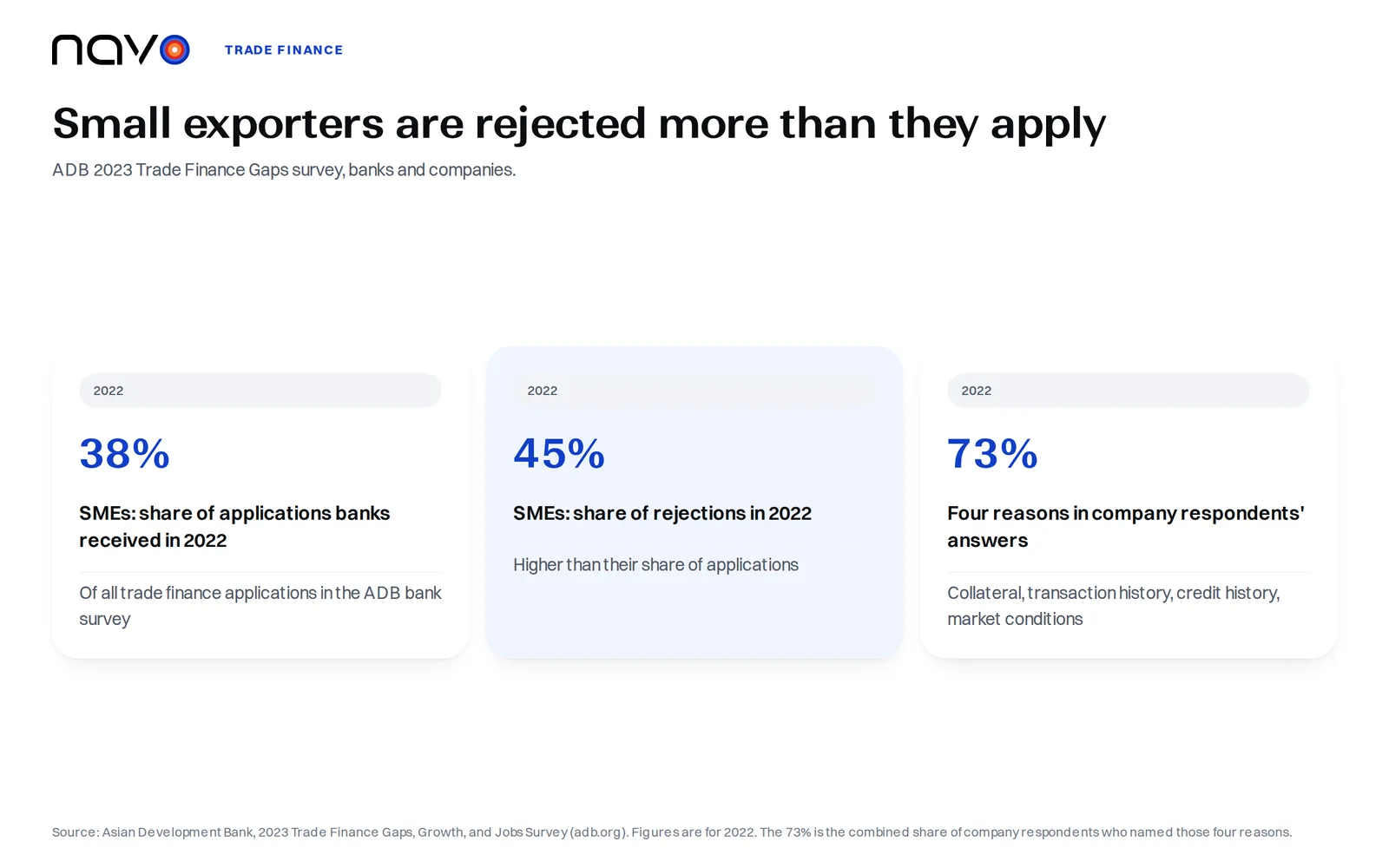
Companies describe it differently. In the ADB’s company survey, taken together, four factors accounted for 73% of company respondents’ reasons for rejection: the lack of collateral demanded by lenders, the lack of transaction history or long-term relationships with bankers, insufficient credit or performance history, and unfavorable market conditions. Collateral alone was 22%. The ADB says company perceptions only partially align with what banks report, and that companies may have room to work on internal issues under their control, naming financial literacy, the ability to present bankable financing proposals, and proactive help with due diligence and KYC requirements.
ADB’s January 2026 news release on its newer survey suggests SME rejection rates (41%) have fallen to nearly the same level as those for large and mid-cap corporates (40%), though this requires more research.
Exporter and importer want opposite things
The U.S. International Trade Administration states the conflict in one line each. For exporters, any sale is a gift until payment is received, so they want money as early as possible. For importers, any payment is a donation until the goods are received, so they want the goods first and payment delayed, preferably until the goods have been resold. The agency lists five primary payment methods for international transactions: cash in advance, letters of credit, documentary collections, open account and consignment.
Cash in advance removes the exporter’s credit risk. It is also the least attractive option for the buyer, and an exporter who insists on it as the only way of selling may lose to competitors offering better terms. Open account sits at the other end: goods are shipped and delivered before payment is due, which makes it one of the highest-risk options for the exporter. An exporter pricing a shipment against these payment terms can start from ocean spot rates by carrier to see what the freight leg costs.
A letter of credit pays against documents
A letter of credit is a contractual commitment by the foreign buyer’s bank to pay once the exporter ships the goods and presents the required documentation to the exporter’s bank, as the ITA’s letter of credit page defines it. The exporter gets a guarantee of payment, and the importer gets reasonable payment terms. The payment-methods guide calls the instrument useful when reliable credit information about a foreign buyer is hard to obtain and the exporter trusts the buyer’s bank.
The bank’s test is written into the credit. Payment is made provided the terms and conditions stated in the letter of credit have been met, as verified through the presentation of all required documents.
Qingdao: a warehouse-receipt dispute in court
Lending against paper assumes the paper stands for real goods. Qingdao is one documented case where that assumption was tested in court. In late May 2014, evidence emerged of a significant fraud involving metal supposed to be stored in warehouses in Qingdao and Penglai, China. The English Commercial Court recorded this in its judgment in Mercuria v Citibank, handed down on 22 May 2015, adding that investigations were ongoing and that it appeared substantial quantities of metal might be missing from the warehouses or pledged more than once. At Penglai, Citi supposedly held metal under five warehouse receipts representing approximately 20,000 tonnes of aluminium. On 4 June 2014 it was told that a stock check the previous week had found only 16,000 tonnes present at the port.
The deals were repo transactions rather than letters of credit. Citi counterclaimed about US$271 million for the price of the metal in the forward sales and argued that it had met its delivery duty by tendering warehouse receipts endorsed in blank. The judge disagreed on that point: Citi’s tender of endorsed warehouse receipts was not good delivery of metal to Mercuria for the purposes of the Master Agreements, so Citi was not entitled to judgment for the unpaid price of that metal. The same judgment found that the notices Citi served on Mercuria were valid and that Mercuria was in continuing breach of its payment obligations, yet Citi was not entitled to be paid the price of the metal at that point.
The law firm HFW, commenting on the judgment, said it illustrates the difficulties a seemingly commonplace arrangement can lead to once it unravels, and that it is not definitive for others caught up in Qingdao.
A government guarantee for the loan behind the export
The Export-Import Bank of the United States describes its Working Capital Loan Guarantee on its Get Financing page: For a business at least one year old, EXIM works with the private lender and guarantees principal and interest for 90% of export-related accounts receivable and 75% of export-related inventory. EXIM says it backs the bank’s loan and increases the borrower’s borrowing power.
Frequently asked questions
Does a letter of credit protect the buyer as well as the exporter?
Yes. The U.S. International Trade Administration says a letter of credit also protects the buyer, because no payment obligation arises until the goods have been shipped as promised.
What is consignment in exporting?
Consignment is a variation of open account in which the exporter is paid only after the foreign distributor has sold the goods to the end customer. The exporter keeps title until then. The ITA calls the method very risky because no payment is guaranteed.
Does a documentary collection verify the buyer's documents like a letter of credit?
No. The ITA says documentary collections offer no verification process and only limited recourse if the buyer does not pay, even though banks act as facilitators. They are generally less expensive than letters of credit.