

A typo on a bill of lading does not stay on the bill of lading. The carrier builds the cargo manifest from it, entry by entry, and the manifest goes to customs. The US, Canada and the EU all want that data before the box goes on the ship, as an electronic cargo declaration or an entry summary declaration. For inbound containers all three set the clock at 24 hours before loading (in Canada for cargo loaded outside the US, in the EU outside short sea shipping). Miss it, or get it wrong, and the US and Canada can fine whoever should have filed. Some carriers also put a line for it in their own tariffs: a flat advance manifest fee at one, a charge for late or wrong filing at another. Before the carrier’s cut-off I would read the draft bill of lading line by line, since that text is what customs will see.
What the manifest copies from the bill of lading, and why a typo travels
Each entry repeats a bill of lading: vessel and voyage, shipper, consignee, notify party, description of the goods, container and seal numbers, payment terms. SeaRates’ explainer on the cargo manifest spells out the consequence. The manifest reproduces whatever was typed in, so a mistake reaches customs unchanged, and a manifest corrector that arrives late at the destination keeps the cargo from clearing. The explainer advises avoiding correctors where possible, since they bring bureaucratic complications. The same explainer adds that a freight manifest exists too, showing the freight charges: prepaid, payable at destination and cash on delivery.
The IMO FAL Convention has its own standard form for the same data, the Cargo Declaration (FAL Form 2). Its Explanatory Manual, FAL.3/Circ.220, treats the duty to provide it as met once the information has gone in as pre-arrival data or in the ship’s manifest, which, the Manual says, invariably holds more than the declaration does. National law decides how far pre-arrival data replaces the forms.
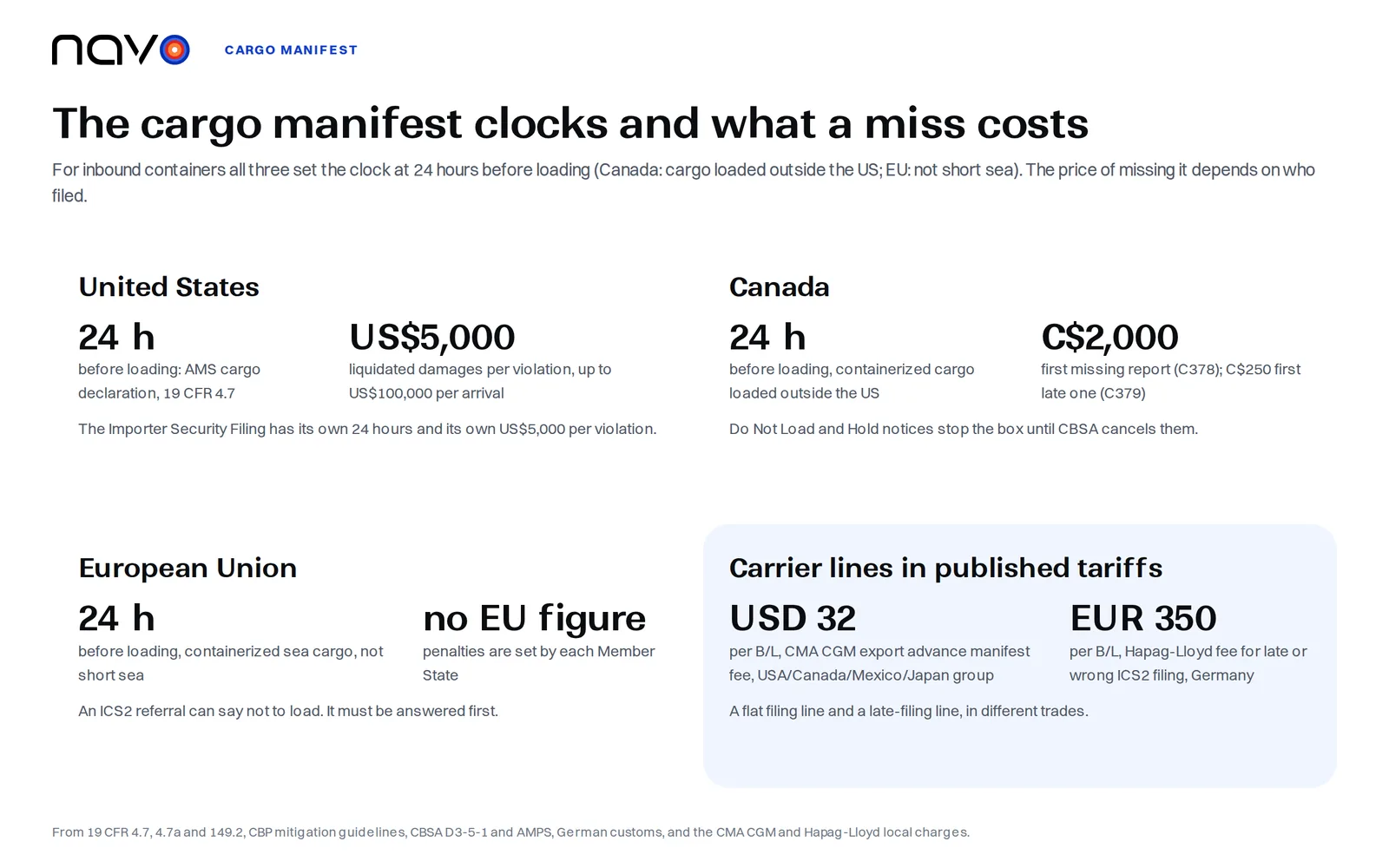
The clock is 24 hours before loading in the US, Canada and the EU
In the US the carrier has to get its electronic cargo declaration to CBP through AMS 24 hours before the cargo is laden at the foreign port (19 CFR 4.7(b)(2)). Bulk and authorized break bulk are exempt (4.7(b)(4)), but CBP still needs their declaration before arrival. NVOCCs can file for themselves under (b)(3), on the same 24 hours, if they hold an FMC license or registration and an international carrier bond. A freight forwarder as defined in part 112 is not an NVOCC for this purpose.
The importer files separately. The Importer Security Filing wants seller, buyer, importer of record number, consignee, manufacturer, ship-to party, country of origin and HTS number 24 hours before lading. Container stuffing location and consolidator are due as early as possible and in no event later than 24 hours before arrival at a US port.
Canada works from CBSA’s Memorandum D3-5-1. Appendix A gives 24 hours before loading for containerized cargo loaded outside the US, 24 hours before arrival for break-bulk and bulk, and 96 hours before arrival for empty marine containers. A change made before loading restarts the 24 hours and needs a new estimated loading time.
German customs lists the EU entry summary declaration deadlines under Article 105 of the Delegated Regulation. Containerized sea cargo other than short sea is due at the latest 24 hours before loading at the port of departure, bulk and break bulk four hours before arrival at the first EU port. The filing itself goes through ICS2.
Does the paper manifest still matter? In the US it does: apart from a cargo declaration filed in advance, 19 CFR 4.7(b)(1) wants the original manifest and one copy ready for the first CBP officer who asks, and the port director may demand more copies.
A late or wrong filing: who gets the claim, and for how much
In the US that means the carrier, NVOCC, slot charterer or other authorized transmitter. CBP’s mitigation guidelines, updated in 2018, allow liquidated damages of US$5,000 for each violation, up to US$100,000 per conveyance arrival. Twenty violations hit the cap.
The master has his own exposure, a civil penalty under 19 U.S.C. 1436 of $5,000 for a first violation and $10,000 for a later one. Because the guidelines allow a single penalty against the master when several late or inaccurate filings fall on one arrival, it does not have to multiply with every bill of lading. 19 CFR 4.7(e) and 4.7a(f) add bond damages of $5,000 per violation, for masters on top of the civil penalty and for NVOCCs that file electronically.
CBP says it may reduce a first penalty or claim to between $1,000 and $3,500 if law enforcement goals were not compromised, and a validated C-TPAT member in good standing can get no more than half of the normal amount, first violation or later. A repeat counts as subsequent for the master only when it breaks the same regulation in the same way more than 30 days after a penalty notice that was not paid in full, and then the range rises to $3,500 to $5,000.
The importer carries a separate exposure through the ISF: CBP’s help article says liquidated damages of $5,000 per violation may follow an inaccurate, incomplete or untimely filing.
Canada publishes a schedule in Canadian dollars. A missing pre-load or pre-arrival report (C378) costs $2,000 for the first instance, $4,000 for the second and $8,000 from the third, and once five or more reports are missing the cap is $12,000, $24,000 or $48,000 by level. Data sent outside the time or the manner (C379) costs $250, then $375, then $750. Inaccurate data (C382) costs $500, $750 and $1,500 per submission. All three go to the party responsible for providing the data.
In the EU penalties are national. Article 42 of the Union Customs Code leaves penalties to each Member State, who must make them effective, proportionate and dissuasive, and the Commission’s ICS2 page adds that customs may impose administrative sanctions for non-compliance with the data requirements.
Can customs stop a box that is already at sea?
In Canada it depends on which notice comes, and CBSA’s memorandum sets out the sequence. A risk assessment notice before loading means the carrier has to retransmit the primary cargo data with the missing information, and the cargo stays off the ship until CBSA sends a cancellation message. A Hold is another matter: it can arrive after loading, with the vessel already under way, and although the cargo may then be unloaded it cannot leave the dock until CBSA cancels the Hold, even if it had been released before. While the cargo is still unreleased, the information a Hold asks for goes in electronically. Once it has been released, the system refuses electronic changes, and the only correction CBSA accepts is a paper BSF673 form, in duplicate, at the local commercial office. A shipper whose box is sitting on a Hold will want to know where it is, and the bill of lading number is enough to find the voyage in Navo’s tracking. Watching for these coded messages is the carrier’s job, and CBSA runs a 24-hour desk, the National Targeting Centre, for calls about them.
ICS2 runs along similar lines. Customs analyse the risk on the entry summary declaration before loading or arrival, and a referral can ask for more information, ask for screening of high-risk cargo, or say not to load. The referral has to be answered before the risk assessment resumes.
In the US, CBP’s guidelines say it may withhold the release or transfer of cargo until it has the cargo declaration information and has had the chance to examine the cargo, and that it may deny a permit to unlade.
What two carriers charge for manifest filing
Carriers add their own per-B/L lines for manifest filing, and two published tariffs show what they look like.
CMA CGM’s United States local charges list an Advanced Manifest Declaration Fee on exports, per B/L. It is USD 32 for the USA, Canada, Mexico and Japan group (CMA CGM, APL, ANL), USD 27 for Europe, Turkey and the Russian Baltic (CMA CGM, APL), and USD 35 for South Africa (CMA CGM, APL). A correction costs extra: amending a B/L is USD 75 per request unless any part of the request is due to an error made by the carrier, and when customs fines, scanning or inspection costs are invoiced against a B/L, CMA CGM adds a USD 75 administrative fee per invoice.
Hapag-Lloyd’s Germany local charges charge for the mistake instead of the filing: since January 2026 the Import Service Fee has been EUR 350 per B/L, described as an administrative charge for an overdue, late, incomplete or erroneous EU ICS2 filing.
Dangerous goods have a manifest of their own
FAL.3/Circ.220 names the Dangerous Goods Manifest (FAL Form 7) as the standard declaration for dangerous goods. It is compiled from information the shipper gives the carrier, and the stowage position on board should be notified so the goods can be found in an emergency. SOLAS chapter VII and the IMDG Code sit behind it. The Code has been mandatory under SOLAS since 2004, although IMO says some parts remain recommendatory.
Maersk publishes a fee for dangerous goods that were declared incorrectly, incompletely or falsely. Its advisory of October 2025 sets USD 5,000 per bill of lading as the base level, USD 15,000 per container in China. An earlier Maersk notice on the MID charge had set USD 15,000 per container globally for dangerous cargo from January 2025, so it is worth checking which figure your own rate sheet carries. Maersk adds that the shipper and the consignee bear full responsibility for the associated costs, which are billed separately. Hapag-Lloyd’s German tariff has a smaller line of a different kind: a terminal cost recharge of EUR 80 per container when the customer does not send complete DG data and the terminal has to enter it by hand, at EUROGATE CTH Hamburg and terminals with the same rule.
What Panama checks in the master’s manifest
Under OP Notice to Shipping N-1-2026 a vessel declares all cargo on board at least 96 hours before arrival, with a few listed exceptions. The Canal authority then verifies the declaration submitted in its Maritime Service Portal and the cargo manifest provided by the master, and the notice names two things it checks: total cargo weight and the number of container units on board. When discrepancies turn up, the operator or agent is contacted and has 96 hours from the report to correct the data. A vessel that misses the 96 hours or files wrong or missing data can be inspected and escorted, a discrepancy can also mean a delayed transit or fines, and the extra resources are charged to the vessel. The correction goes through the portal and has to be in before the vessel sails, otherwise the Port Facility Officer at the next port of call may be notified and the vessel’s security level may be raised the next time it is presented for transit.
Frequently asked questions
My forwarder says he files the ISF for me. Do I still have to send him anything?
Yes. The regulation defines the ISF importer as the party causing the goods to arrive: the owner, purchaser or consignee, or an agent such as a licensed customs broker (19 CFR 149.1). A forwarder can submit the filing as your agent, but he will usually need the seller, buyer, manufacturer, ship-to party, country of origin and HTS number from you or your supplier. Four of them, the manufacturer, ship-to party, country of origin and HTS number, may go in first on the best data available, and the filer then has to update them as soon as better data exists, in no event less than 24 hours before arrival at a US port (149.2(f)).
The consignee changed while the container was at sea. Who tells customs, and what does it cost?
For Canada, CBSA's memorandum has the freight forwarder send an electronic update to the house bill data as soon as it learns of the change, and its own example is a bank that endorses a "to order" bill to a third party while the goods are at sea. After arrival, carriers can make electronic changes until the cargo document is released or acquitted. On the carrier side, Hapag-Lloyd's German tariff charges EUR 150 per B/L for customs manifest detail changes made after the customs reference is issued and before the container is discharged. After discharge it is EUR 395 per B/L, the same line that covers release against a letter of indemnity.
Can I put "general cargo" or FAK on the bill and fix it later?
Do not count on fixing it later. For US-bound cargo the declaration rule lists generic descriptions such as FAK, general cargo and STC (said to contain) as not acceptable and asks for a precise description, or the HTS number to six digits if the shipper has supplied it (19 CFR 4.7a(c)(4)(vii)). CBP accepts a declaration prepared on the shipper's load and count, but qualifying words do not limit the master's responsibility for accuracy. A carrier or NVOCC that cannot verify what it was given may file what it reasonably believes to be true (4.7(b)(3)(iii)).