

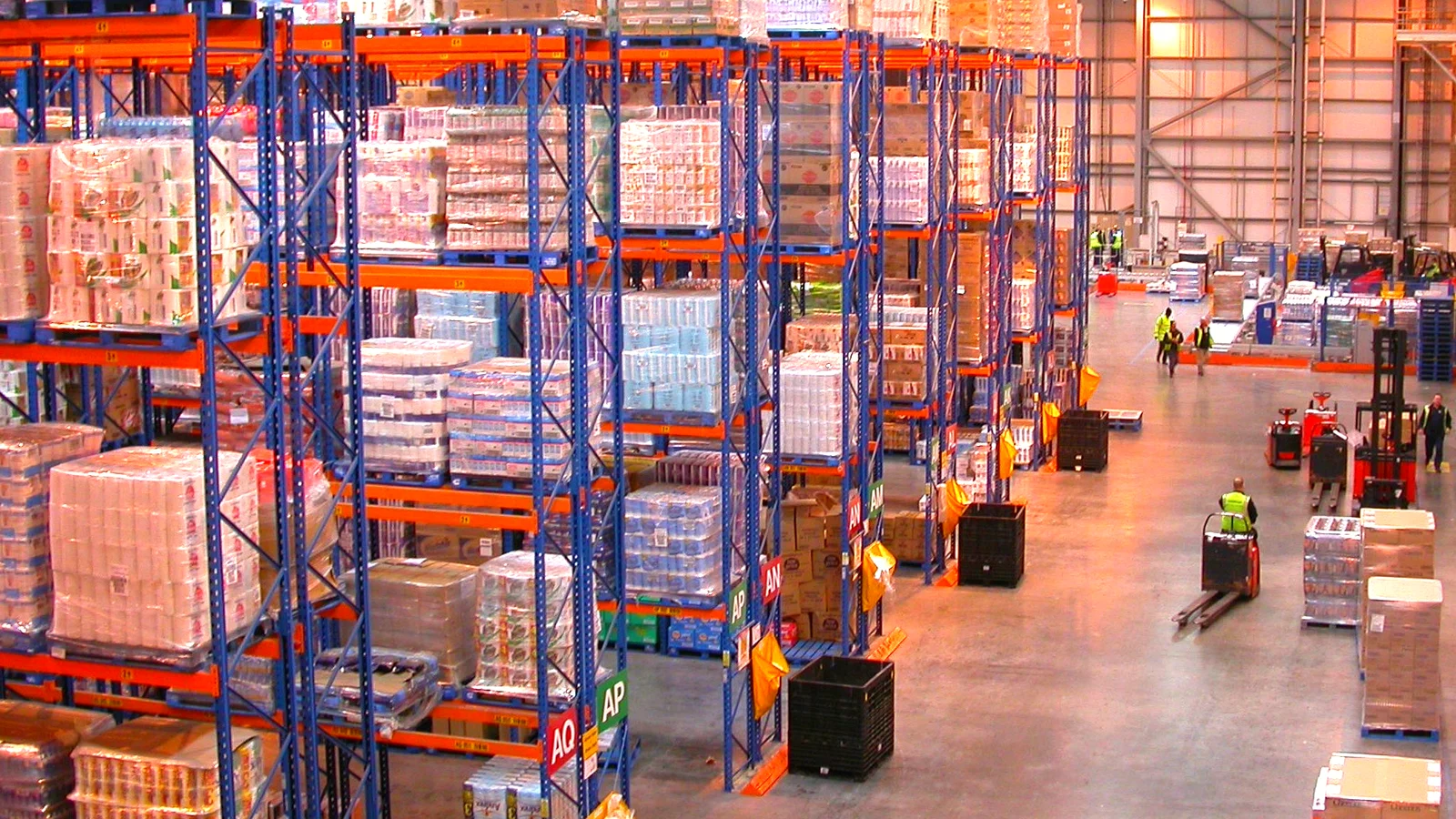
Anata Fulfillment publishes an invoice estimator next to its rate card, and its default case shows where one 3PL’s bill goes. Pick and pack takes three quarters of the total it prints, and Anata itself calls the figure a directional estimate that depends on SKU mix. Storage, receiving, returns and a flat tech fee share the rest. Postage and packaging go on top.
The total is $2,290, from defaults of 1,000 orders a month at 1.5 items each, 10 pallets stored, 4 received and 3% of orders returned. Postage and packaging are billed at cost plus 10%. The $2,000 onboarding fee listed lower on the same page is not in the estimate.
One month on three rate cards
The month: 500 single-item orders under a pound, 10 pallets in storage, 4 pallets received. No postage, no one-time fees. The sums come from each provider’s own published rates as read on 17 October 2026, and packaging is not equalized: Hermeslines uses its own, Anata’s pick fee includes a poly mailer, and San Diego says additional fees may apply for special packing.
Hermeslines comes to $966: pick and pack at $1.57 with the provider’s packaging, storage at $14.11 a pallet in its 9 to 14 pallet tier, receiving at $10 a pallet. Anata comes to $1,305, with a $1.60 base fee per order, $35 a pallet for storage, $20 a pallet for receiving and the $75 tech fee. Fulfillment San Diego comes to $1,350. At its Start Up tier (capped at 15 SKUs) a one-item order is $0.50 pick plus $1.50 pack, storage is $29 a pallet and receiving $15.
Three cards, three ways of billing, and the ranking will not survive your own SKU mix.
Storage age is where they diverge. Leave a pallet at San Diego for six months and it costs $234, not the $174 you would get at the opening rate: $29 for the first 90 days, then $49 (if the step lands after month three). Anata makes the same move from $35 to $45. Of the warehouses The Fulfillment Advisor surveyed for its 2026 results, 41% add a long-term storage fee. Its 2026 table gives no average surcharge, only “varies by provider”, so get the percentage in writing.
Some cards price by volume and some by the pallet, so you cannot line them up until you know your stock dimensions. Hand every provider the same inventory file and compare invoices.
If your stock arrives in containers, look for a container line on the card. San Diego unloads a 20ft box from $299 and a 40ft for $499, while Hermeslines quotes containers on request. Navo’s freight rates page shows an indicative ex-Asia spot rate per lane to anchor on before you ask anyone for a quote.
Minimums sit underneath. The Advisor’s 2026 respondents reported an average minimum of $752.08. Hermeslines has no invoice minimum, only a one-pallet storage minimum.
Where in-house still wins
Divide the fixed-cost gap by the per-order gap and you have the break-even. ELM Global Logistics does the sum for a sample brand: in-house costs $19,000 a month more in fixed expenses and the 3PL charges $1.90 more per order. Result: 10,000 orders. For most consumer brands, ELM says, the crossover falls somewhere between roughly 1,000 and 12,000 orders a month, depending on rent, labor and how fiddly the orders are. One trap it names: a lease you cannot exit saves nothing when you move, and booking it as a saving flatters the 3PL.
ShipMonk, like ELM and Lite below, sells fulfillment, so its numbers are a provider’s view. Under 500 orders a month it calls self-fulfillment often competitive. From about 1,000, once every in-house cost is counted, it says a 3PL typically wins. ELM says the 300 to 500 order crossover quoted in industry guides is a rough signal, not a verified benchmark.
ELM’s example is a November of 18,000 orders after a normal month of 4,000, and it says an annual average of about 6,000 tells you almost nothing. In-house cost jumps in steps. Second shift, temp labor at premium pay, overflow space, and sometimes a bigger lease that you carry for all twelve months.
Product can settle it before the arithmetic does. If you sell loose lithium batteries or perishables, read the exclusions before the rate card. RES lists both, plus hazardous materials. Lite Fulfillment adds that heavy machinery and white-glove assembly get declined by most 3PLs or priced until the savings vanish. Among brands above about $5M in revenue, Lite says, it sees a hybrid model with a split. Most often the ratio is roughly 80 to 90% of orders through the 3PL. VIP orders, returns triage and influencer kits stay in-house.
What breaks mid-move
Commonwealth, a warehouse operator, says most 3PL switches fail in the middle, not at the signing. Its playbook pictures the bad week. The new building is ready and the old one still ships. Stock sits in both. EDI points at only one of them, and a retailer chargeback arrives for a PO that neither warehouse thought was theirs. The two playbooks used here cover a move between 3PLs. A first move out of your own building is not covered by either.
Start with the count. WarehouseQuote wants a final physical or cycle count from the old site. That count is then frozen into one file of quantities, lot numbers and locations, and the new WMS is loaded from it. Commonwealth’s test: the opening count at the new building and the closing count at the old one have to reconcile to a single book. If the two do not match, Commonwealth’s advice is to stop receiving and look for a unit-of-measure problem before volume buries it.
Then the store connection, which can shift your cut-off in practice. IDCEA builds the cut-off backwards from carrier pickup, minus the time your orders realistically need. Sync the store to the WMS every 15 or 30 minutes and part of that time is gone. Fraud or address checks can hold an order past the line. Two clients in one building can sit at 3 pm and noon. In peak weeks, IDCEA says, one common response is to move the cut-off earlier. WarehouseQuote wants the new provider connected to the storefront and ERP and tested before stock lands.
Overlap is the stretch where two warehouses hold your stock. None of the sources prices it, so ask each provider what the double-running months cost. Commonwealth recommends freezing SKU setup changes, new retailer programs and packaging redesigns during the overlap unless they are the reason for the move: every master-data change gets entered twice and wrong once. Its plan ends with 30 days of hypercare, named owners on both sides, and an old building that is empty or contractually done.
Containers still at sea mid-move need a watcher. Navo’s shipment visibility page describes container timelines built from carrier events, with an ETA that moves for a stated reason. For the truck leg between warehouses, WarehouseQuote adds a unique ID on every pallet tied to the frozen manifest, and transit insurance for full value, because the risk peaks while stock is moving.
Frequently asked questions
I ship about 400 orders a month from a spare room. Is a 3PL worth it yet?
Look at the monthly floor before the per-order fee. Anata's base fee for a single-item order is $1.60, so 400 orders are $640 in pick fees alone, before storage, receiving and the $75 tech fee. Its $500 minimum is billed only when total monthly charges fall under it. ELM Global Logistics says that at a few hundred orders self-fulfillment is often still cheaper in cash, and that the case for outsourcing is then time and capacity. Its advice is three quotes and a pilot before deciding.
My stock is worth more than $50 a unit. Who pays if the 3PL loses it?
Read the liability clause before the rate card. Anata caps liability at the lesser of wholesale value or $50 per unit and leaves insuring the inventory to the client. RES caps it at $100 per piece unless a higher value is declared in writing and insured before the stock is received. RES makes the declaration and the cover a condition of inbound. Anata leaves insurance to you, so ask both what a lost pallet pays out before it arrives.
Will I pay storage at two warehouses while I move?
Possibly, and the contract decides for how long. WarehouseQuote advises reading the old provider's exit clause and termination fees first and defining the financial cut-off points for storage and fulfillment fees. Anata states that its receiving fees may be discounted or waived during onboarding when a brand is moving from a previous 3PL, so ask the new provider the same question.