

A loaded excavator does not care how badly you need it on the next job, and the ocean it has to cross does not care either. Heavy machinery moves on its own terms, and anyone who has arranged one of these shipments knows the standard rules of freight mostly stop applying once the cargo is too big for a pallet.
Most people shipping heavy equipment like a bulldozer, crane, or excavator for the first time assume it works like sending a container of furniture. The equipment is heavy, oddly shaped, and expensive enough that handing it off without understanding the process tends to go badly. This is a rundown of how the process actually works, based on how freight companies that specialize in this kind of cargo operate day to day.
Four Ways to Get a Machine From Here to There
There is no single correct way of shipping heavy equipment. The shape and size of the load decides that for you, and each method comes with its own tradeoffs.
Lift on/lift off, or LoLo, is about as straightforward as heavy shipping gets. A crane does the work, lifting cargo directly onto and off of the vessel. Because these vessels can take on containers with substantial capacity, the transport itself tends to be efficient. The catch is that running those cranes takes a specialized crew, and that shows up in the price.
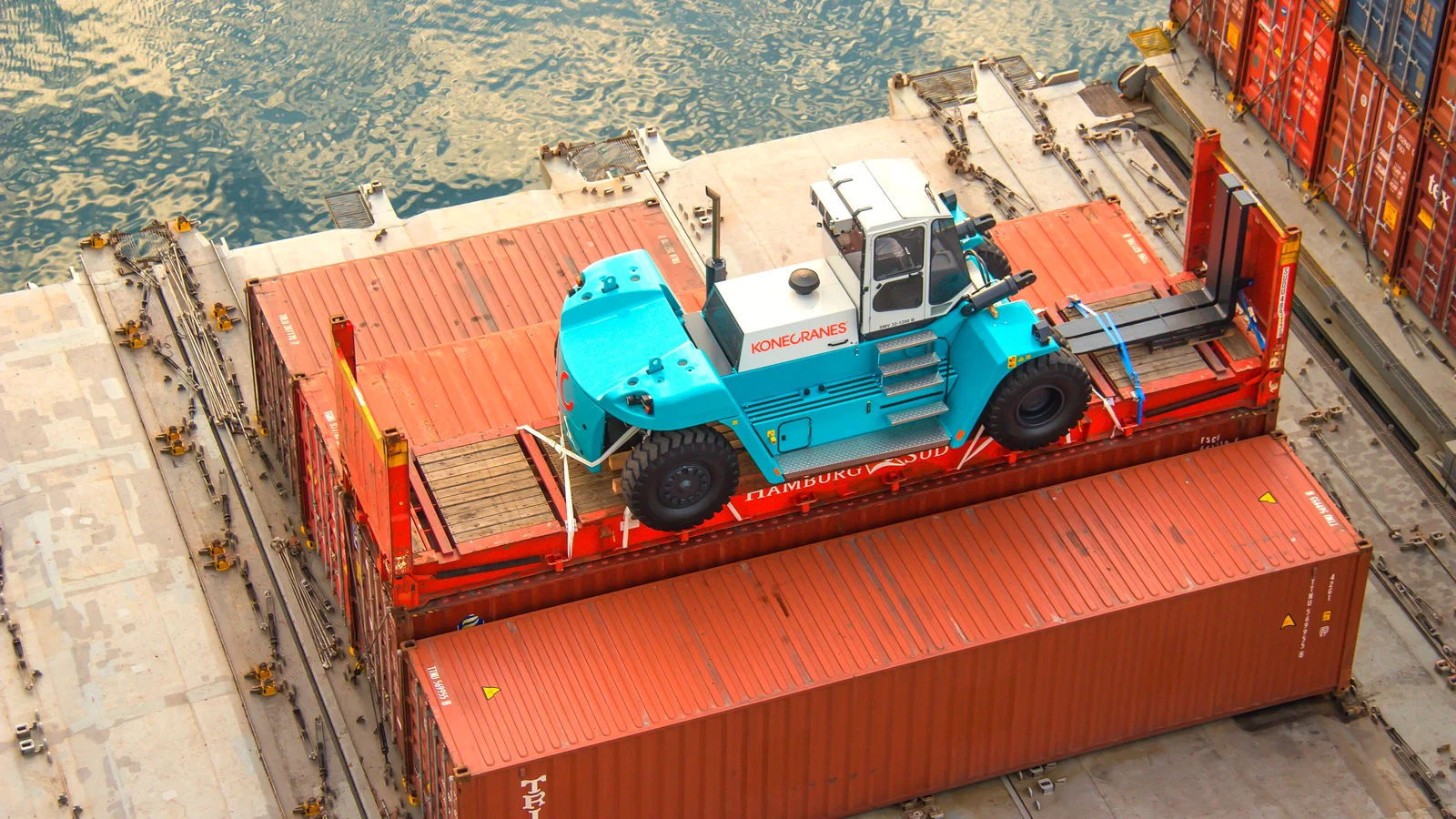
Flat rack shipping works differently. These beds only have support posts at the two ends, leaving the top and sides open, so equipment can be loaded from above or from the side. Flat racks come in the standard 20-foot and 40-foot sizes, and a single one can carry up to 48,000 lbs. For oversize load transportation, or anything that sticks out past normal container dimensions, this is often the only real option, and they are loaded by crane or forklift from above or the side. The tradeoff is exposure. With no walls, the cargo faces the weather directly, and tarping it helps but never protects quite like a sealed container would.
Container shipping is what most equipment manufacturers rely on for exporting, mainly because loading and unloading is simple. The problem shows up when the machine is too big or too heavy for a standard box. The CTU Code (section 7.2) notes that the lashing points in general purpose containers have limited capacity, and that container floors are designed for a concentrated load of 0.5 kN/cm², which can cap forklift-loaded packages at roughly 3 to 3.5 tonnes. For heavier items it points to open top, open side, platform or flat rack units. At that point you are looking at disassembly, which means paying for labor and time both before the trip and after it, putting everything back together on the other end.
Then there is roll-on/roll-off, RoRo shipping, built for anything with wheels, trucks, railroad cars, buses, cars, that can be driven straight onto the vessel and off again under its own power. It is arguably the least complicated method there is. RoRo freight is not measured in tonnes the way most shipping is; it runs on lanes in meters, a figure you get by taking the cargo’s length and width and multiplying that by however many decks the ship has. No specialized crew or lifting equipment is needed. Because RoRo does not allow stacking, though, you cannot make efficient use of the space, and costs climb fast once you are moving several machines at once.
What Actually Drives the Price
Density is the number that shapes almost everything else. In this industry it refers to how a piece of equipment’s weight stacks up against its physical size, and it functions as the baseline measurement carriers use to figure out how a piece of equipment should move. A tractor, an aircraft engine, a boat, none of them fit neatly into standard shipping assumptions, so the carrier ends up making exceptions for shape and bulk that a normal shipment would never require. Density ends up accounting for most of what you pay across pickup, handling, and delivery, and it narrows down which shipping method even makes sense for your load.
Insurance matters more here than with ordinary freight. Basic coverage from a carrier handles some damage in transit, but it rarely covers everything, and it will not touch anything classified as an act of God. Heavy equipment often needs more coverage than that baseline provides. A lot of shippers end up buying a third-party policy or upgrading what the carrier offers by default. It costs more upfront, but when an accident actually happens, that extra layer is often what stands between a shipper and a total loss.
Priority shipping costs extra on top of that, plain and simple. If a machine has to arrive fast, expect to pay for it. There is no quick fix that gets a last-minute deadline met on its own, though a broker who deals in rush freight regularly can sometimes still pull it off through a third-party logistics arrangement.
Freight brokers are easy to dismiss until you actually need one. A broker is a third party who connects shippers with carriers, and a good one maintains relationships across a wide network of haulers. That kind of experience and connections tends to point you toward a reliable carrier and toward equipment arriving on schedule.
What the Shipping Company Needs to Know About Your Machine
At minimum, the carrier needs to know precisely which brand and model you’re sending, so dig up that information if you’re not already sure of it. Any modifications from the factory spec need to be disclosed as well, along with the actual dimensions and weight. Don’t round these off.
It is also worth confirming exactly what the hauler’s insurance covers, since that is what tells you whether supplemental coverage is necessary. A few photos from different angles round things out and give the shipping company a real visual reference instead of just numbers on a form.
Heavy Equipment Shipping Checklist
- Specs. Brand, model, factory modifications, exact dimensions and operating weight, not rounded.
- Method. RoRo if it drives, flat rack or platform if it is over-width or too heavy for a box, container if it fits or can be partly dismantled, LoLo for the biggest lifts.
- Securing. Bracing, blocking and lashing plan. The CTU Code expects flat rack lashing brackets rated at least 30 kN, often 50 kN; ask the carrier what the unit you get is rated for.
- Weather and corrosion. Tarping or protective wrap for open units, and a note to the carrier if the machine corrodes easily.
- Insurance. What the carrier’s cover excludes, and whether you need a third-party policy.
- Paperwork. Permits or licenses in the destination country.
- Both ends. Trucking to and from the port, unloading equipment at destination, and lead time before arrival.
Finding a Carrier You Can Trust
Ask people who have shipped heavy equipment before which company they used and whether it went well. That kind of referral is still one of the better filters available.
How far the equipment has to travel, how close the nearest port is, and what kind of transportation is available along that route all affect what you end up paying, and the size of the load factors in just as heavily: is the heaviest piece something one truck can handle, or does it need two smaller ones? Does one box hold everything, or are you looking at multiple shipments?
Insurance is worth asking about directly rather than assuming it’s covered by default. If there’s an incident, what’s the financial exposure, and does the policy actually cover the equipment you are sending? Some shippers add liability and property damage coverage on top of whatever the carrier includes by default.
It also helps to ask how long loading and unloading typically takes, since an honest estimate lets you plan your own timeline with some confidence, along with what a trip actually costs. Most companies charge by the pound or by cubic foot, and packaging choices affect that rate, so find out upfront what materials they use and how the billing works.
Loose Ends Before You Book
Air, sea, or some combination of the two, which route actually makes sense for this load? Vessel schedules show which carriers actually call at the ports near you, and a freight rate check gives a baseline before the specialist quotes come in. Does the equipment need permits or licenses, and do those requirements shift depending on which country it is entering? Will it need bracing and blocking to stay in place during transit?
On the destination end, how much lead time is needed before the cargo arrives, and will unloading require specialized equipment arranged in advance? Packaging is part of that conversation too, boxed, tarped, and palletized are all different jobs, and the shipping company needs to know which one applies before the truck shows up.
There is also everything that happens off the ship. Trucking is usually involved getting the load from its starting point to the docks and again from the arrival port to its final destination, and rough terrain along either leg can complicate things. If the equipment is vulnerable to corrosion, mention that too, since it changes what kind of protective packaging gets used. When none of this is clear, the equipment’s own manual is often the better source, more reliable than guessing.
Buying heavy equipment is expensive enough on its own, and getting it where it needs to go adds another layer of cost and risk that is easy to underestimate the first time around. That is the whole case for bringing in a freight broker or a third-party logistics firm: the variables involved are hard to manage without someone who already knows where the pitfalls tend to be.
Frequently asked questions
What is the best way to ship heavy equipment overseas?
It depends on the machine. Equipment that drives, such as trucks, buses or wheeled machinery, often goes RoRo. Over-width or very heavy items usually travel on a flat rack or platform. Machines that fit inside a standard container, or can be partly dismantled, go containerized. The largest lifts go LoLo by crane.
What is the difference between RoRo and flat rack shipping?
With RoRo the machine is driven on and off the vessel under its own power, and space is sold by lane metres rather than tonnes. With flat rack shipping the equipment is lifted onto an open platform with end walls only, lashed down, and loaded by crane. Flat racks suit non-running or oversized cargo but leave it exposed to the weather.
Can heavy machinery go in a standard shipping container?
Sometimes, if it fits the internal dimensions and the floor and lashing points can take the load. The CTU Code notes that container floors are designed for about 0.5 kN per square centimetre, which can limit forklift-loaded packages to roughly 3 to 3.5 tonnes, and recommends open top, open side, platform or flat rack units for heavier items.
What information does a carrier need to ship heavy equipment?
The exact brand and model, any changes from factory spec, precise dimensions and weight without rounding, and photos from several angles. Also say whether the machine runs, whether it is prone to corrosion, how it will be packaged, and what the destination needs for unloading. Ask what the carrier's insurance covers so you can decide on extra cover.