

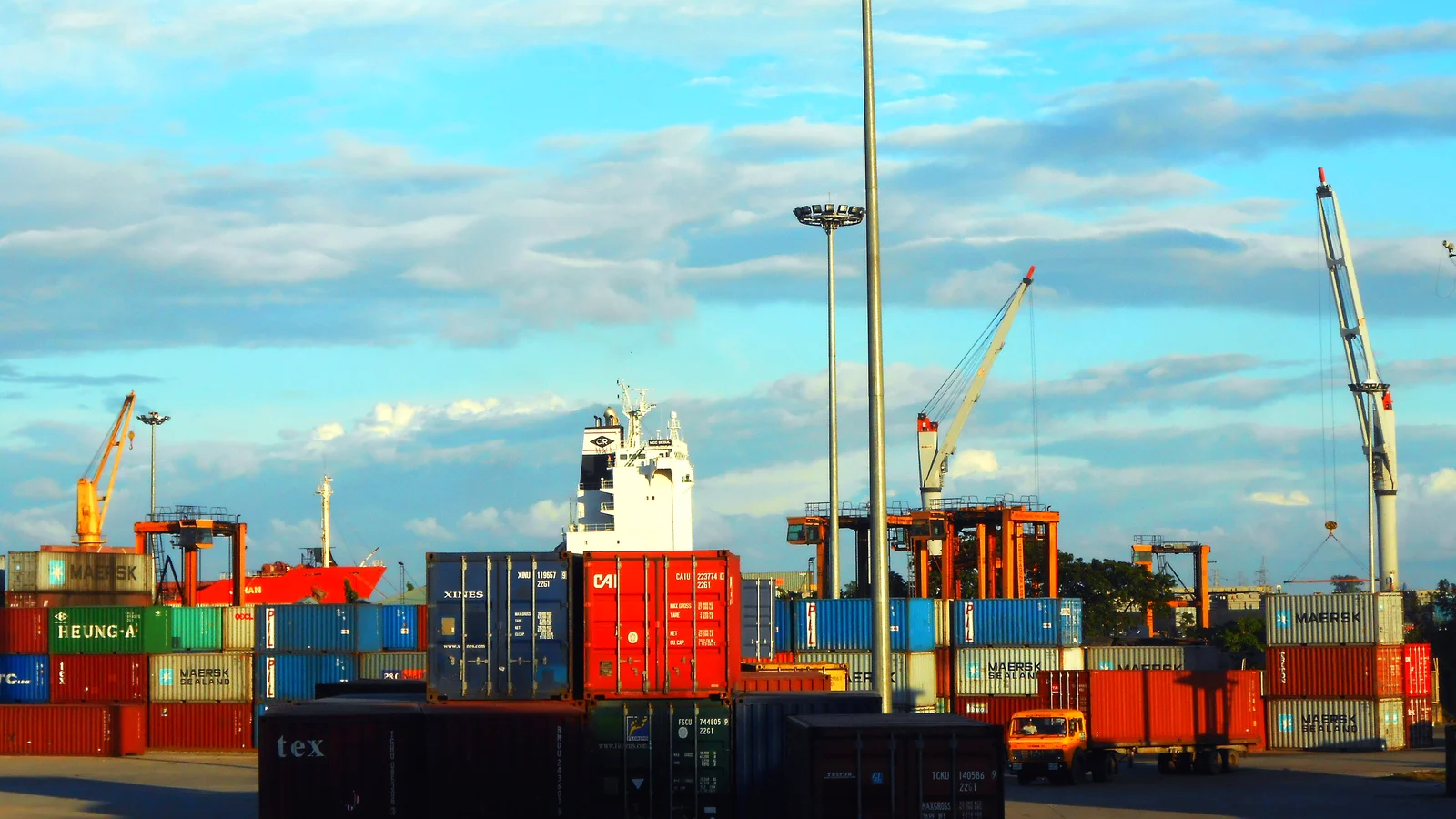
BarthHaas lists its hop pellet pallet at 120 x 100 x 120 cm and 570 kg, 500 kg of it hops, in its packaging guide for cold-store planners. The arithmetic below uses those figures for a 40’ box: two pallets stacked need 2,400 mm of headroom, and that height decides between a standard box and a high cube.
Seven millimetres decide the booking
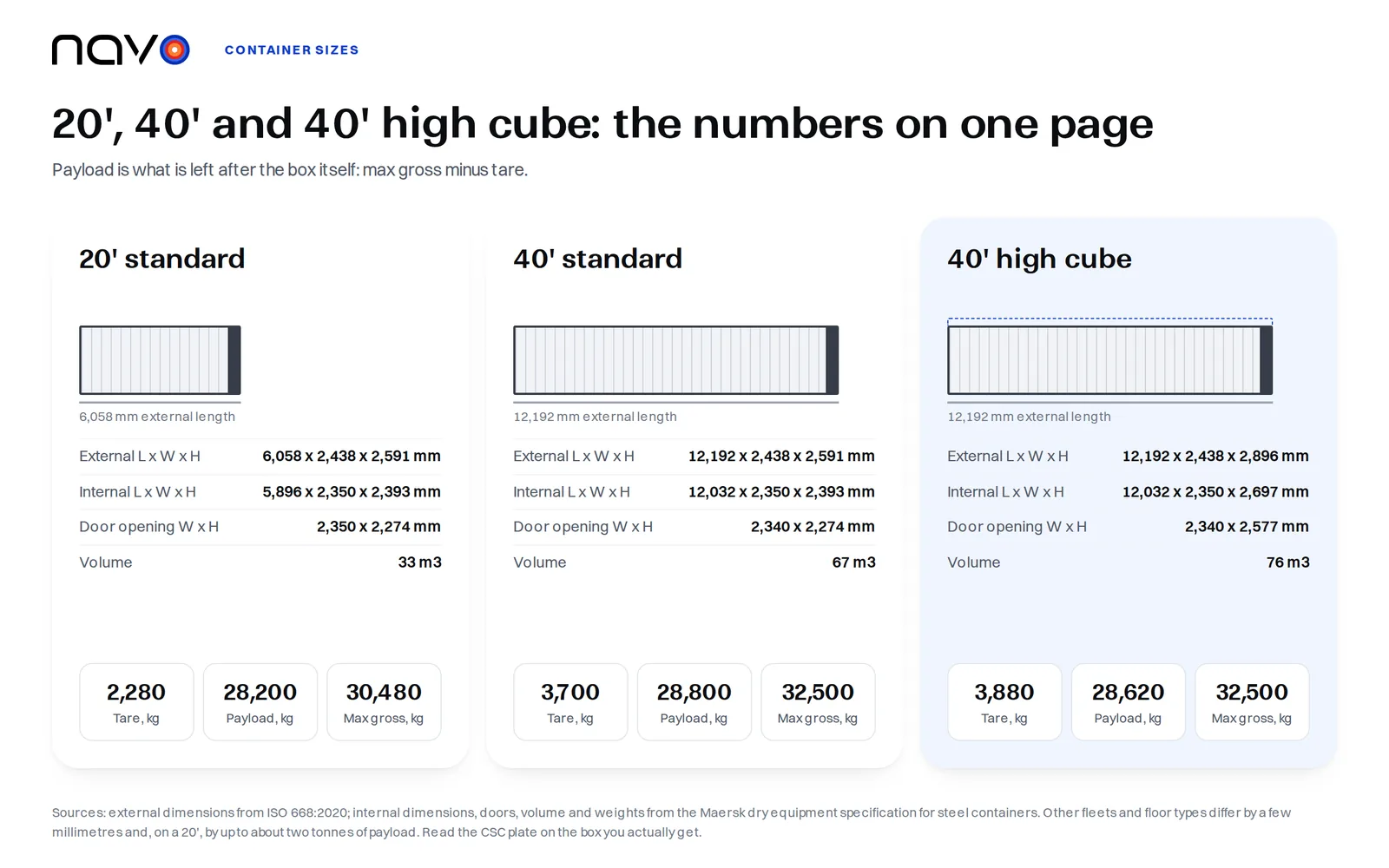
Maersk’s dry equipment specification gives its 40’ standard container 2,393 mm of inside height and the high cube 2,697 mm. ISO 668 sets the outside dimensions and only minimums inside, so the height a shipper plans with comes from the line, and Hapag-Lloyd calls its own figures nominal because production tolerances can make a measured box differ.
The floor takes two pallets abreast and ten rows, twenty to a layer. In the standard box that is all there is, 20 pallets and 10 tonnes of hops. With a second layer a high cube would take forty pallets and 20 tonnes of hops, where the standard box needs two boxes for the same load.
BarthHaas gives no stacking rule for this pallet. The bottom cartons would carry the top ones at sea, and only the supplier can say whether they hold. A second layer needs that answer in writing.
Which weight goes on the paper
Maersk’s own documents give the 40’ standard container two payloads, 28,800 kg on the equipment sheet and 28,870 kg on the cargo weight limit page, which adds that limits vary by country. The CSC plate, usually on the left rear door, states the gross the box may reach. The shipper declares a third number.
Since 1 July 2016 a packed container cannot be loaded onto a SOLAS ship without a verified gross mass (IMO). The shipper either weighs the packed box or weighs every item and adds pallets, dunnage and tare, with a method certified by the authority of the State where the box was packed. Forty pallets weigh 22,800 kg gross and the high cube itself 3,880 kg, so a declaration for that load would read 26,680 kg.
In Europe in 2007 the weight was declared by the packer or the shipper, and no port had to weigh a container before loading, the UK Marine Accident Investigation Branch noted after the loss of MSC Napoli. The ship left Antwerp on 17 January 2007 with 2,318 containers, about 700 of them on deck, and suffered a structural hull failure in the English Channel the next morning. When the boxes came off at Branscombe, the investigators weighed the 660 that had stayed dry on deck and found 137 of them, one in five, more than 3 tonnes away from the manifest, the worst by 20 tonnes. Together those 137 were 312 tonnes heavier than declared. Many packers have no scale, the report says, and some shippers declare less to cut import tax charged on weight, to overload the box or to stay under road and rail limits. Its verdict in 2008, eight years before the verified gross mass rule: “Container shipping is the only sector of the industry in which the weight of a cargo is not known.”
Will the truck take it?
In international traffic EU law lets a five or six axle lorry weigh 40 tonnes, and an intermodal move of a container up to 45 feet gets 44 tonnes on a three-axle tractor with a two or three-axle trailer, or 42 tonnes on a two-axle tractor (Directive 96/53/EC, consolidated text of 2019). For a move using water transport the road leg is limited to 150 km, with exceptions to reach the nearest suitable terminal.
The tractor and chassis come out of that allowance. UIC assumes 8 tonnes for the tractor and 4 to 5 for a 45’ chassis, so about 13 tonnes of a 40 tonne limit are gone before the box is lifted, and 27,000 kg remain for a load of 26,680 kg, a margin of 320 kg. UIC’s 4 to 5 tonnes is for a 45’ chassis, and a 40’ chassis can weigh less. Under the 44 tonne intermodal limit the same box has 4 tonnes more room. Rigs vary. Techno Group, a US flexitank supplier, puts an average three-axle sleeper-cab tractor at 8,618 to 9,526 kg and a three-axle 40’ chassis at 4,899 kg, and with the heaviest tractor the sum is 14.4 tonnes. Against a 40 tonne limit that leaves 25,600 kg, so a load of 26,680 kg would be a tonne over and two pallets would stay on the dock. Under the 44 tonne limit the same load passes.
For the US, Techno Group lists a recommended 19,820 kg of cargo for a 40’ high cube on a standard chassis, which is 34 of the 40 pallets.
The same pallets in a cold box
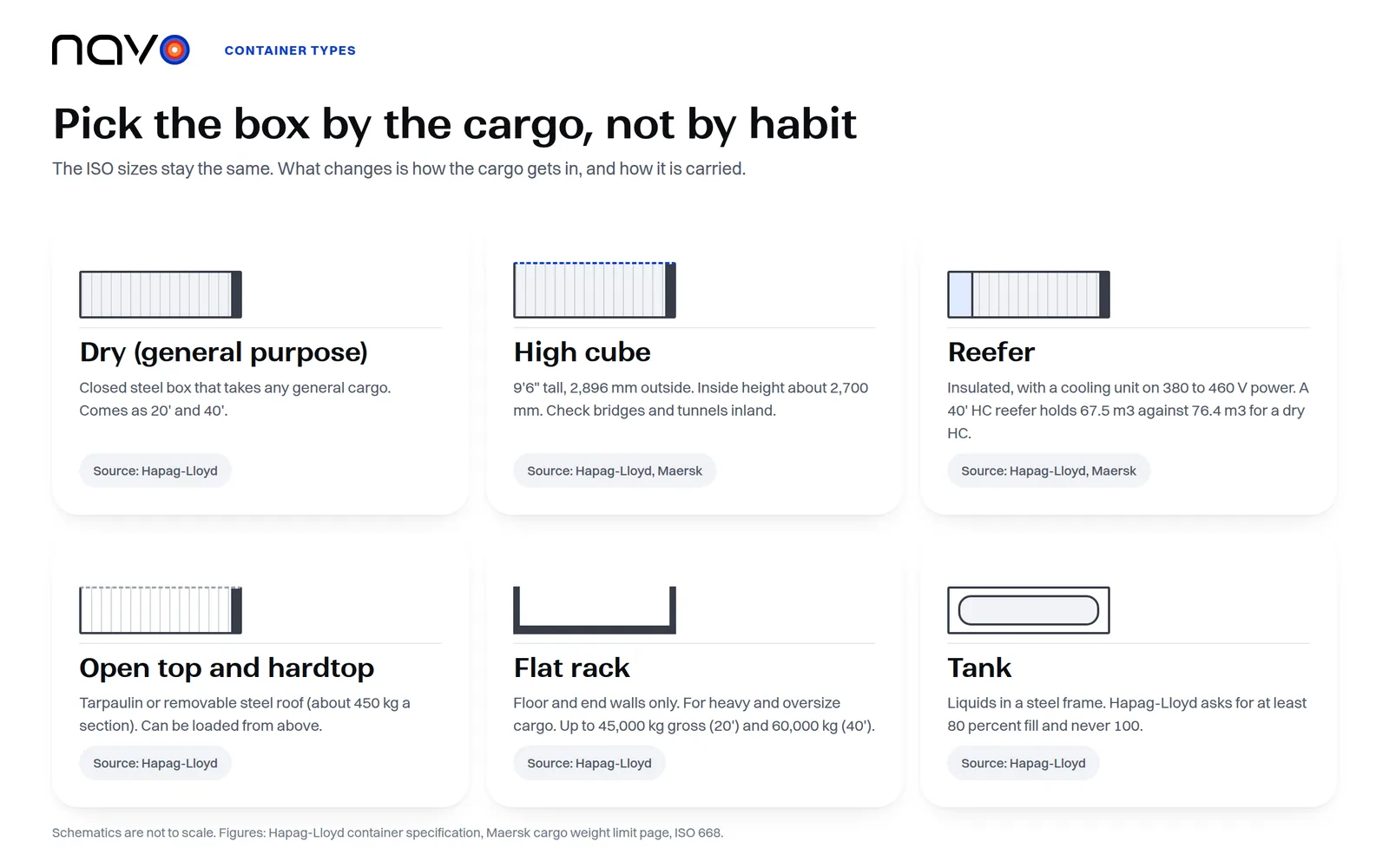
A reefer needs power on the ship and at the terminal, and it holds less than the dry box: Maersk lists 67.5 m3 for its 40’ high cube reefer and 76.4 m3 for the dry one. Inside, a red line marks the highest point where cargo may stand, so that air can circulate. On one Hapag-Lloyd 40’ high cube it sits at 2,425 mm, and two pallets at 2,400 mm clear it by 25 mm. That unit is 11,578 mm long inside, enough for nine rows and 36 pallets.
One terminal tariff shows how the plug is billed, by the day. Yilport Gävle charges SEK 506 to plug in and out and SEK 395 a day for monitoring and electricity, so ten days come to SEK 4,456 before VAT. On a train the unit needs its own power source. A 2020 paper from TU Delft and Erasmus University says the tank of a typical clip-on genset lasts a few days at most, and describes wagon-based systems fed from the catenary, one of them running from the Port of Koper on a small scale since 2018. Newer suppliers sell such wagons and kinetic generator packs approved for use across Europe, so the choice of power depends on the operator.
Open tops, flat racks and tanks
Cargo lowered by crane goes into an open top under a tarpaulin, and Hapag-Lloyd’s high cube version adds 305 mm of loading height. Flat racks come without stanchions unless the booking asks for them, and their payload drops when a heavy load is short, since the weight has to spread over the floor. Hapag-Lloyd asks for tanks to be filled to at least 80 percent and never to 100.
Frequently asked questions
The terminal says my container has no VGM. Do they just leave it behind?
It is not automatically left behind, but the VGM is a condition for loading it. The master has the final say on accepting a packed container, and the master or the terminal may obtain the VGM by weighing the box at the terminal or elsewhere. Whether the terminal does that, and who bears the cost, is agreed between the commercial parties, so settle it with your forwarder before the cut-off.
Is a 45' high cube worth booking instead of a 40' high cube?
On Maersk's cargo weight limit page the 45' holds 86 m3 against 76.4 m3 for the 40' high cube and carries about a tonne less. That suits light, bulky cargo and punishes dense cargo. In Europe the directive also lets the road combination run 15 cm longer for a 45' on an intermodal move. Before booking it, check that your trucker and your port of discharge can handle the 45'.
How do I know the container the line gives me has been inspected?
Look at the CSC plate. For a box more than five years old the date of the next periodic examination is stamped on the plate or fixed beside it as a decal, and the box is examined at least every 30 months after the first examination. A box in an approved continuous examination programme carries a mark starting ACEP on or near the plate and shows no date. A box less than five years old may show none of this, so check the manufacture date on the plate. An older box with neither a date nor an ACEP mark is a question for the line before the box is packed.