





















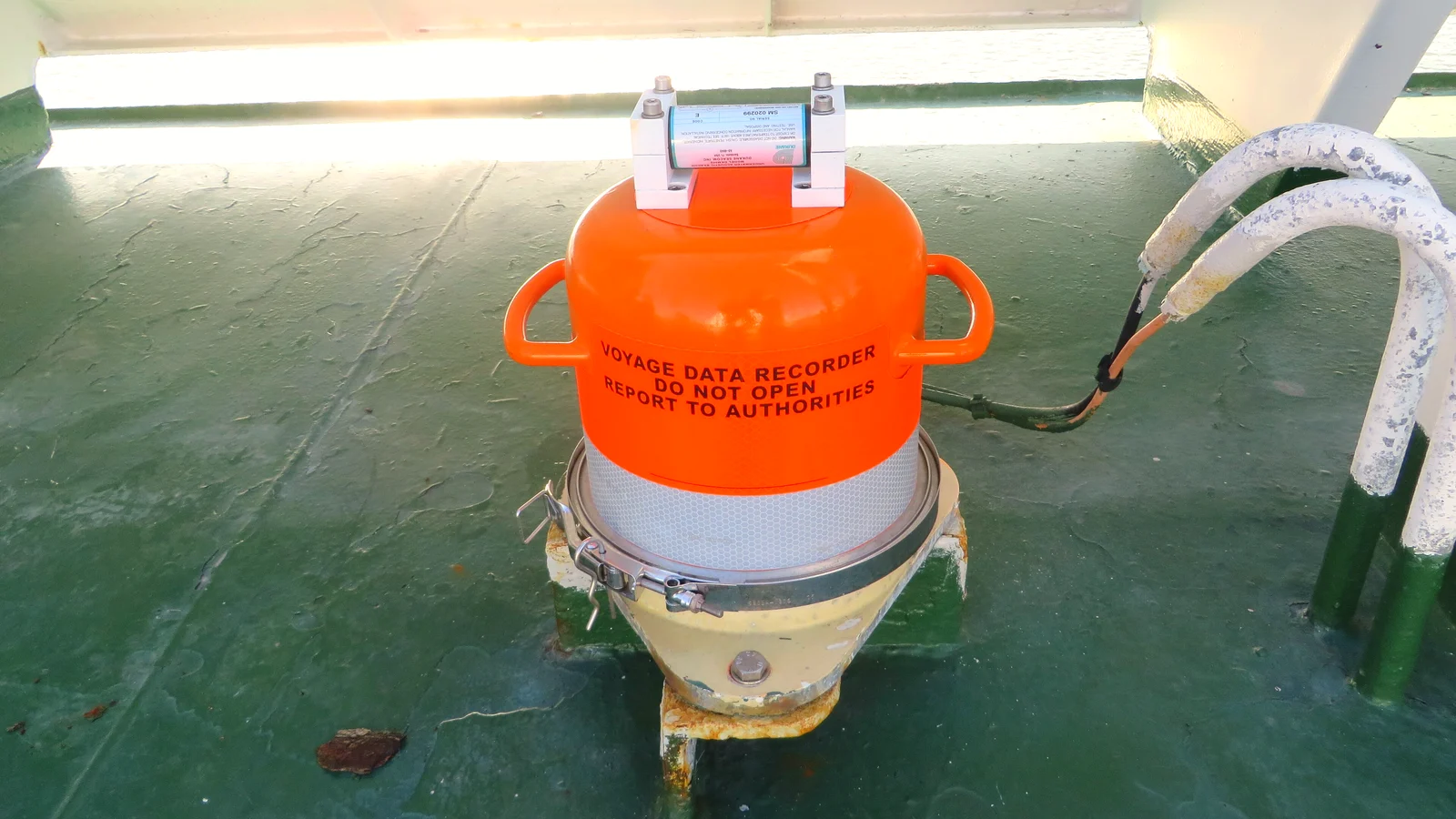
The VDR on the Dali, the NTSB wrote in a footnote to its Key Bridge report, “did not provide, nor was it required to provide, a backup power source to the unit that records parametric data.” When the containership lost power on 26 March 2024, the recorder stopped logging parametric data until power returned 58 seconds later, while the automatic identification system carried on transmitting the ship’s location, speed, heading, course and rate of turn.
Ship communication systems come as a stack, since a vessel carries an AIS transponder, a GMDSS radio installation and a voyage data recorder, and it may sail through waters covered by a vessel traffic service run from the shore. The IMO treats them as four separate subjects with four separate scopes, and the Dali investigation looked closely at only one of them, the recorder, where it found problems that a ship can have while still meeting the standard.
Each system answers to a different part of SOLAS
SOLAS puts each of these systems in a different place and aims it at a different listener. AIS sits in chapter V, regulation 19, and covers ships of 300 gross tonnage and upwards on international voyages, cargo ships of 500 gross tonnage and upwards not on international voyages, and all passenger ships. GMDSS radio belongs to chapter IV. The VDR is regulation 20 of chapter V, which IMO applies to passenger ships and to cargo ships of 3,000 gross tonnage and upwards, with separate dates for ships built before 1 July 2002 and for existing cargo ships. Vessel traffic services come from regulation 12, and only where a government has set one up.
The AIS thresholds leave out some ships, and a flag State may exempt certain ships from carrying it.
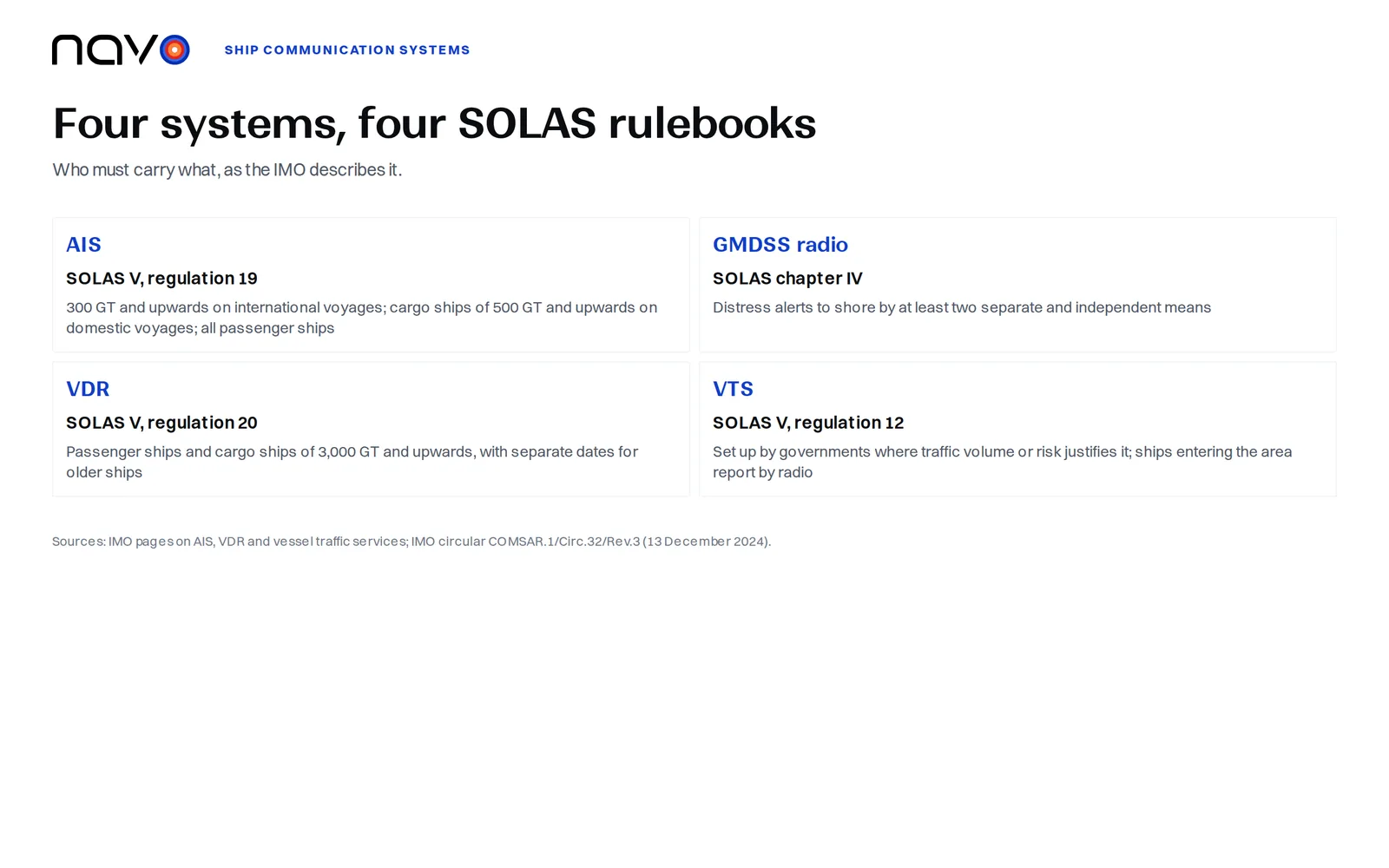
Who listens to each system
AIS feeds the vessel dots on many tracking pages. The IMO describes a transponder that sends the ship’s identity, type, position, course, speed and navigational status automatically to shore stations, other ships and aircraft. If you read incoming cargo off such a map, how AIS positions reach a tracking page explains why the arrival estimate next to the dot deserves a second look.
The GMDSS radio set has a plainer duty, and according to the IMO circular on GMDSS installations every ship at sea must be able to send ship-to-shore distress alerts by at least two separate and independent means, each using a different radiocommunication service, and it should be possible to start them from the position where the ship is normally navigated. An EPIRB can count toward that if it is installed close to the navigation bridge or can be activated remotely from it.
The voyage data recorder is the one built for investigators, and in the performance standards the IMO page describes it sits in a brightly coloured protective capsule with a device to aid location, is entirely automatic in normal operation, and keeps sequential records of data about the ship’s equipment and its command and control. A vessel traffic service works from the shore, and ships entering its area generally report by radio, may be tracked by the control centre and keep watch on a set frequency, while the operator can call them directly if there is a risk of an incident.
The Dali report found gaps in the recorder
The NTSB’s Key Bridge report, published on 18 November 2025, says the Dali’s VDR “generally complied” with IMO regulations and IEC standards. It then lists deficiencies in data access and audio anyway, three of which matter to anyone who may later need that data.
Power was the first gap, because the Dali’s recorder had an internal battery that kept the bridge microphones and the cabinet running through the loss of ship’s power, but the parametric unit had no battery of its own, and it was not required to have one. During the first blackout nothing numerical was recorded, although the report notes that AIS transmissions provided some parametric data the VDR had not captured. Recording resumed after 58 seconds, and once the emergency generator had started, the VDR kept recording audio and parametric data through the second blackout.
The recorder also mixed the left and right bridge wing microphones into one mono channel, a practice the NTSB says IMO resolution MSC.333(90) does not prohibit as long as the recording stays intelligible. The alarms were loud and frequently masked crew conversation during the blackout, and because the channels were mixed together, alarms or specific conversations could not be filtered without also affecting other parts of the recording. Only the bridge side of the electric telephone was captured, so the NTSB never heard the engine room’s replies.
Getting the data out took work, and although investigators pulled a six-hour segment through the bridge USB console, the full 30 days were harder, because a certified marine electronics technician contracted through the vessel operator tried to download directly from the VDR cabinet and, even with help from the manufacturer, could not retrieve the data on board. The NTSB removed the memory components and took them to the manufacturer’s facility in League City, Texas. The six-hour audio segment came out as 2,160 individual files that needed extra software to combine for playback. The NTSB writes that IMO regulations require a VDR to record audio continuously for at least 30 days, and that the manufacturer’s software made exporting the full 30-day audio dataset with commercially available software unfeasible. The NTSB’s own phrase for the result is a disconnect between regulatory performance standards and practical investigative needs.
Why a shipper should care about a recorder
The recorder is the only one of the four whose main job is to serve investigators after a casualty. In my view, a claim or a delay dispute after a casualty may rest on what it captured, and in the Dali case the people who needed that data waited on a manufacturer’s software to read it. Cargo owners usually see only the vessel dot, not the ship communication systems behind it, and the container tracking page or the tracking API shows the same kind of position feed.
Check the time stamped next to an AIS position before quoting an arrival to a customer, and compare it with the sailing schedule for the same vessel. If a loss involves a vessel, ask the carrier early whether the VDR data has been secured and who holds the recorder.
Frequently asked questions
Can an older ship be exempt from carrying a VDR?
Sometimes. IMO says Administrations may exempt ships, other than ro-ro passenger ships, constructed before 1 July 2002 from being fitted with a VDR, where it can be demonstrated that interfacing a VDR with the existing equipment on the ship is unreasonable and impracticable.
Can a crew switch AIS off at sea?
No, with narrow exceptions. IMO says ships fitted with AIS shall keep it in operation at all times, except where international agreements, rules or standards provide for the protection of navigational information.
How often does a voyage data recorder have to be tested?
Every year. IMO states that the VDR system, including all sensors, shall be subjected to an annual performance test, and that the test verifies the accuracy, duration and recoverability of the recorded data.