





















The ESIGN Act has protected electronic signatures in US commerce since October 2000, and two groups of shipping records are carved out of its general rule. For those, other law can set the terms: the Uniform Commercial Code to the extent it governs documents of title, the hazmat regulations for dangerous goods papers. So an electronic signature for shipping documents starts with one question: which kind of paper is being signed?
Two counts, one market
In October 2026 the FIT Alliance reported that 51.1% of respondents use electronic bills of lading, alone or next to paper, up from 49.2% in 2024, based on 190 cleaned responses from the alliance’s member networks. A company that mixes them with paper counts in that figure.
The Digital Container Shipping Association (DCSA) counts bills instead and put the issued share at around 11% in 2025.
Barriers are a separate question, and legal acceptance is one of them. In the 2024 survey, technology and platform issues led at 71.2% of respondents, stakeholder readiness followed at 61.7%, and legal acceptance was still flagged by 42.6%, down from 55.0% in 2022. The 2026 round changed the method to open-ended answers and interoperability between eBL platforms topped the list, so its numbers are not comparable with the 2024 ones.
What ESIGN covers and what it leaves out
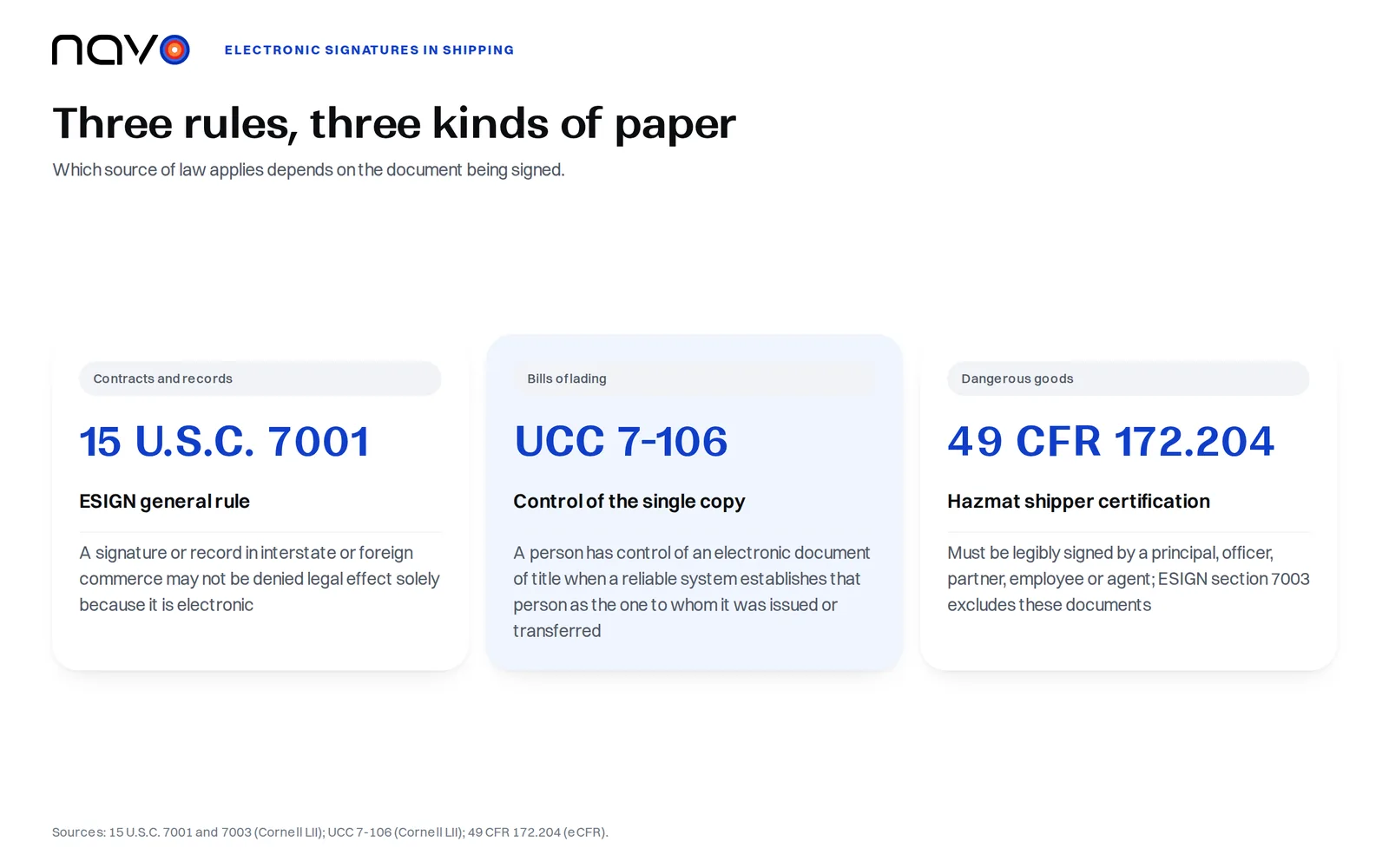
The ESIGN Act says a signature, contract or other record relating to a transaction in or affecting interstate or foreign commerce may not be denied legal effect solely because it is in electronic form. The same section says nothing in the subchapter requires a private party to agree to use or accept electronic records or electronic signatures.
A counterparty can still decline.
Section 7003 removes two groups that touch shipping. Records are out to the extent the Uniform Commercial Code governs them, apart from sections 1-107 and 1-206 and Articles 2 and 2A, and Article 7 on documents of title is not in that list. Any document required to accompany the transportation or handling of hazardous materials, pesticides or other toxic or dangerous materials is out too.
Control of the single copy
A negotiable bill of lading is a document of title, and the UCC defines the person entitled under such a document as its holder, which is a different matter from where the cargo is. The cargo side is covered by tracking a container by its bill of lading number alone.
For an electronic version, Section 7-106 of the Uniform Commercial Code gives a person control of an electronic document of title when a system reliably establishes that person as the one to whom it was issued or transferred. One of its tests is a single authoritative copy that is unique, identifiable and, with stated exceptions, unalterable.
The UK’s Electronic Trade Documents Act 2023 sets five requirements for the reliable system. It must identify the document so it can be told from copies, protect it against unauthorised alteration, make sure no more than one person controls it at a time, let the controller demonstrate that control, and make a transfer deprive the previous controller of it. Under section 3, in force since 20 September 2023, an electronic trade document has the same effect as its paper equivalent.
MSC launched its eBL in April 2021 after a two-year pilot in India, on the blockchain-based WAVE BL platform. In February 2023 it signed, with the eight other DCSA carriers, a commitment to issue 50% of bills of lading digitally within five years and 100% by 2030.
Dangerous goods: US rule and international codes
An electronic signature for shipping documents that carry dangerous goods is covered by separate rules. Under 49 CFR 172.204, the shipper’s certification on a hazardous materials shipping paper must be legibly signed by a principal, officer, partner, employee or agent. Paragraph (d) lets the certification be signed manually, by typewriter or by other mechanical means. For rail, the rule lists two routes. One is a verbal certification, which the carrier records with the date and the name of the person who gave it. The other is electronic: the field designated for the shipper’s signature is completed with the name of the offeror’s representative. ESIGN’s own exclusion in section 7003 covers these documents as well.
The international codes read differently.
Paragraph 5.4.1.6.2 of the IMDG Code allows an electronic signature, or the signatory’s name in capitals, when dangerous goods documentation reaches the carrier by EDP or EDI transmission. The 2017 edition of ADR, in 5.4.2.3, gives the same for the container or vehicle packing certificate.
Frequently asked questions
What counts as an electronic signature under US federal law?
The ESIGN Act defines it as an electronic sound, symbol or process attached to or logically associated with a contract or other record and executed or adopted by a person with the intent to sign the record. The intent to sign is part of the definition.
Which documents does the UK Electronic Trade Documents Act name as examples?
Section 1(2) lists a bill of exchange, a promissory note, a bill of lading, a ship's delivery order, a warehouse receipt, a mate's receipt, a marine insurance policy and a cargo insurance certificate as examples. To count as a paper trade document, the document must be in paper form, be of a type commonly used in trade or transport of goods or its financing, and require possession to claim performance of an obligation.
Does the UK Electronic Trade Documents Act reach bills of lading issued before it came into force?
No. Section 8(3) says sections 3 and 4 do not apply to a paper trade document or an electronic trade document issued before the day the Act came into force, which was 20 September 2023.