

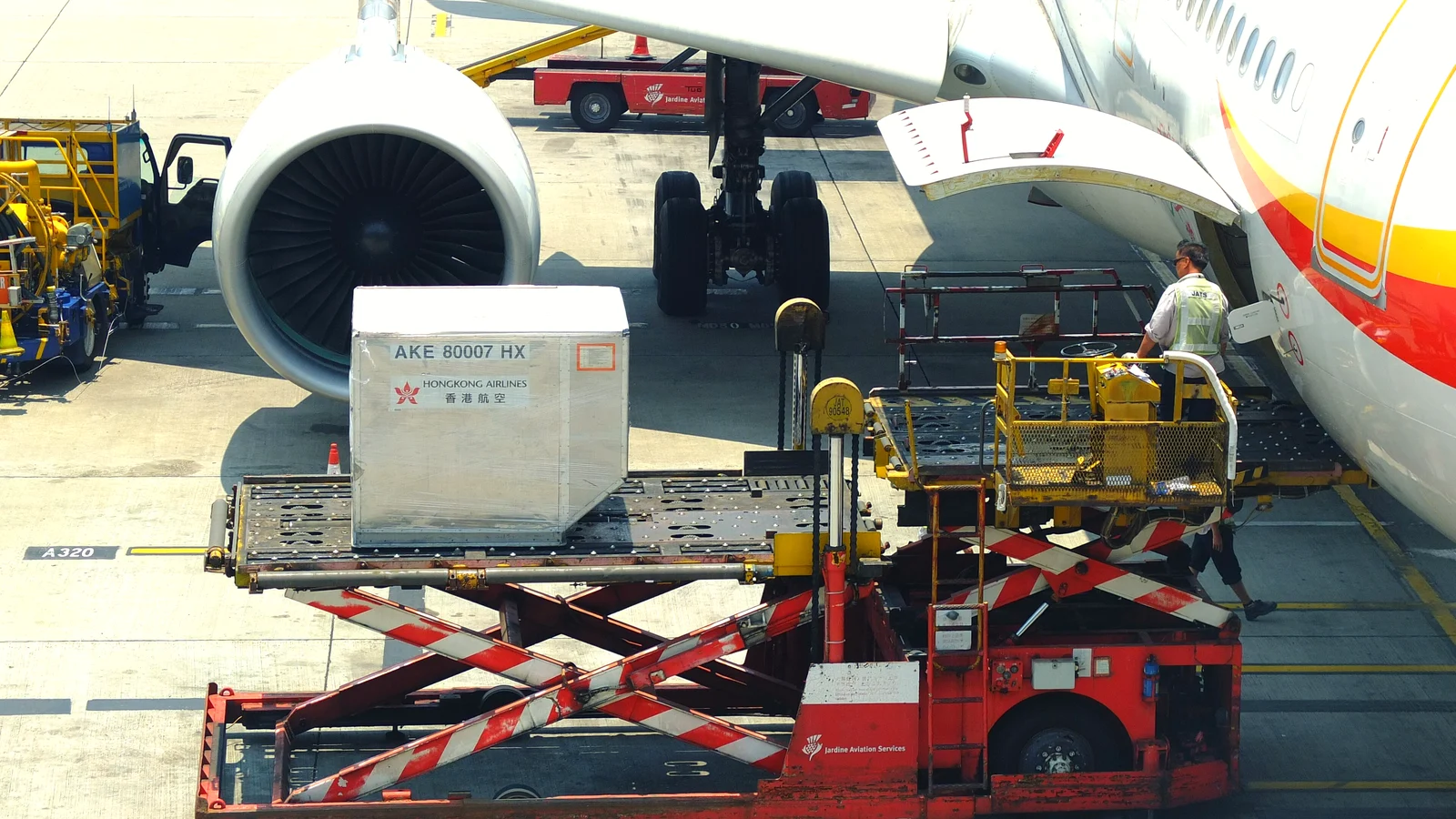
A power bank counts as a battery for IATA, so a carton of them ships as dangerous goods. Depending on the battery you add a mark, a label, a signed declaration, or all three. T-shirts are different. IATA lists textiles and most consumer goods as general cargo. Phones, tablets and laptops are the exception.
The air cargo types below change something on the shipper’s side: lithium batteries, cold-chain freight with dry ice, valuables and outsized pieces. Human remains, firearms and diplomatic consignments are not covered. Live animals get a pointer only. Their rulebook is the IATA Live Animals Regulations, and IATA says the current edition has been in effect since 1 January 2026.
Lithium batteries and the Shipper’s Declaration
Loose lithium-ion batteries (UN3480) are forbidden on passenger aircraft unless the relevant authorities approve it (Special Provision A201). Each package also carries a Cargo Aircraft Only label. That leaves a freighter. The numbers below come from IATA’s 2026 guidance document on lithium and sodium ion batteries, which follows the 67th edition of the Dangerous Goods Regulations (DGR). IATA labels the document guidance only. Check the DGR text before you ship.
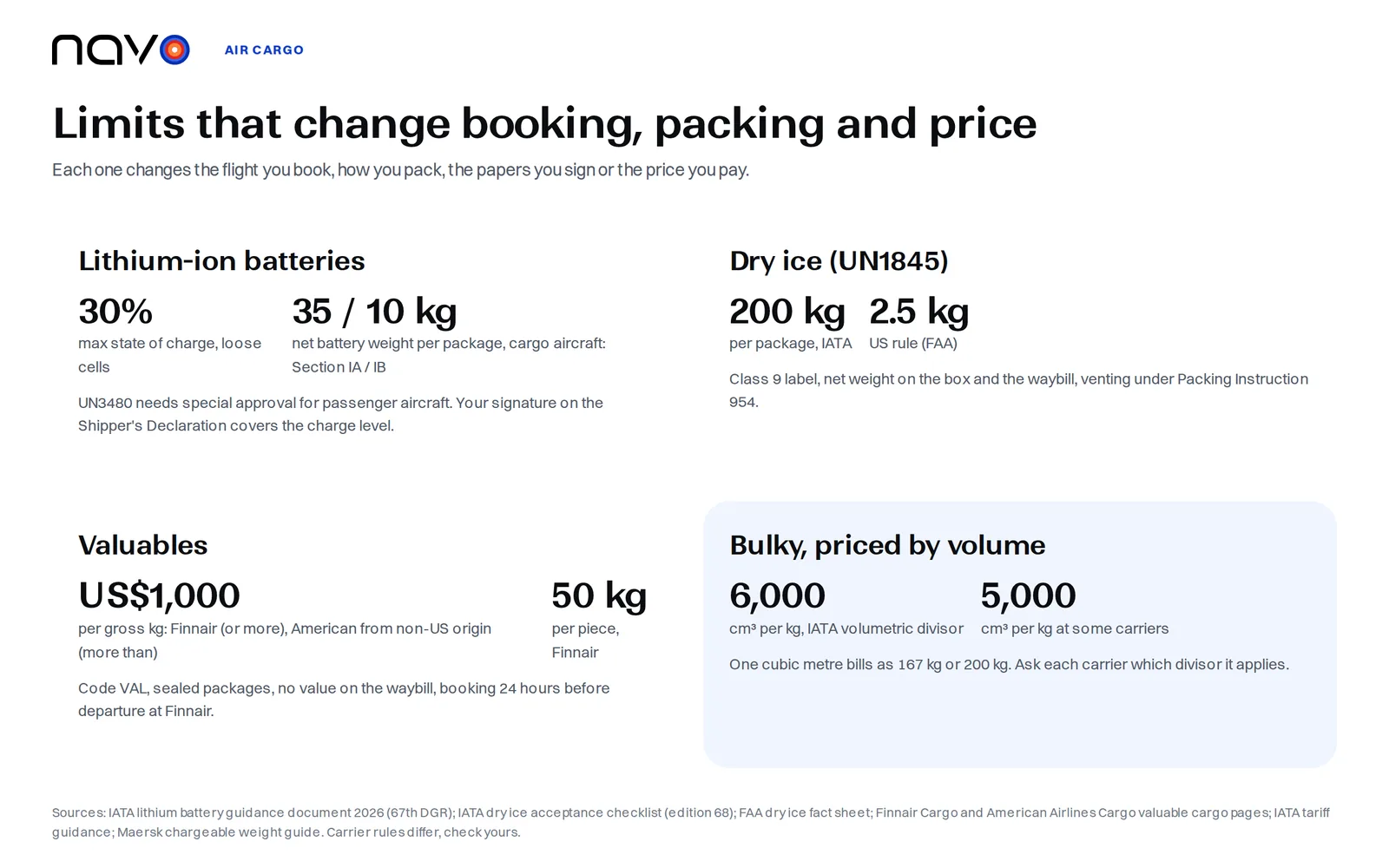
Loose lithium-ion batteries ship at 30% state of charge or lower. Anything above needs approval from the State of Origin and the State of the Operator under Special Provision A331. Your signature on the Shipper’s Declaration says the DGR are met, the 30% limit included. IATA calls that signature a legal statement.
Battery size sets how much goes in one package, and the limit counts the net weight of the batteries, not the carton. Cells above 20 Wh or batteries above 100 Wh (Section IA of Packing Instruction 965) have a table limit of 35 kg per package on a cargo aircraft. Smaller ones (Section IB) have 10 kg. For Section IB, IATA says the shipper needs dangerous goods training under DGR 1.5.
Batteries inside equipment can be lighter on paperwork. Under Section II of Packing Instruction 967, a package with no more than four cells or two batteries installed in equipment can go without the UN3481 battery mark. That holds only in a consignment of two packages or less. Send three packages and every package carries the mark. Section II also skips the formal course, but your packers still need “adequate instruction” under DGR 1.6. The employer documents what that covers.
A State or an operator may ask for the UN 38.3 test summary. Unless one does, it does not have to travel with the shipment. Keep it where you can email it in minutes anyway. Classification is your job too: IATA’s dangerous goods page puts it on the shipper. The 68th DGR edition carries the date 1 January 2027, so near that date ask your airline which edition it applies.
Pharma, perishables and dry ice
Healthcare cargo with a temperature range gets its own label. IATA’s pharma page says the Time and Temperature Sensitive Label has been mandatory since July 2012 on every healthcare shipment booked as time and temperature sensitive. You put it on, or your agent does if the service agreement names one. It shows the external temperature range for transport. Since July 2013 airlines and ground handlers also run IATA’s standard acceptance checklist on the shipment.
Dry ice brings dangerous goods rules into a cold-chain booking. It ships as UN1845, Class 9. Packed alone or with non-dangerous goods, it needs no Shipper’s Declaration. IATA’s acceptance checklist covers exactly that case. The handler goes through it line by line, and you can too before you pack. The published copy is the 68th edition and carries the date 1 January 2027, and the 67th edition in force today may word it differently.
The first four lines check the waybill: UN1845, the words “Carbon dioxide, solid” or “Dry ice”, the number of packages (unless they are the only packages in the consignment) and the net kilograms. The same name and weight go on the box, next to a Class 9 label. The box must vent (Packing Instruction 954). A package can hold 200 kg of dry ice at most, unless the dry ice travels in a ULD. Item 5 sends you to state and operator variations. One “No” and the handler turns the shipment away.
The US rule has a 2.5 kg line per package for refrigerant dry ice, which the FAA explains. Up to 2.5 kg the package still has to vent, with lighter markings. Past 2.5 kg the package is fully regulated, and hazmat training applies. The FAA says to settle it with the carrier before you ship, either way. IATA’s checklist has no 2.5 kg line, and neither does the copy of Packing Instruction 954 we checked (hosted on a third-party site, edition not stated). So before you pack, ask the carrier which rule it runs on your route.
The temperature logger in the box runs on a battery too. DGR 1.2.7.1(i) lets it travel outside the regulations while it is in use or intended for use during transport. The caps: 20 Wh for lithium-ion, 1 g of lithium for lithium metal, and the cell or battery has to meet the rule’s test provisions. A bigger cell loses the exception. The logger then moves under the packing instructions, which have their own allowance for active loggers.
Two IATA manuals cover the rest of the cold chain: the Perishable Cargo Regulations for food and flowers, the Temperature Control Regulations for pharma. Both carry operator variations. Check what your carrier changes. CEIV Pharma certifies a company’s facilities, equipment, operations and staff. IATA lists certified companies in its One Source registry. At booking, ask whether your forwarder, airline and handlers appear there.
Space is the other half of a cold-chain booking. C.H. Robinson’s October 2026 air freight update makes the point: passenger bellies carry plenty of general freight but cannot replace freighters for every commodity. Among the air cargo types, oversized, dense, temperature-controlled and some hazardous freight can lean on the main deck. There is less of it. The same update says airlines often shift aircraft, schedules and allocations toward the lanes with the strongest bookings, and it describes this for the Asia peak. A lane can look loose and still leave a pharma pallet with few options.
Look at the buyers’ side. Xeneta put September 2026 demand up 6% on a year earlier, with capacity up 2%. The global spot rate was $3.10 per kg, up 27%. Of the new contracts that started in the third quarter, 60% ran three months or less. A year earlier it was 25%.
An average like that says little about your lane, so ask the forwarder one question: is the space confirmed on this departure, or only quoted? Line up a second carrier and a second gateway before cutoffs move. C.H. Robinson says the same. DHL, for one, put a dedicated Boeing 777 freighter on Brussels to Cincinnati in 2026 and calls it consistent capacity on a pharma lane.
Valuable cargo
Each airline draws its own line for valuable cargo. At Finnair Cargo it is a declared value of US$1,000 or more per gross kilogram (GBP 450 or more in the United Kingdom). American Airlines Cargo says more than US$1,000 per gross kilogram on cargo that originates outside the US (GBP 450 for the UK) or leaves the US or Canada. Within or between the US and Canada the line is a declared value of US$10,000 or more. American also counts bullion, currency, jewelry other than costume jewelry, watches and works of art as valuable at any declared value.
On your side this is packing and paperwork. Finnair wants the handling code VAL and the words “Valuable Cargo” on the air waybill, with no value written on it. Seal each package so tampering shows. Nothing on the outside may hint at the contents. Finnair caps a piece at 50 kg, with bigger shipments on request, and the booking has to be in 24 hours before departure. It accepts valuables on certified routings and not on a road feeder service. In a consolidated shipment loaded in a ULD, it accepts them only when the whole shipment is valuable cargo.
American Airlines refuses a high value shipment more than three hours before departure and wants sealed containers of at least 1,728 cubic inches. It also asks for your written promise that the consignee will collect within three hours of arrival. If nobody shows up, American may hire an armored vehicle and bill the shipment.
Outsized pieces, ULDs and chargeable weight
Whether a piece flies at all depends on the aircraft. Take the 747-8F. Main-deck pallets on it reach 118 in (3.0 m) in height, according to Atlas Air’s specification sheet. The side door opens 120 in by 134 in (3.05 m by 3.40 m), per Boeing’s airport planning document, and Atlas gives 134 in as the width. The nose door trades height for width. Atlas lists 147 in of width at 30 in of height and only 106 in at 96 in. That is one aircraft type. Use the numbers as an example and measure your own piece.
Pallets and containers are scarce too, and the shipper can end up holding one. Build a load off-airport on an airline’s ULD and you hold the airline’s equipment. Cargolux’s conditions for ULD use are a public example. The customer returns the unit within five days of release. Daily demurrage starts on day six, weekends included. The January 2021 annex lists EUR 5.94 a day for a PMC pallet with net and EUR 60.54 for an AMD container. Cargolux may update the annex yearly. Past 180 days a missing unit counts as lost, and the bill is replacement cost: EUR 1,069 for that PMC. “Customer” in the text covers the shipper, the consignee and the forwarder.
Other airlines write their own terms, and many charge nothing. ULD CARE runs a system its member airlines use to bill each other for ULDs. Its 2022 white paper says nearly all airlines let third parties return equipment with no penalty. It also cites anecdotal evidence that up to 10% of an airline’s ULDs may be unavailable because they sit off-airport. Get the free period and the daily rate in writing before you accept a unit.
Airlines bill the larger of real weight and volumetric weight. That is the chargeable weight. IATA’s tariff guidance states the general rule: cubic centimetres divided by 6,000 give volumetric kilograms. Maersk says some carriers divide by 5,000 instead.
Take a Euro pallet. The standard EPAL footprint is 1,200 by 800 mm. Assume the stack reaches 1.0 m: 120 x 80 x 100 cm, or 960,000 cm3. Divided by 6,000 it bills as 160 kg, and a scale reading below that changes nothing. Divided by 5,000 it bills as 192 kg. Put Xeneta’s September 2026 global spot average of $3.10 per kg on the 32 kg difference and one pallet costs about $99 more. Your lane’s rate will differ. At 90 cm the 6,000 figure is 144 kg.
After booking, put the 11-digit air waybill number into Navo to track air cargo by status, route, flights, pieces and weight.
Frequently asked questions
The safety data sheet from my supplier does not say whether the product is dangerous goods. What now?
Do not guess from the sheet. IATA notes that many safety data sheets lack an accurate classification for transport. It says to ask the manufacturer or distributor, or to have the product tested by an authorized laboratory. Settle that before you book.
How do I know my batteries meet UN 38.3?
Ask the manufacturer or distributor for recent production information. IATA says it may be on their corporate website, in product data sheets or through their technical support lines.
Our forwarder builds the pallet on an airline ULD at our warehouse. Who is liable if it comes back late?
It depends on the airline's terms. The IATA ULD Control Receipt, as ULD CARE quotes it, makes the receiving party liable once the time in the applicable tariff has passed. Cargolux's conditions put it on the customer. Ask who signs for the unit and whether the contract passes the charge on to you.