






















McKinsey’s US consumer survey ranked speed as the top delivery priority in 2022. In the 2024 round it had dropped to fifth place, behind cost, which now ranks first. Fewer than 5 percent of respondents, in a sample of more than 1,000, would take the fastest option regardless of price. Other surveys weight what customers want from delivery differently. Bringg’s puts a kept date ahead of delivery costs. Radial’s, which asked how shoppers choose direct-to-consumer brands, puts speed first, then product availability and easy returns.
Shoppers trade speed for a free shipping label
When people have to choose, price wins. Over 95 percent of McKinsey’s respondents wanted free standard shipping rather than paid expedited shipping, and over 80 percent would still buy if free delivery took four to seven days. About half would not pay for shipping at any speed. Over 90 percent said they were likely to abandon an online purchase over high shipping costs.
Speed still counts. AlixPartners’ 2026 U.S. home delivery survey, reported by Logistics Management in June, puts the expected wait for free delivery at 2.7 days on average, down from 3.5 days or more in earlier years. Grocery is at 0.9 days and large general merchandise at 3.2. AlixPartners estimates that over 20 percent of demand is at risk when a retailer misses that expectation.
Read side by side, the 2024 McKinsey results and the 2026 AlixPartners figures suggest shoppers accept a slower option when it is free, while the expected wait for free delivery has shortened. That is a reading across two surveys, not a finding of either.
On-time delivery ranks above fast delivery
McKinsey’s respondents rated on-time delivery above fast delivery. They said a week’s wait was fine as long as the parcel showed up when promised. Parcels did get quicker, with average delivery time dropping from 6.6 days in early 2020 to 4.2 days by the second quarter of 2023. But before the pandemic about 85 to 90 percent of last-mile shipments met their first estimated date, and in May 2020 only 72 percent or so did. Things have improved since, though not fully. McKinsey puts it down partly to tighter promised windows and a more varied mix of products.
A miss of a day or two is mostly forgiven: about 85 percent of respondents would not call such an order unacceptably late. Lateness has a separate cost. In a Q3 2025 survey of 1,000 US online shoppers commissioned by the last-mile software vendor Bringg, 35 percent said they permanently abandon a retailer after a late delivery. The two surveys ask different questions, so the figures are not a before-and-after pair.
Half of McKinsey’s respondents check on their orders to see whether a shipment is on schedule, so a promised date gets tested. A retailer that imports its stock can follow the inbound container in Navo’s tracking tool before it commits to a date.
Returns are judged at checkout
An inflexible return policy sends carts away: more than 65 percent of McKinsey’s respondents said they were likely to abandon one when it applied, with final-sale items as the example. Radial, a fulfillment provider, found a related result in its March 2025 survey of 1,000 US consumers, run through Dynata. Easy or free returns influenced 63 percent of those choosing direct-to-consumer and modern brands.
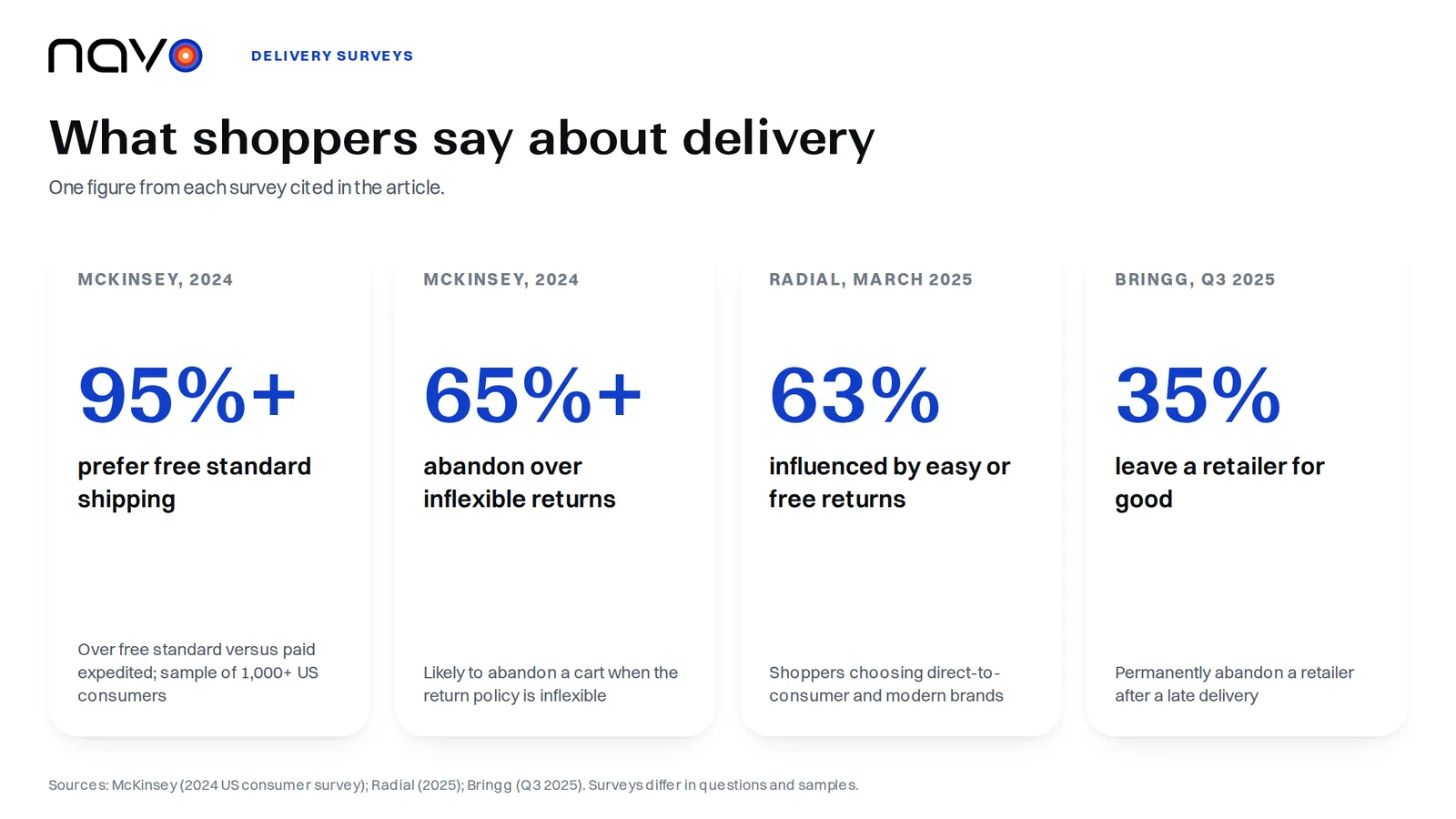
Surveys disagree on how far returns drive behavior. Bringg’s Q3 2025 study found that 63 percent of shoppers value easy returns, but only 11 percent say return policies lead them to abandon a brand. Bringg also found that 69 percent rate low or free shipping as important and only 31 percent would abandon a cart if it is not offered. McKinsey asked about abandonment over high shipping costs instead. Bringg reports that on-time arrival outweighs delivery costs for its respondents, while Radial’s respondents put delivery speed first. The surveys differ in wording and sample, and the ranking depends on the question asked.
Nearly 40 percent of Radial’s respondents had stopped buying from a direct-to-consumer brand they liked because of fulfillment problems. Radial’s list of causes includes stockouts, unexpected fees (30 percent), shipping delays (29 percent) and return friction (24 percent).
Amazon Day: choosing the delivery day
Amazon Day is a free Prime option shown at checkout for eligible items: the buyer chooses a day of the week for orders to arrive, and the option lets buyers combine multiple orders into one delivery. Amazon says that in 2024 Amazon Day orders used 20 percent fewer boxes on average and caused lower carbon emissions than its other delivery options. That figure is Amazon’s own.
What customers want from delivery includes some say over timing, and not only at Amazon. More than half of McKinsey’s respondents say being able to schedule deliveries is important, about 70 percent of urban ones value choosing a delivery time, and roughly 45 percent of urban shoppers have orders sent to a workplace, a store or a locker.
Sustainability ranks comparatively lower in McKinsey’s results. Even so, over 35 percent of respondents would pay one to two dollars more for greener shipping, and over 55 percent of 18- to 34-year-olds say so.
Frequently asked questions
Will rural shoppers wait longer for an order?
Many will, if the shipping is free. In McKinsey's 2024 survey of more than 1,000 US consumers, more than 55 percent of rural respondents were willing to wait seven days or more for delivery as long as shipping cost nothing. McKinsey says this is possibly because quick shipping options have historically been limited in more remote zip codes.
What did McKinsey forecast for US e-commerce growth?
In its February 2025 report, McKinsey said US e-commerce sales grew 18 percent a year between 2019 and 2023. Its analysis suggested growth could normalize at roughly 6 percent a year, closer to prepandemic levels. It added that this is a good time to reassess the landscape for e-commerce deliveries. That is a forecast from early 2025.
Do older shoppers pay for two-day shipping?
Mostly no. In the McKinsey survey, more than 80 percent of consumers aged 55 and over said they will not pay for two-day shipping. Across all ages, about 50 percent said they are unwilling to pay anything for shipping regardless of delivery speed.