





















A September 2020 SeaRates post on seafarer safety said 151 crew were abducted in 2019 and two died. The International Maritime Bureau’s 2019 annual report counts 134 crew kidnapped and one person killed.
The number 151 does appear in IMB data, under other headings. It is the 2016 hostage count in Table 8 of the 2019 report. In Gard’s summary of the 2025 report it is the number of crew directly affected in 2024. Counts of maritime piracy depend on what is being counted.
The 2019 count: 134 crew kidnapped, 121 in one gulf
Maritime piracy in 2019, by the IMB’s count, meant 162 incidents, down from 201 in 2018. Four vessels were hijacked, 130 boarded, 17 reported attempts and 11 fired upon. Kidnapping stood out: 134 crew, of whom 121 were taken in the Gulf of Guinea, up from 78 the year before. That is over 90% of crew kidnappings worldwide. Table 8 adds 59 hostages and one person killed. The IMB noted that late reports could still raise the count.
Two cases. On 2 January 2019 the Panama-flagged container ship MSC Mandy was boarded about 55 nautical miles south of Cotonou, Benin, and six crew were kidnapped. The rest of the crew sailed to port, and the six were released safely.
On 3 February 2019 five armed men in a speedboat chased and boarded a landing craft about 136 nautical miles southwest of Brass, Nigeria. Three crew were taken.
2025: fewer kidnappings, more incidents, the Straits take over
The 2025 IMB report counts 137 incidents, against 116 in 2024 and 120 in 2023. Crew kidnapped came to 25, down from 134 in 2019 but up from 12 in 2024, and 46 crew were taken hostage, against 59 in 2019. The Gulf of Guinea logged 21 incidents, and 23 of the 25 kidnapped crew were taken there in four separate incidents.
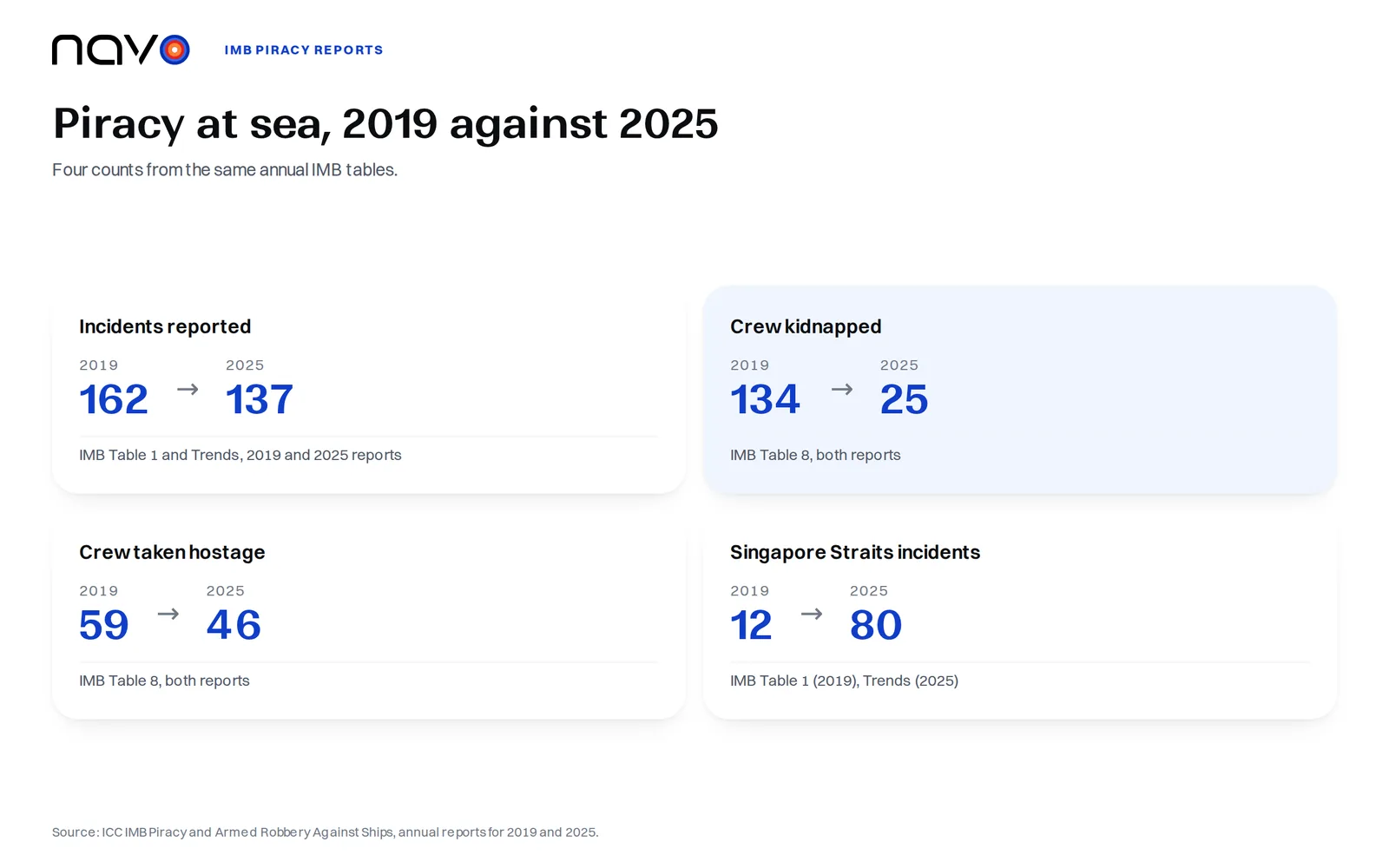
The growth sits in the Singapore Straits: 80 incidents in 2025 against 43 in 2024 and 12 in 2019, over 58 percent of everything reported worldwide. The IMB still calls them low level and opportunistic, yet guns were reported 27 times, up from eight in 2024, and 14 crew were taken hostage. Reports fell in the last two quarters of 2025, after the Indonesian Marine Police arrested two gangs in July.
On 28 January 2025 the duty crew of the tanker Bristol, underway in the Singapore Straits, saw a wooden boat approach and hook a ladder onto the ship. Three men with long knives climbed aboard.
ReCAAP, the Asian regional cooperation agreement, reports 132 incidents in Asia in 2025, up 23% from 107 in 2024. It puts the Straits of Malacca and Singapore together at about 82% of them, with most cases opportunistic boarding and theft of engine spares and ship’s stores, most often between midnight and 5 a.m. ReCAAP counts all of Asia, while the IMB figure covers one waterway, so the two totals do not match and should not be added or compared line by line.
A shipper whose box rides a vessel crossing the Straits can watch the AIS position and ETA in container tracking, together with port congestion at the discharge port, so a slipping arrival comes with a reason.
Checking the 2020 post against the reports
The ladder boardings the post describes are in the reports. On 21 July 2019 seven pirates in a small speedboat boarded a bulk carrier underway near Pulau Damar using a ladder attached with a hook, and the 2025 report has the Bristol case above. Mother vessels turn up for Somalia: on 3 November 2025 a skiff turned back toward its mother vessel after the ship’s security team fired warning shots. The IMB notes that Somali pirates sometimes use skiffs launched from mother vessels, and that past incidents were recorded over 1000 nautical miles from the Somali coast.
Two claims from the 2020 post, ransom up over 300% and anchorages as the main kidnapping hotspot, are not backed by the IMB reports, Gard or ReCAAP: none gives a ransom figure, and none ranks anchorages as the main hotspot, though anchorage kidnappings do happen: on 2 November 2019 armed men boarded the bulk carrier Bonita at anchor about 9 nautical miles southeast of Cotonou and took nine crew, and the owners confirmed their release on 12 December.
The post also put a 120 nautical mile range in the years before 2010. The IMB reports give longer distances but no years: incidents off Nigeria up to about 170 nautical miles from the coast in the 2019 report, and up to 300 in the 2025 one.
The cyber paragraph of the 2020 post joins two separate stories. The pirates-and-hackers link comes from a Maritime Executive case study of 2 March 2016: Verizon investigated a shipping company whose server had been hacked, and pirates used the stolen bills of lading to pick out specific crates and the vessels carrying them.
The Coast Guard alert is a different event. Marine Safety Alert 06-19 of 8 July 2019 covers a deep draft vessel bound for the Port of New York and New Jersey, which reported a significant cyber incident in February 2019. Malware degraded the onboard computer system. Essential vessel control systems were not affected. No effective cybersecurity measures were in place, and one network carried electronic charts, cargo data and messages to pilots, agents and the Coast Guard.
The alert names no attacker and links the incident to no pirates. One practice stood out: cargo data was routinely moved at the pier on USB drives, and the drives went into the ship’s computers without a malware scan. Marine Safety Information Bulletin 04-19 also covers phishing attempts against commercial vessels.
What the Coast Guard and the IMB recommend
Both IMB reports give a ship heading into Somali waters the same instruction: register and report the vessel under the industry Best Management Practices procedures (BMP 5 in the 2019 report), harden the vessel before the high-risk area, and keep a 24-hour visual and radar watch.
The Coast Guard, after the New York incident, strongly recommends five basic measures to vessel and facility operators. The five are network segmentation, a personal login for each person, scanning external media such as USB drives on a standalone system, basic antivirus software and regular patching, and the alert gives them to operators of vessels and facilities rather than to cargo owners.
Frequently asked questions
How far from the Somali coast was a ship boarded in 2025?
The IMB reports that on 6 November 2025 a product tanker was boarded about 560 nautical miles from Eyl. Three days earlier a chemical tanker had been fired upon about 330 nautical miles east-southeast of Mogadishu.
Which ships were targeted in the Singapore Straits in 2025?
The IMB reports that 21 large vessels over 100,000 DWT were targeted, including two crude oil tankers over 300,000 DWT, and that 19 of these were successfully boarded, though the report does not say whether these means the 21 vessels or the two tankers.
When should a master report an incident to the IMB?
Immediately. The IMB's 2025 report noted several cases of late reporting and urged masters to report every incident as it happens, so safety information can reach other vessels quickly.