






















Shawn Montgomery’s tractor-trailer was stopped on the side of an Illinois road when another truck, driven by Yosniel Varela-Mojena, hit it. The court record says Montgomery’s leg had to be amputated, and that he suffered other severe and permanent injuries.
Varela-Mojena drove for Caribe Transport II, a motor carrier. The load had been coordinated by C.H. Robinson Worldwide, a broker. Montgomery sued the driver, the carrier, the broker and companies tied to them. One claim reached the Supreme Court: that the broker negligently hired an unsafe carrier. The District Court and the Seventh Circuit both held that federal law kept that claim out of court. In 2026 a unanimous Supreme Court disagreed and sent the case back.
The Court decided only that the claim is not preempted by the Federal Aviation Administration Authorization Act (FAAAA). Whether C.H. Robinson did anything wrong is untried. On the older freight forwarder vs freight broker question that every shipper meets, the Montgomery opinion sets no test: when a company sells you a move, which one is it in law? The Eleventh Circuit’s Essex decision drew the neighboring line, between a carrier and a broker.
Two separate statutory definitions
A broker, under 49 U.S.C. 13102, is a person other than a motor carrier or an employee or agent of a motor carrier that sells, offers for sale, negotiates for, or holds itself out as selling, providing or arranging for, transportation by motor carrier for compensation. The definition turns on selling and arranging.
A freight forwarder is defined differently. In the ordinary course of its business it holds itself out to the general public, assembles and consolidates shipments, and assumes responsibility for the transportation from the place of receipt to the place of destination, using a carrier for some part of the trip. All three conditions must hold, including that the company takes responsibility for the whole trip.
The same section defines “carrier” as a motor carrier, a water carrier, and a freight forwarder. A broker is not on that list.
Why that list matters when cargo goes missing
The cargo-claim rule, 49 U.S.C. 14706, makes carriers liable to the person entitled to recover under the receipt or bill of lading for the actual loss or injury to the property. For a freight forwarder it adds that the forwarder is both the receiving and the delivering carrier. Within that domestic regime, which covers carriers under subchapters I and III of chapter 135 of Title 49, a shipper with a damaged pallet has a statutory defendant in the forwarder, within any liability limit the shipper agreed in writing.
The provision names carriers and forwarders and does not mention brokers. One court addressed that gap. In Essex Insurance v. Barrett Moving & Storage (11th Cir. 2018), the Eleventh Circuit held that a company can insulate itself from strict carrier liability for a shipment by making clear in writing that it is merely a go-between. Without such a writing, the court looks at how the company held itself out, its dealings with the shipper, and who the parties understood would take responsibility for delivery. A party that agreed to accept legal responsibility for the shipment is not a broker. That is circuit case law, and it turns on the facts of each shipment. Montgomery’s claim was about the choice of carrier, a state-law tort, and the Supreme Court’s answer concerned whether the FAAAA’s safety exception leaves states room for such claims, and the Court said it does.
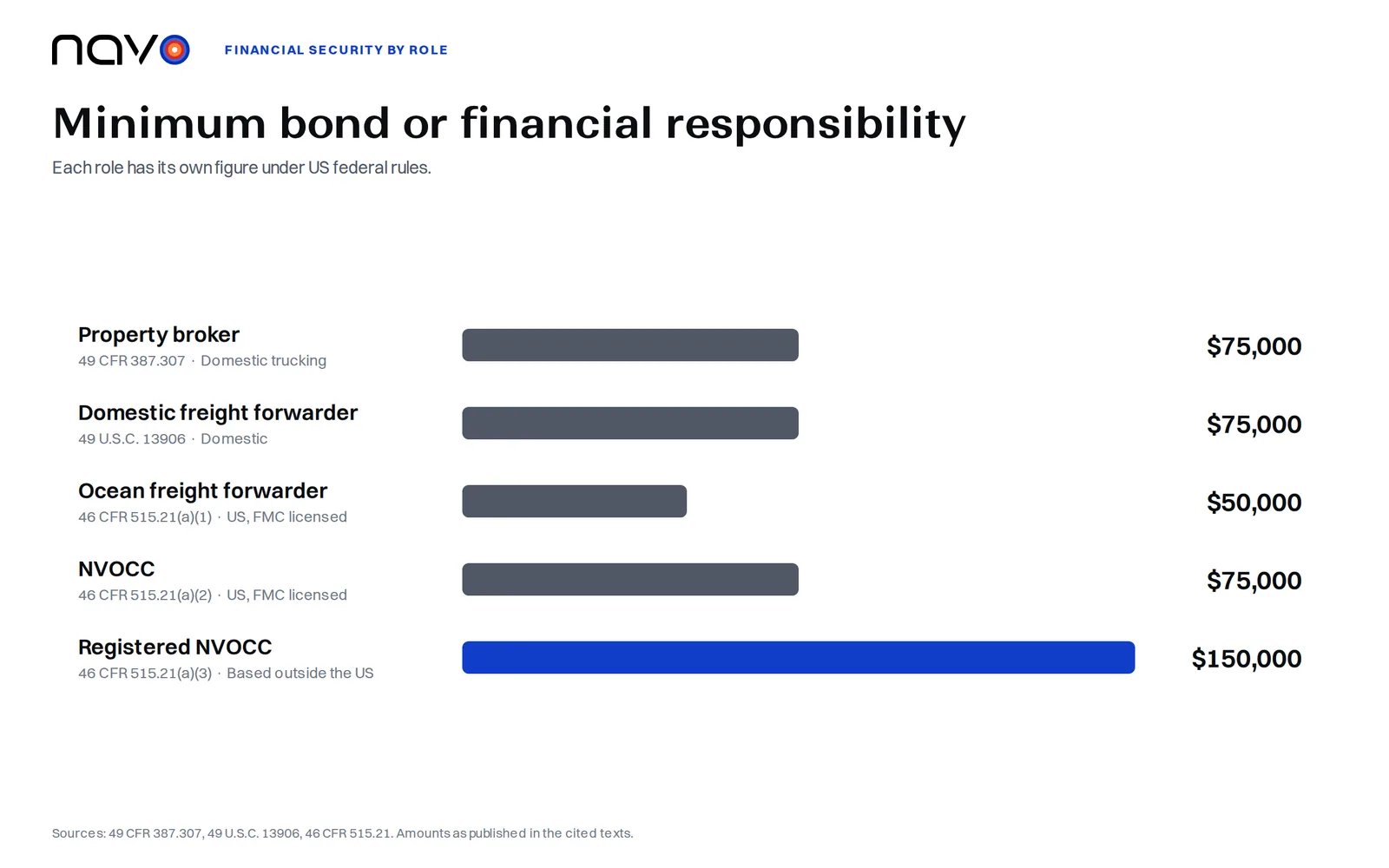
A domestic broker and a domestic forwarder both must show $75,000 of financial security, and the ocean roles differ. A property broker must hold a surety bond or trust fund of $75,000, which pays shippers or motor carriers if the broker fails to carry out its arrangements, and 49 U.S.C. 13906 sets the same $75,000 for a domestic freight forwarder. Ocean freight is regulated separately: under 46 CFR 515.21 a US ocean freight forwarder furnishes $50,000 of financial responsibility and a US NVOCC $75,000.
Which of the two is your ocean booking agent?
Possibly neither. 46 CFR 515.2 defines an ocean freight forwarder as a person who dispatches shipments from the United States on a common carrier, books space for them and processes the documentation, and an NVOCC as a common carrier that does not operate the vessels and is a shipper in its dealings with an ocean carrier. The shipping agent, forwarder and NVOCC comparison on this blog walks through the tasks and documents of each role.
Many people follow cargo by bill of lading number, and one bill of lading can carry several boxes. In a pull from the Navo tracking API on 16 November 2026, 254 of the 304 bill-of-lading entries returned child container numbers. Most listed one or two boxes, and at least 19 listed five or more. The pull does not show which numbers were a carrier’s own and which a forwarder’s house number. If you follow cargo by bill of lading number, check who issued the document before you rely on the status.
What the label does not settle
The remand means nobody has yet found that a broker’s hiring choice caused harm in this case. The federal rule at 49 CFR 371.2 says a motor carrier authorized to transport a shipment that has accepted and legally bound itself to transport it is not a broker for it, and the Essex court called the analysis case-specific, so the freight forwarder vs freight broker label on a website does not settle it. Check the document you actually hold: the carrier named on the bill of lading, the registration behind it, and the bond on file with the regulator.
This article is general information, not legal advice. For a specific shipment or claim, ask a transport lawyer.
Frequently asked questions
Is a carrier's own sales agent a freight broker?
Not if the person is a bona fide agent. Under 49 CFR 371.2 that means someone who is part of the carrier's normal organization, works under the carrier's direction on a preexisting continuing agreement, and has no discretion to allocate loads between the carrier and others. Such agents are not brokers when they arrange shipments the carrier is authorized to transport and has legally bound itself to transport.
Which forms prove a US broker's financial security?
A surety bond is filed on Form BMC-84 and a trust fund on BMC-85. Either one has to be in effect before FMCSA registers the broker.
Is an NVOCC closer to a broker or to a forwarder?
Neither, strictly. The Federal Maritime Commission (FMC) defines it separately. An NVOCC is a common carrier that does not operate the vessels, and a registered NVOCC, one based outside the United States that registers instead of getting a license, must furnish $150,000 under 46 CFR 515.21(a)(3). Ask which kind your NVOCC is before you read its bond as a measure of risk.