





















In 2022 the American Trucking Associations illustrated truckload turnover with a driver four months into a job who can jump to another carrier for a $15,000 sign-on bonus and a raise, then do it again six months later. ATA’s point was that, in a tight labor market, carriers compete for the same limited pool of drivers. Logistics employee retention has to work in that market. The published cases below show what a few operators changed.
Where the drivers go
ATA says its truckload turnover figure more accurately measures drivers moving between carriers than drivers leaving trucking, since retirements and exits are a small part of it, and that a tight labor market pushes it up. The same piece reports weekly earnings for long-haul truckload drivers up more than 25 percent between the start of 2019 and March 2022.
The split by fleet type is old data, from 2015, and Costello said it may come from a variety of factors. In the third quarter of 2015 large truckload carriers reached 100 percent turnover, the first time since 2011. Small fleets under $30 million in revenue stood at 68 percent and LTL carriers at 10. ATA chief economist Bob Costello called it one data point. TruckersReport attributed the LTL result largely to more home time, fixed routes and consistent schedules.
A signing on the warehouse floor
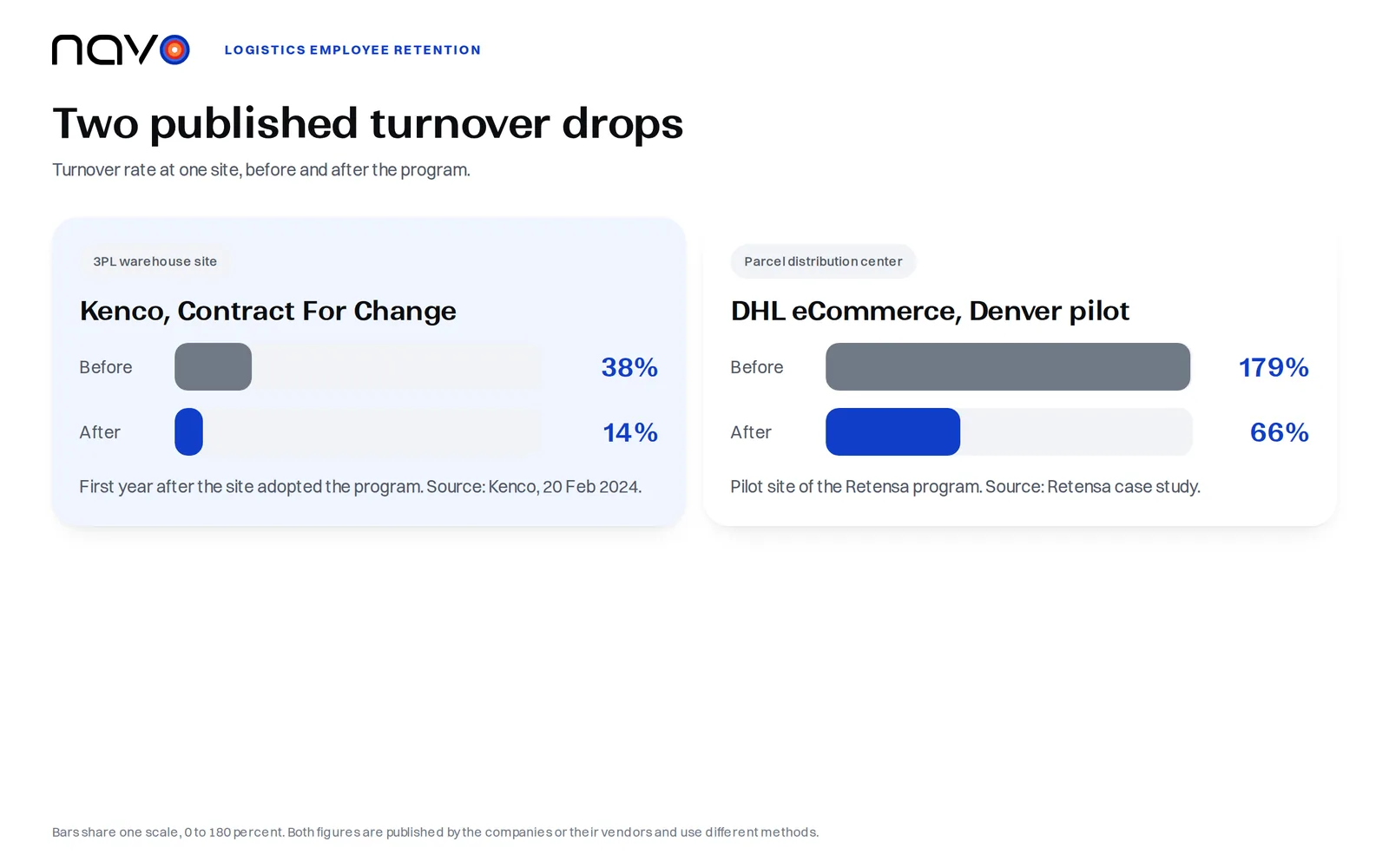
Kenco, a third-party logistics provider, runs a program called Contract For Change for operations with consistent performance issues. It begins by identifying areas of concern. Leaders join a steering committee, the desired results are documented, and the facility holds a signing to mark the turning point. Weekly meetings carry on from there. One site went from 38 percent turnover to 14 in its first year, Kenco wrote in February 2024, without saying which one.
Kenco also holds a three-year agreement with Gallup for the 12-question engagement survey. Afterwards each supervisor sits down with associates and walks through the answers (Kenco calls this impact planning). Skip that talk, and the survey only lets people express their feelings, the post says.
Recognition has its own evidence, and the study is not specific to logistics. Gallup and Workhuman tracked the career paths of nearly 3,500 employees from 2022 to 2024, and employees who were well recognized were 45 percent less likely to have turned over after two years. Gallup’s 2016 article on recognition recommends giving it every seven days.
Three vendors, three yardsticks
The next cases come from vendors writing about their own clients, so read the figures as claims.
After COVID, turnover at some of DHL eCommerce’s 20-plus North American distribution centers reached as high as 180 percent. Retensa’s case study picks Denver as the pilot. There it lists turnover falling from 179 percent to 66 and a saving of $532,641 a year. Across the network it reports a 50 percent reduction and $24.97 million a year. Retensa analyzed exit interviews, ran on-site interviews, focus groups and surveys, trained leaders and made scheduling improvements.
GEODIS employs more than 46,000 people and serves 168 countries. WorkStep reports that regular check-ins with its hourly staff began at four campuses and spread nationwide within three months. In 2022 workforce turnover fell 22 percent in relative terms and new-hire retention rose 9 percent. Facility leaders acted on what the check-ins said.
Kelly Services describes a US transportation and logistics company, unnamed (the page also calls it a manufacturer), where turnover cost about $12 million in 2020. Pay rose $5 an hour. Kelly replaced an unpopular attendance policy with a rewards system and put worker advocates on site. The study says turnover fell 12 percent, and elsewhere calls it a 12 percent retention gain in three months, so the metric is unclear.
The yardsticks differ (63 percent at one pilot, 22 relative, 12 in a quarter), so nobody can add them up. In every case of logistics employee retention here, the source describes a change employees could see: a signed plan with weekly meetings, scheduling improvements, a different attendance rule, a pay rise. Retensa and WorkStep also describe asking staff for feedback first. Teams that spend shifts on container status checks have one option on the tooling side, Navo’s container tracking API, a single API for 240+ carriers.
Frequently asked questions
What does it cost to replace a frontline logistics worker?
Gallup puts the replacement cost of a frontline employee at about 40% of salary, against 80% for technical roles and 200% for managers and leaders. The estimate leaves out lost morale and lost knowledge, so the real bill is higher.
How engaged were GEODIS frontline staff in the WorkStep program?
WorkStep says frontline engagement at GEODIS ran 8% above industry benchmarks and 80% of HR and operations leaders were actively engaged with the platform.
How fast did Kelly staff up at the logistics client?
Kelly says it hired 30 people in the first week of the program and delivered 60 in three weeks, using a streamlined screening process.