





















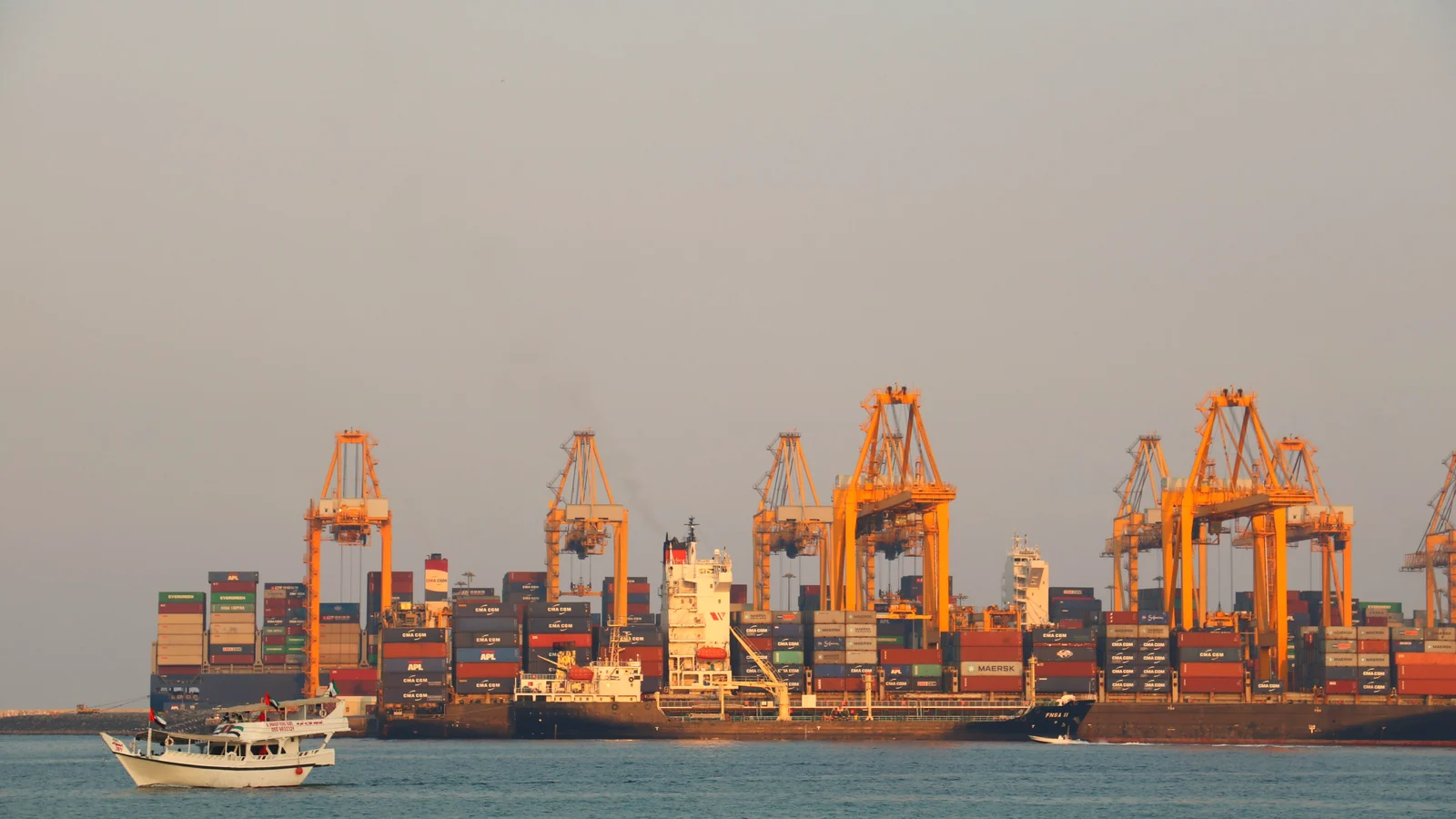
Navo’s tracker held 36 containers on their way to Fujairah and Khor Fakkan when we queried it on 10 November, a snapshot of how Strait of Hormuz shipping looks from inside the UAE east-coast lane. For 33 of them the ETA carried a flag for congestion at the next port. The Joint Maritime Information Center’s 8 November update shows the scale of the queue: about 162 vessels sit at anchor near the two ports, and it expects the queue to persist.
Nine COSCO boxes and an 11-day gap
Nine COSCO containers from Shanghai and Qingdao are heading for Fujairah, and the carrier gives them 15 or 16 November. Navo’s own date for them is 26 or 27 November. The difference comes from the lane’s record: 62 earlier observations over 365 days, none on time, with a median delay of 285 hours, about 12 days. Two of the nine rest on a second lane record, 101 observations and a 246-hour median. Confidence in the carrier’s date is 5 to 6%. Five of the nine have already been moved to a different vessel after loading.
Eight more boxes were due to leave Shanghai on 10 November. COSCO quotes 3 December for them, Navo expects 14 December.
China United Lines, which serves Khor Fakkan in the same data, looks calmer. Ten of its boxes have waited at Kandla in India since 8 November, with a carrier ETA of 14 November and a Navo date of 17 November. That is a three-day gap.
Boxes that landed and stayed
Eleven China United Lines containers were due at Khor Fakkan on 27 October. They came off the ship between 29 October and 1 November, 1.6 to 4.6 days late. Two have been delivered. Nine are still marked discharged. Across Khor Fakkan the tracker flags 10 boxes, 9 of them China United Lines, as a possible silent customs hold: discharged three or more days ago, not released for pickup. That flag is Navo’s inference, not a carrier statement.
Kuehne+Nagel’s port update for 27 October to 3 November puts the average vessel wait at 7.25 days in Khor Fakkan and 8.86 days in Fujairah (the Fujairah figure covers the past seven days). Terminal transfers from both ports to Jebel Ali, Sharjah and Abu Dhabi take about 12 to 15 days, against around five before. A box that has landed is therefore not yet delivered.
How the expected date is built
Strait of Hormuz shipping makes carrier dates unreliable, so Navo does not copy them. For each box the API returns the carrier’s ETA, the history of that carrier on that lane over the past 365 days, and the median delay from that history. COSCO’s Fujairah lane record has 62 observations, a median delay of 285 hours and a 90th-percentile delay of 285 hours as well. The carrier ETA for container CSCU7927172 is 15 November at 04:00, and 285 hours later is 27 November at 01:00, which is the date Navo shows.
Two limits. A lane record only knows what happened before, so it cannot tell whether the queue starts to clear next week. And 36 containers are the part of the market that passed through our tracker, not the market itself. The COSCO result is one lane with nine boxes in transit.
Maersk’s advisory of 30 October temporarily adjusts booking acceptance and cargo flows to Khor Fakkan, Fujairah and selected Upper Gulf destinations. It names no end date, and cargo already in transit “remains subject to delays”.
What the east coast costs now
AKM Shipping’s November update calls the east coast the main UAE entry point, since Jebel Ali has no direct calls. War risk and emergency conflict surcharges run at a typical USD 1,500 per TEU on Gulf routes (USD 3,500 for reefer and special cargo), and inland trucking from the east coast costs up to four to five times a direct call. Jebel Ali is undamaged, AKM adds, and DP World says it can return to full capacity within 48 hours of normal shipping resuming.
AKM also reports that Khor Fakkan is expanding to 5 million TEU and that a new Asia service calls there from mid-November.