





















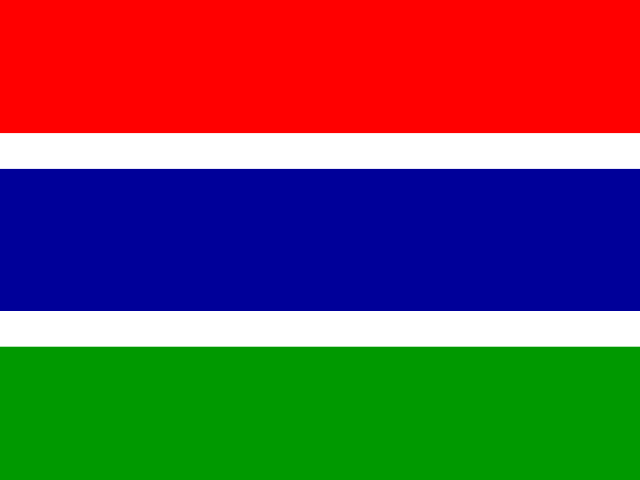
 Logistics services in The Gambia.
Sub-Saharan Africa · Low income · capital Banjul
The Gambia scores 2.3 of 5 on the World Bank Logistics Performance Index 2022, 145th of 169 countries: in the lower third of the world ranking.
The World Port Index lists 1 port here; the biggest is Banjul (GMBJL).
Its container ports handled 71,470 TEU in 2019 (135th in the world).
Merchandise trade in 2025: $514 million exports and $894 million imports.
Source: World Bank Open Data, latest year reported per indicator; ranks count only countries with data.
The Gambia logistics overview: modes, trade and gateways
Logistics services in The Gambia center on sea and air connections. Most seaborne cargo moves through the port of Banjul, which handles about 71,500 TEU and has a cargo pier depth of 9.4 m, served by global lines such as CMA CGM, Hapag-Lloyd, MSC, and Maersk. Banjul International Airport provides scheduled air services for higher-value or time-sensitive shipments.
Overland, freight moves by road across the 749 km border with Senegal to reach regional markets in ECOWAS. As a coastal country with about 80 km of coastline, seaborne trade is the main channel for containerized imports and exports, with air used for selected commodities.
| Main exports | packaged medicine, cars, harvesting machinery, refined petroleum, trailers |
|---|---|
| Export partners | Kazakhstan 92%, Guinea-Bissau 2%, China 1%, India 1%, Greece 1% |
| Main imports | crude petroleum, refined petroleum, cotton fabric, iron alloys, rice |
| Import partners | Kazakhstan 26%, China 18%, Senegal 8%, India 7%, Brazil 4% |
Source: CIA World Factbook, top five goods and partners by value.
Freight forwarders in The Gambia
Freight forwarders in The Gambia work mainly through the port of Banjul and Banjul International Airport. The logistics performance index score of 2.3, with customs at 1.8 and infrastructure at 2.3, suggests shippers should look closely at a forwarder’s ability to manage documentation quality and local coordination.
Customs procedures and tracking are weaker than the world median, so experience with Gambia-specific processes matters. Forwarders with strong relationships to lines such as CMA CGM, Hapag-Lloyd, MSC, and Maersk can consolidate volumes on the main container services calling Banjul. Given trade links with Kazakhstan, Guinea-Bissau, China, India, Greece, Senegal and Brazil, it can help if the forwarder is used to routing cargo via these partners and within ECOWAS and AU frameworks.
FCL and LCL shipping to and from The Gambia
FCL and LCL shipping from and to The Gambia moves through Banjul, the country’s only key seaport and a very small port by global standards. It handles about 71,500 TEU and has a cargo pier depth of 9.4 m, suitable for smaller container and general cargo vessels. The country’s liner shipping connectivity index is 6.64, placing it around 129 of 169 worldwide.
CMA CGM, Hapag-Lloyd, MSC and Maersk all have offices in Banjul, giving shippers access to global networks for both FCL and LCL. For a low-income economy with exports around 514 million USD and imports around 894 million USD, container flows are modest, so sailings and space can be sensitive to seasonal demand.
Seaports in The Gambia
1 port in the World Port Index:1 very small.
| Port | UN/LOCODE | Size | Harbour type | Cargo pier depth | Rail access |
|---|---|---|---|---|---|
| Banjul | GMBJL | Very SmallXS | River (Natural) | 9.4 m | - |
Source: NGA World Port Index, Pub. 150. Depths are charted values, not today's draft limits. Old names are kept in brackets.
Shipping lines with offices in The Gambia




Source: the lines' own office and agent pages, checked 25 Oct 2026.
Air freight in The Gambia
Air freight in The Gambia uses Banjul International Airport, which has scheduled services and is the main air cargo gateway. With overall logistics performance at 2.3 and timeliness at 2.6, air is generally used when speed is more critical than cost.
Higher-value goods such as packaged medicine or spare parts can move by air when lead times or reliability make ocean shipping less suitable. The country’s air transport is ranked around 156 of 184 worldwide, so shippers often combine air legs with regional road distribution in West Africa.
Airports for air cargo
1 airport with scheduled passenger and cargo service.
BJLBanjul International AirportBanjul (Yundum) · GBYDSource: OurAirports open data.
Rail and road freight in The Gambia
Rail and road freight in The Gambia is dominated by road transport, connecting seaports and airports with the hinterland and neighboring Senegal. The country shares a 749 km land border with Senegal, allowing cross-border trucking to regional markets and to other ECOWAS states.
As a coastal state with about 80 km of coastline, road freight typically feeds imports and exports through Banjul port and Banjul International Airport rather than distant gateway ports. Overland routing through Senegal is central for regional distribution and backhaul flows.
| Land borders | Senegal 749 km |
|---|
Source: CIA World Factbook.
Customs clearance in The Gambia
Customs clearance in The Gambia operates within international frameworks, with the country a member of the World Trade Organization and the World Customs Organization since 1987. It belongs to ECOWAS and the African Union, which shape many regional trade arrangements.
The average applied tariff is about 16, and the logistics performance index customs score is 1.8 compared with a world median of 2.6. Export and import border compliance is relatively fast at about 1 day each. Shippers typically need a commercial invoice, packing list and the relevant transport document for clearance, supported by a local broker where needed.
| World Customs Organization | Member since 1987 |
|---|---|
| World Trade Organization | Member |
| Trade and economic blocs | ECOWAS, AU |
| Average applied tariff | 16.4% (2022, weighted mean, all products) |
| LPI customs score | 1.80 / 5 (world median 2.6) |
| Export lead time, port or airport | 1.0 days median (2016) |
| Import lead time, port or airport | 1.0 days median (2016) |
Every shipment needs at least a commercial invoice, a packing list and a transport document (bill of lading, air waybill or CMR). See Incoterms for who clears customs at each end.
Sources: Wikidata (customs authority, WCO membership), CIA World Factbook (WTO, blocs), World Bank (tariff, LPI, lead times). Rules change; confirm with a licensed customs broker.
Logistics Performance Index 2022: The Gambia
Six survey scores from 1 to 5. The grey tick is the world median. Every LPI component sits at or below the world median; customs trails it the most.
Source: World Bank LPI, survey of logistics professionals.
Logistics in The Gambia: FAQ
What are the main ports in The Gambia?
By World Port Index harbour size: Banjul (GMBJL). 1 ports in total.
How does customs clearance work in The Gambia?
The Gambia has been a World Customs Organization member since 1987. Average applied tariff: 16.4% (2022). LPI customs score 1.8 against a world median of 2.6.
Which shipping lines have offices in The Gambia?
CMA CGM, Hapag-Lloyd, MSC, Maersk, according to the lines' own office pages.
How to choose a freight forwarder in The Gambia?
Freight forwarders in The Gambia work mainly through the port of Banjul and Banjul International Airport. The logistics performance index score of 2.3, with customs at 1.8 and infrastructure at 2.3, suggests shippers should look closely at a forwarder’s ability to manage documentation quality and local coordination.
How good is logistics in The Gambia?
The Gambia scores 2.3 of 5 on the World Bank LPI 2022, 145th of 169. Every LPI component sits at or below the world median; customs trails it the most.
Which airports in The Gambia handle air freight?
Airports with scheduled service: Banjul International Airport (BJL).
Neighbours and Sub-Saharan Africa
 Senegal · LPI 2.3
 Burkina Faso · LPI 2.3
 Madagascar · LPI 2.3
 Mauritania · LPI 2.3
 Equatorial Guinea · LPI 2.3
 Lesotho · LPI 2.3
 Ethiopia · LPI 2.4
 Gabon · LPI 2.4
Data built 31 Oct 2026. Text written from these figures and checked against them. Flags: flag-icons (MIT). Something out of date? [email protected].