





















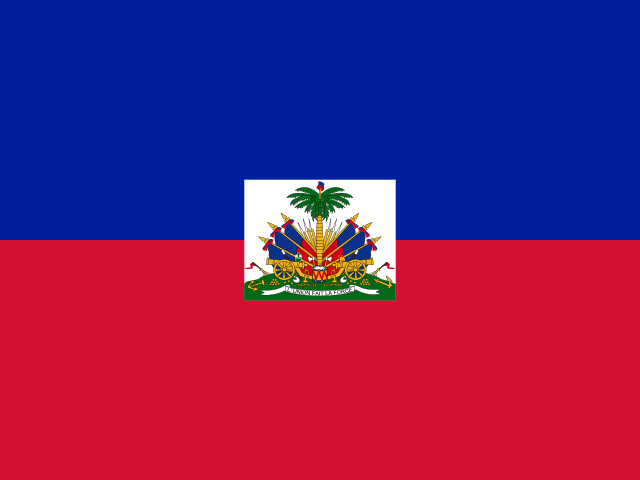
 Logistics services in Haiti.
Latin America & Caribbean · Lower middle income · capital Port-au-Prince
Haiti scores 2.1 of 5 on the World Bank Logistics Performance Index 2022, 159th of 169 countries: in the lower third of the world ranking.
The World Port Index lists 5 ports here, 1 of them large or medium; the biggest is Port Au Prince (HTPAP).
Its container ports handled 201,514 TEU in 2024 (107th in the world).
Merchandise trade in 2025: $554 million exports and $4.6 billion imports.
Source: World Bank Open Data, latest year reported per indicator; ranks count only countries with data.
Haiti logistics overview: modes, trade and gateways
Goods move in and out of Haiti mainly by sea and air. The country has about 5 seaports along a coastline of about 1,771 km, including Port Au Prince, Cap Haitien, Jacmel, Miragoane and Petit Goave, plus 1 oil terminal. Scheduled air services operate through 4 main airports, with a wider network of about 17 airports in total.
Containerized sea freight, breakbulk and small volumes move through these ports, supported by several global shipping lines with offices in Port Au Prince. Air freight capacity is limited in tonne-km terms, so higher-value or time-sensitive cargo typically uses air, while bulkier imports like refined petroleum and rice usually move by sea. Road transport connects production and consumption areas to seaports and airports inside the country and to the border with the Dominican Republic.
| Main exports | garments, essential oils, scrap iron, industrial acids/oils/alcohols, bedding |
|---|---|
| Export partners | USA 82%, Canada 4%, Mexico 2%, France 2%, India 2% |
| Main imports | refined petroleum, rice, garments, cotton fabric, plastic products |
| Import partners | USA 31%, Dominican Republic 23%, China 14%, Indonesia 4%, India 3% |
Source: CIA World Factbook, top five goods and partners by value.
Freight forwarders in Haiti
When choosing freight forwarders in Haiti, shippers work around a system where logistics performance is below the world median. The overall Logistics Performance Index is 2.1 compared with a world median of 2.7, with weaker scores in infrastructure at 1.8 and logistics quality at 2.0. Customs, tracking and international shipments sit around 2.0 to 2.3, so process reliability and information flow should be a focus.
Forwarders familiar with Port Au Prince and secondary ports like Cap Haitien, Jacmel, Miragoane and Petit Goave can help route cargo efficiently. Haiti’s main export partners are the USA, Canada, Mexico, France and India, and import partners include the USA, Dominican Republic, China, Indonesia and India, so experience on these lanes is useful. For ocean moves, coordination with carriers such as APL, CMA CGM, COSCO, Evergreen, Hapag-Lloyd, Maersk, ONE and X-Press Feeders based in Port Au Prince is an advantage.
FCL and LCL shipping to and from Haiti
Haiti handles about 201,514 TEU of container traffic, ranking 107 of 168 worldwide and 21 of 38 in its region. The country’s liner shipping connectivity index stands at 8.68, with a world rank of 105 of 169, indicating limited but established connections for FCL and LCL shipping from and to Haiti. Port Au Prince is the main container port, with a cargo pier depth of about 9.4 m and a rail connection at the port.
Other seaports include Miragoane with about 11.0 m depth, Cap Haitien at about 9.4 m, Jacmel at about 4.9 m and Petit Goâve at about 1.8 m. Global shipping lines with offices in or serving Port Au Prince include APL, CMA CGM, COSCO, Evergreen, Hapag-Lloyd, Maersk, ONE and X-Press Feeders. These carriers support container flows tied to exports such as garments, essential oils and scrap iron, and imports such as refined petroleum, rice, garments, cotton fabric and plastic products.
Seaports in Haiti
5 ports in the World Port Index:1 medium, 4 very small.
| Port | UN/LOCODE | Size | Harbour type | Cargo pier depth | Rail access |
|---|---|---|---|---|---|
| Port Au Prince | HTPAP | MediumM | Open Roadstead | 9.4 m | Yes |
| Miragoane | HTMIR | Very SmallXS | Open Roadstead | 11 m | - |
| Cap Haitien | HTCAP | Very SmallXS | Open Roadstead | 9.4 m | - |
| Jacmel | HTJAK | Very SmallXS | Open Roadstead | 4.9 m | - |
| Petit Goâve | HTPEG | Very SmallXS | Open Roadstead | 1.8 m | - |
Source: NGA World Port Index, Pub. 150. Depths are charted values, not today's draft limits. Old names are kept in brackets.
Shipping lines with offices in Haiti
 APLPort Au Prince
 CMA CGMPort Au Prince
 COSCOPort-au-Prince
 EvergreenPort Au Prince
 Hapag-LloydPort-au-Prince
 MaerskPort Au Prince
 ONEPort-au-Prince
 X-Press FeedersPort au Prince
Source: the lines' own office and agent pages, checked 25 Oct 2026.
Air freight in Haiti
Airports for air cargo
4 airports with scheduled passenger and cargo service.
CAPCap Haitien International AirportCap Haitien · MTCHPAPToussaint Louverture International AirportPort-au-Prince · MTPPCYAAntoine-Simon International AirportLes Cayes · MTCAJEEJérémie AirportCarrefour Sanon · MTJESource: OurAirports open data.
Rail and road freight in Haiti
Haiti shares a land border of about 376 km with the Dominican Republic. This corridor provides a road route for cross-border trade and for road freight linking inland production areas to Haiti’s seaports and airports.
Port Au Prince port has a rail connection at the cargo pier, while the other listed ports do not. Road freight supports movements of export goods such as garments and scrap iron, as well as imports like refined petroleum and rice, between industrial zones, population centers and gateways at the ports and main airports.
| Land borders | Dominican Republic 376 km |
|---|
Source: CIA World Factbook.
Customs clearance in Haiti
Haiti is a member of the World Customs Organization, with membership recorded since 1958-01-31, and also participates in the World Trade Organization. The average applied tariff is about 6.76 percent. For planning, shippers usually prepare at least a commercial invoice, packing list and transport document for customs clearance in Haiti.
The Logistics Performance Index customs score is 2.1 compared with a world median of 2.6, indicating less efficient border processes than the median country. Overall LPI is 2.1 vs a world median of 2.7. Reported border compliance lead times are about 2 days for exports and about 2 days for imports. Shippers trading with main partners such as the USA, Dominican Republic, China, Canada and others benefit from forwarders who understand Haiti’s customs procedures and documentary expectations.
| World Customs Organization | Member since 1958 |
|---|---|
| World Trade Organization | Member |
| Average applied tariff | 6.8% (2020, weighted mean, all products) |
| LPI customs score | 2.10 / 5 (world median 2.6) |
| Export lead time, port or airport | 2.0 days median (2016) |
| Import lead time, port or airport | 2.0 days median (2016) |
Every shipment needs at least a commercial invoice, a packing list and a transport document (bill of lading, air waybill or CMR). See Incoterms for who clears customs at each end.
Sources: Wikidata (customs authority, WCO membership), CIA World Factbook (WTO, blocs), World Bank (tariff, LPI, lead times). Rules change; confirm with a licensed customs broker.
Logistics Performance Index 2022: Haiti
Six survey scores from 1 to 5. The grey tick is the world median. Every LPI component sits at or below the world median; infrastructure trails it the most.
Source: World Bank LPI, survey of logistics professionals.
Logistics in Haiti: FAQ
What are the main ports in Haiti?
By World Port Index harbour size: Port Au Prince (HTPAP), Miragoane (HTMIR), Cap Haitien (HTCAP), Jacmel (HTJAK). 5 ports in total.
How does customs clearance work in Haiti?
Haiti has been a World Customs Organization member since 1958. Average applied tariff: 6.8% (2020). LPI customs score 2.1 against a world median of 2.6.
Which shipping lines have offices in Haiti?
APL, CMA CGM, COSCO, Evergreen, Hapag-Lloyd, Maersk, ONE, X-Press Feeders, according to the lines' own office pages.
How to choose a freight forwarder in Haiti?
When choosing freight forwarders in Haiti, shippers work around a system where logistics performance is below the world median. The overall Logistics Performance Index is 2.1 compared with a world median of 2.7, with weaker scores in infrastructure at 1.8 and logistics quality at 2.0. Customs, tracking and international shipments sit around 2.0 to 2.3, so process reliability and information flow should be a focus.
How good is logistics in Haiti?
Haiti scores 2.1 of 5 on the World Bank LPI 2022, 159th of 169. Every LPI component sits at or below the world median; infrastructure trails it the most.
Which airports in Haiti handle air freight?
Airports with scheduled service: Cap Haitien International Airport (CAP), Toussaint Louverture International Airport (PAP), Antoine-Simon International Airport (CYA), Jérémie Airport (JEE).
Neighbours and Latin America & Caribbean
 Dominican Republic · LPI 2.6
 Cuba · LPI 2.2
 Venezuela · LPI 2.3
 Bolivia · LPI 2.4
 Guyana · LPI 2.4
 Grenada · LPI 2.5
 Jamaica · LPI 2.5
 Nicaragua · LPI 2.5
Data built 31 Oct 2026. Text written from these figures and checked against them. Flags: flag-icons (MIT). Something out of date? [email protected].