





















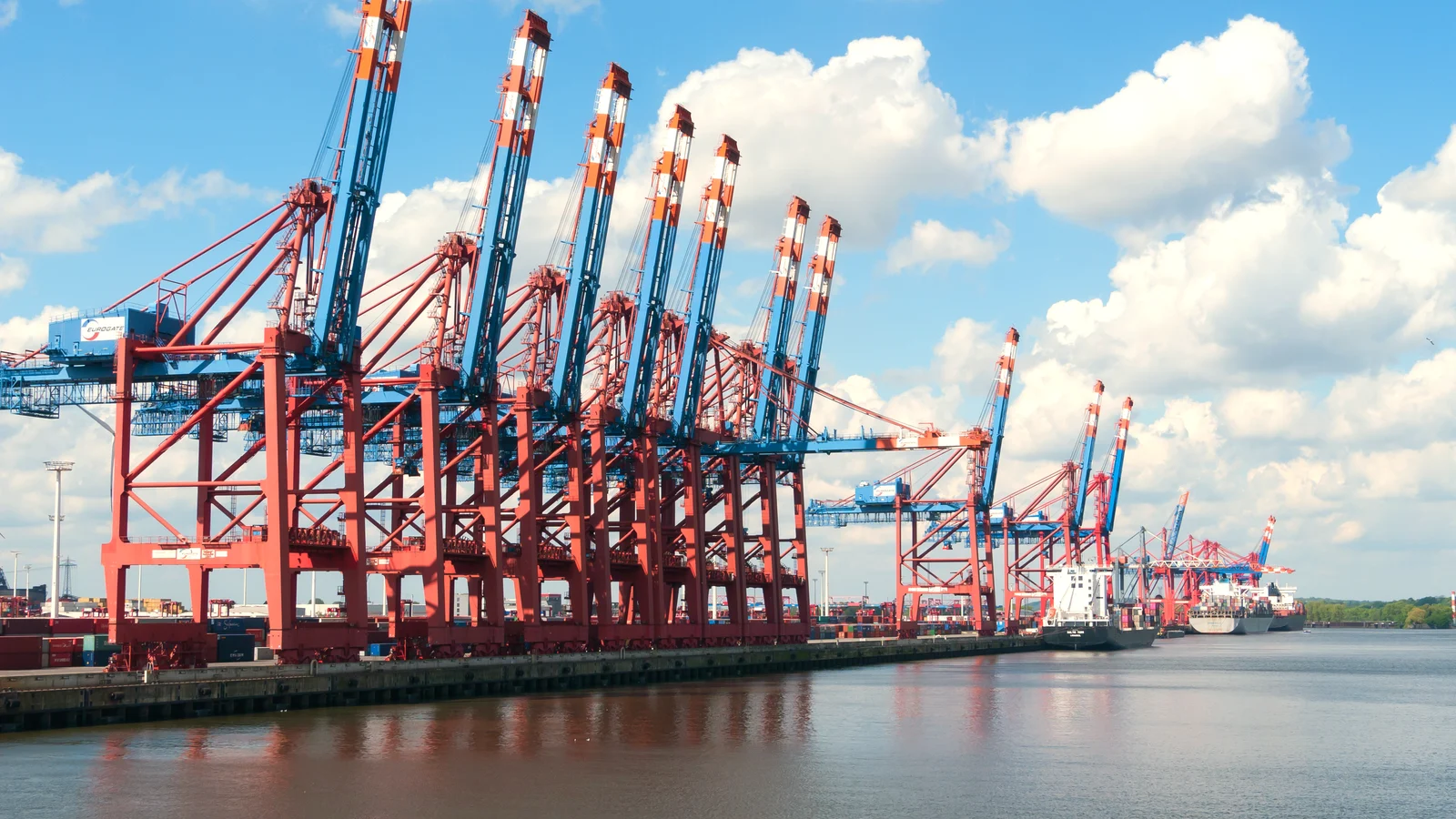
Syed Ali joined PSA nearly 30 years before that day as a yard crane operator at Keppel Terminal. Back then he climbed up to the cabin of each crane, and each operator ran one. By the opening of Tuas Port on 1 September 2022 he was a senior quay crane specialist there, and Prime Minister Lee Hsien Loong, telling his story, called Tuas the world’s largest fully automated port to come. So what is a smart port? There is no single answer, and UNCTAD’s, covered below, is the only formal definition among these sources. Lee never defines one. He tells the story of a crane operator’s changed job. Hamburg and Rotterdam describe other work, and the sources show how little of it is comparable.
Singapore plans automated yards and more cranes per specialist
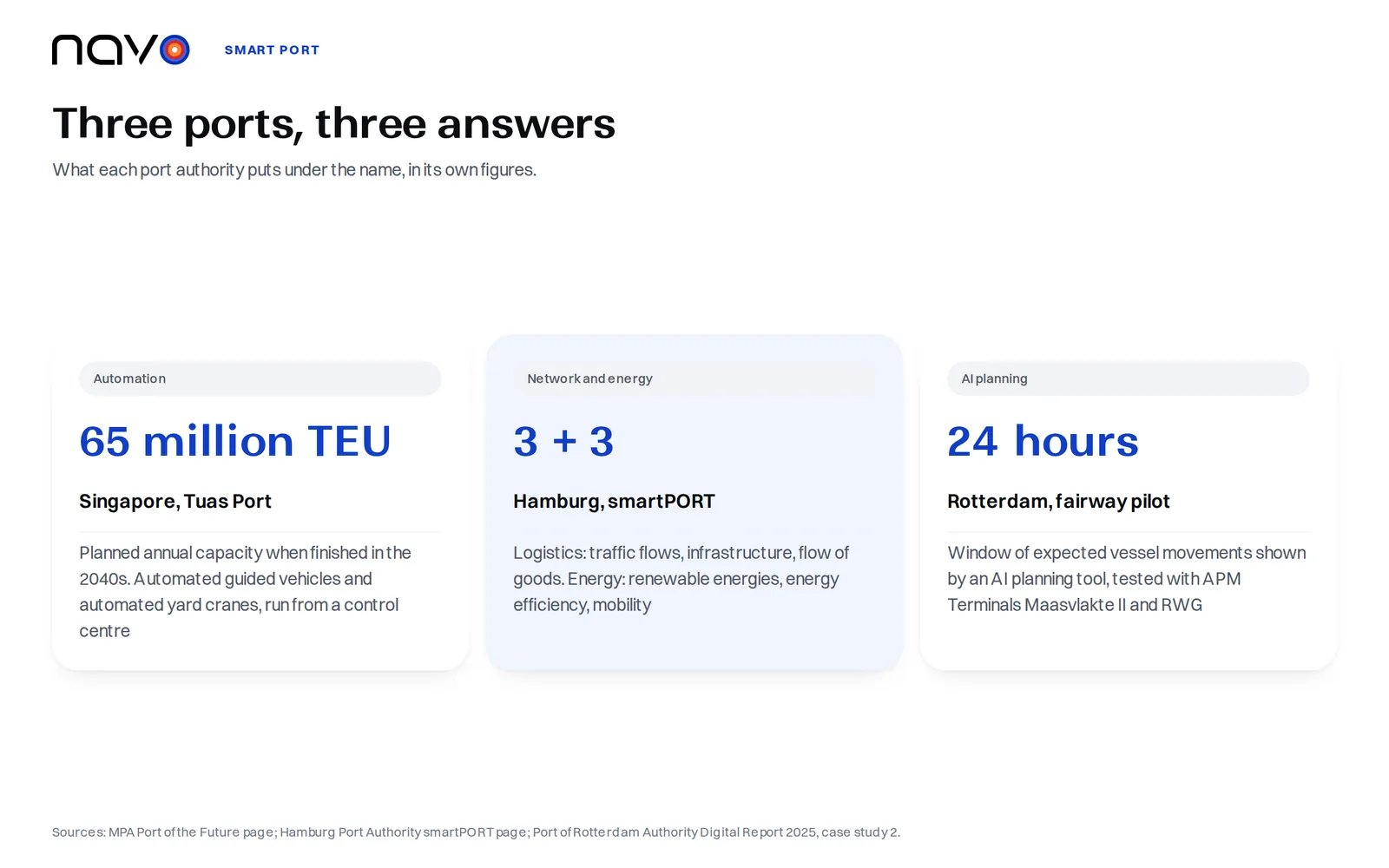
The Maritime and Port Authority of Singapore (MPA) targets a handling capacity of 65 million TEU at Tuas by the 2040s, against Singapore’s total of 37.5 million TEU handled in 2021, and calls the port automated, intelligent and sustainable. MPA’s Port of the Future page gets concrete: automated guided vehicles (AGVs) will carry containers between the wharf and the yard, and operations will be managed remotely from the Tuas Port Control Centre. PSA, the operator, plans a private 5G network for the AGVs and automated cranes at Tuas and at Pasir Panjang, and MPA says the electric AGVs cut carbon emissions by about 50% against current diesel prime movers. The figures on that page count berths, capacity and emissions. A container’s journey is not among them.
The labour side comes from Lee’s speech at the opening. When Pasir Panjang Terminal Phases 3 and 4 opened, Ali moved to a control centre and oversaw several semi-automated yard cranes at once. At Tuas, Lee said, yard crane specialists will oversee twice as many automated cranes at a time as at Pasir Panjang, and the quay cranes are automated as well.
Hamburg puts sensors on switch points and co-founds a port network
The Hamburg Port Authority (HPA) uses the name smartPORT for two strands of work. smartPORT logistics has three sub-sectors: traffic flows, infrastructure and the flow of goods. smartPORT energy has three core areas: renewable energies, energy efficiency and mobility. One example is the harbour railway. Sensors on frequently used switch points send data in real time to a central IT system.
Beyond the port itself, Hamburg also helped start a network: a Port of Hamburg release of 5 April 2016 announced chainPORT as a platform for ports to exchange information and develop solutions together. By September 2023 the port’s own release listed 13 supporting ports, Rotterdam, Singapore, Shanghai and Tanger Med among them, and described members as committed to sharing knowledge and innovation. The same release says chainPORT was initiated in April 2016 by the port authorities of Hamburg and Los Angeles with the Global Institute of Logistics.
Rotterdam tested a forecast and a terminal planner was disappointed
The Port of Rotterdam Authority’s Digital Report 2025 describes a pilot with APM Terminals Maasvlakte II and Rotterdam World Gateway (RWG). The Authority asked the IT partner BIT for a tool that shows which vessels are expected in and out over the next 24 hours. An AI model trained on AIS data, vessel visit data, basic restriction rules and weather predicts actual arrival and departure times and advises the Harbour Master on fairway planning.
The report’s summary is that AI adds value but cannot yet perform every task. The tool did well on the draft of every vessel in port and on what that means for short-term fairway planning. Recognising reliable patterns and predicting departure times from open sources such as Vesselfinder proved harder. “To be honest, I was a bit disappointed,” said Frank van Veen, a berth planner at APM Terminals. RWG’s Danny van Pomeren, whose terminal runs 24/7, 363 days a year, said the pilot gave “much greater insight” and that RWG would like to continue. The pilot partners say they are working on quantifying the gains based on data, but the report gives no figure. The report says gains can be realised throughout the entire chain, from terminal clients to tugboats and pilots, but none of them is followed through to a shipper’s booking.
UNCTAD ties the definition to energy
What is a smart port for a UN trade body? A 7 December 2023 UNCTAD webinar presentation defines a “Smart Sustainable Port” as a port that uses the energy transition and technology-based solutions for two things: better operational efficiency through energy efficiency, and the use, production and distribution of clean or renewable energy. Energy is part of the definition. The slides come from UNCTAD’s “Sustainable Smart Ports for African countries” project, whose beneficiaries are Port Louis, Tanger Med and the Port of Tema.
What a shipper can take from the label
Put the four sources side by side and “smart” covers four different things: crane labour and equipment in Singapore, sensors and energy in Hamburg, a forecasting tool in Rotterdam, the energy transition in UNCTAD’s definition. Rotterdam’s report says outright that the partners are still quantifying the gains. The other three pages carry no dwell time, transit time or cost per container either.
The nearest thing to a cargo-owner angle is the chainPORT and IAPH project, described in a September 2023 release on the Port of Hamburg site. The project prioritises beneficial cargo owners who want more control and visibility, and its stated aim is a common understanding of what digital port infrastructure consists of. To see what the label does for cargo, compare two ports by how closely vessels keep their published sailing dates over several months, and ask your forwarder for actual container dwell times at each. Vessel schedules show the published sailing dates to start from.
Frequently asked questions
What will Singapore's next-generation vessel traffic system do?
In his 2022 opening speech Prime Minister Lee Hsien Loong said MPA's next-generation vessel traffic management system (VTMS) will use artificial intelligence and machine learning to predict and prevent potential collisions, as the port manages a larger number and greater density of vessel movements.
How big will Tuas Port be when it is finished?
MPA says Tuas Port will occupy about 1,337 hectares, roughly 3,300 football fields, with 66 berths spanning 26 km that can handle the largest container ships.
What else is Hamburg's port authority measuring besides railway switch points?
The smartPORT page describes a mobile GPS sensor under development that sends data wirelessly to the HPA IT system. It is meant to show where a floating crane or the nearest emergency vehicle is, and to take other measurements such as temperature, wind speed and direction, air pollution and the flow of the Elbe.