





















Meta keywords: fake container tracking website, container tracking scam, verify container number, ISO 6346 check digit
“Do not provide any personal or financial information,” Maersk tells anyone who suspects a phishing email or a fake website, and adds that you should reach the company through a contact you already trust (Maersk). Fine. But a consignee who has just received a tracking link has no contact yet, and nobody has told them how to size up the page. A fake container tracking website is cheap to build: a logo, one search field, one reply. We took a real one apart on 7 November 2026.
A logistics company that leased boxes
The site was seacogloballog.com, and it called itself “Seaco Global Logistics Company”. Ocean freight, air freight, customs, warehousing, “Delivering Beyond Borders”. No ports named. No licence numbers. No staff. One info@ mailbox on the same domain, and no phone line.
The name borrows from Seaco, which is a container lessor. Seaco says on its own site that it began leasing containers in the 1960s (Seaco), and we found no link from there to the look-alike domain. The street address on the look-alike page is 3773 Richmond Avenue, Suite 625, Houston. That is the Houston office of Seaco America LLC, listed with a phone number on Seaco’s locations page. The registry record for seacogloballog.com shows registration on 3 November 2025, and the Internet Archive holds no captures of it. When we loaded it on 7 November 2026, plain HTTP returned a Namecheap parking notice, “Domain registration has expired”, and HTTPS did not answer.
Those are the records. They do not say who ran the site or why. They do show what to test on any unfamiliar link, so here are the tests in the order we would run them.
Domain, address, licence
Start with the registry. Any RDAP or WHOIS lookup gives the registration date (Verisign publishes .com records at rdap.verisign.com). A forwarder that claims decades in business and registered its domain last year owes you an explanation. An old domain proves little the other way, because domains get sold.
Then search the street address instead of the company name. Business towers rent suites to dozens of firms, so an address alone settles nothing. An address that a known company publishes as its own office, next to its own phone number, is a different matter.
Then look for a licence. The Federal Maritime Commission requires a US-based ocean freight forwarder or NVOCC to hold an FMC licence and an NVOCC to publish a tariff (FMC). A site that sells ocean freight out of Houston and shows no licence number leaves that question open.
The number on the box says more than the site does
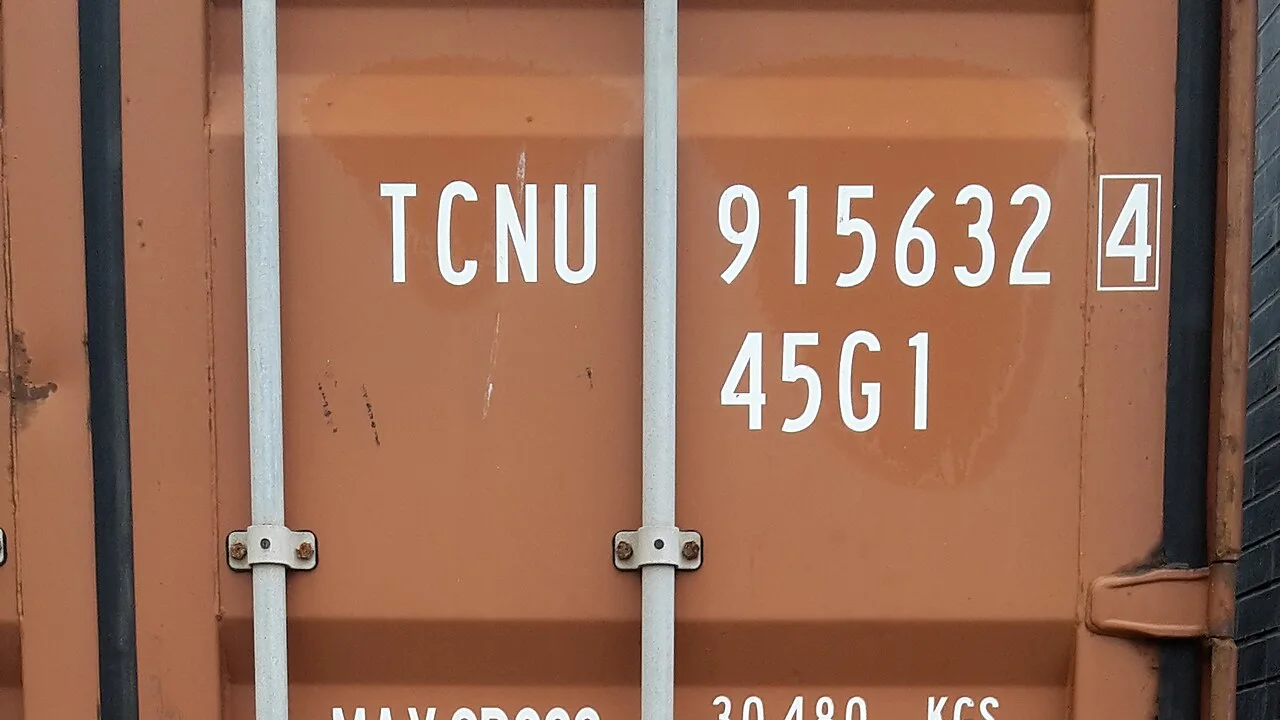
The first four letters of a container number are the owner code, registered with the Bureau International des Containers. Many belong to lessors, who rent boxes to carriers and move no cargo. Ours is a live example. On 7 November 2026 the Navo API returned Textainer Equipment Management Limited as the owner of TGBU6232251, a box booked with KMTC from Nhava Sheva to Long Beach with an ETA of 6 December. TCKU6265245 came back owned by Triton Container International and booked with CMA CGM from Santos to Chittagong. In both cases the owner of the box and the carrier on the booking are different companies. A “logistics company” wearing a lessor’s brand has to say which carrier it actually books with. Our pages on container markings and SCAC codes decode the prefix and the carrier code.
The eleventh character is a check digit, and you can calculate it by hand. Under ISO 6346 each letter takes a value starting at A=10 and skipping multiples of 11, so K is 21, T is 31 and U is 32. Each of the first ten characters is multiplied by 2 to the power of its position, counting from zero, and the products are added. For TCKU6265245 that is 31×1 + 13×2 + 21×4 + 32×8 + 6×16 + 2×32 + 6×64 + 5×128 + 2×256 + 4×512, which makes 4141. Divide by 11 and the remainder is 5, the last digit of the number. A number that fails the sum was mistyped or invented.
Passing the sum proves little, though. We sent the API SEAU1234563, a number we made up that does pass it. The answer was a plain 404, “Container not found”. The tracker on the look-alike site answered “No shipments found” to every number our team entered, real or not. A tracker with no carrier connections can say nothing else. So take the number to a second source: the carrier’s own site, or a neutral tracker such as Navo24 tracking.
What to do when a message asks for money
A note that says your cargo is held until a release fee arrives, sent from a free-mail address instead of a company domain, is where you stop replying. Find the carrier’s phone number on its own website, call it, and pay nothing until that call is done. Any single oddity above can have an innocent explanation. A site that fails four or five of the tests has told you what you need to know.
We could not establish whether the parked site ever took a payment from anyone, and no public record we checked says so. If you have already sent money to a site like this one, call your bank first and the real carrier second.
Frequently asked questions
How do I check that a container number is real?
Run two tests. First the ISO 6346 check digit: the last character must equal the weighted sum of the first ten, divided by 11, remainder kept. Then look the number up on the carrier's own site or a neutral tracker. Our 7 November 2026 test number SEAU1234563 passes the sum and still returned "Container not found", so the sum alone proves little.
Does a container owner code tell me which shipping line carries the box?
Not reliably. The owner code is registered with BIC and often belongs to a lessor such as Textainer, Triton or Seaco. On 7 November 2026 the Navo API showed a Textainer-owned box on a KMTC booking and a Triton-owned box on a CMA CGM booking.
What should I do if I already paid a fake logistics site?
Call your bank at once and ask about stopping or recalling the payment. Then contact the real carrier or forwarder using the details on its own website, and keep every email and the payment receipt.