





















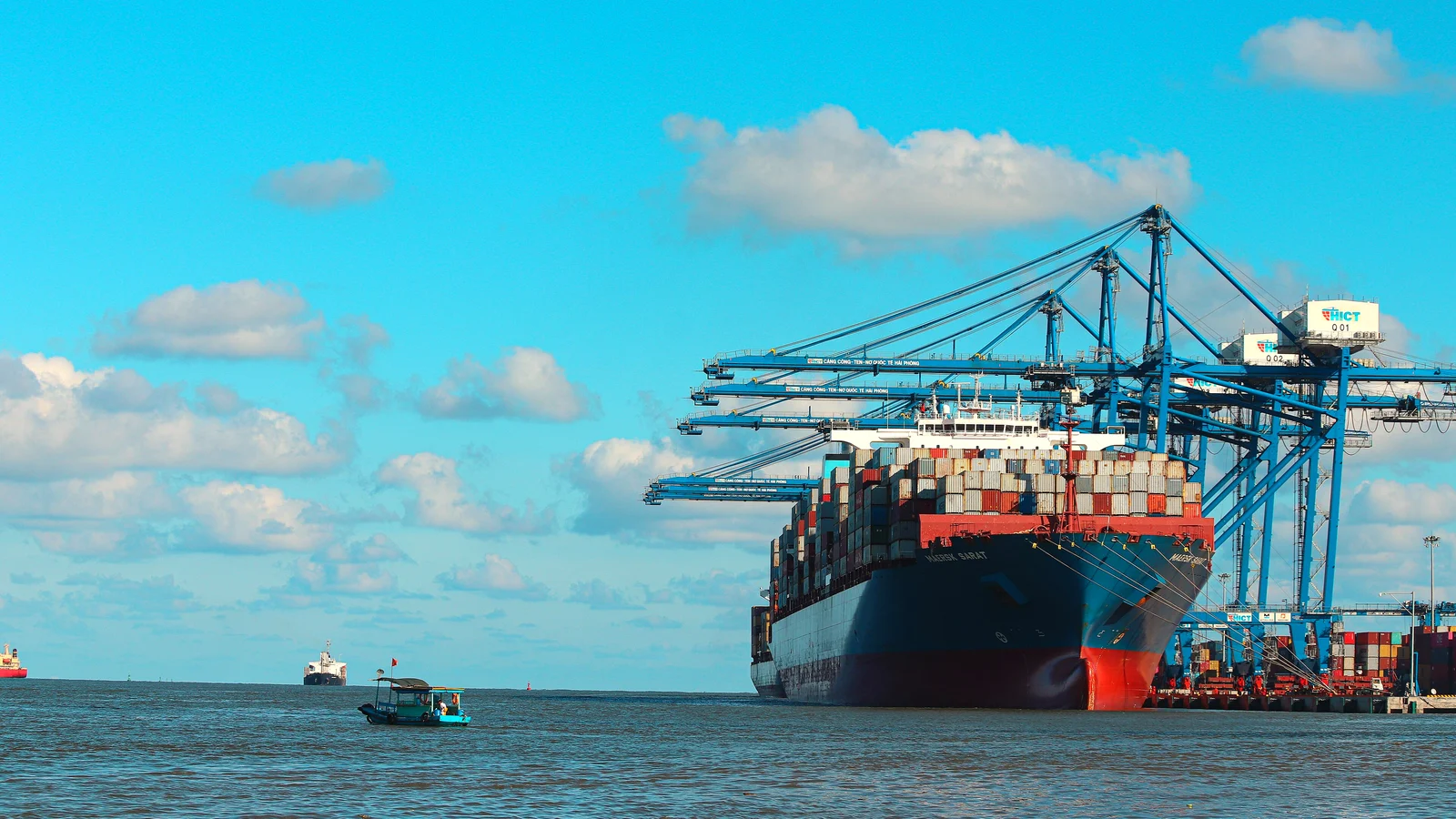
Vietnam to Canada shipping comes down to two shapes. The container crosses the Pacific to Vancouver or Prince Rupert and goes inland by rail, or it goes the long way round to Halifax or Montreal and stays on the water. Take wooden bedroom furniture (tariff item 9403.50.00) bound for Toronto as the one worked example. Other goods have other rates. On sailing distance alone the Pacific is far shorter. For both shapes the harder question is where the box changes ship, because a CPTPP duty claim has to survive every stop.
How far is the Pacific route, and how far is the east?
Navo24’s own route calculation gives sea distances in nautical miles. Divided by a steady 14 knots, with no port calls, no transhipment and no waiting, they give the days below. Ho Chi Minh City to Vancouver comes out at 6,704 nautical miles, about 20 days. Starting from Hai Phong in the north takes it down to 6,375 nm, about 19 days. Prince Rupert is a little closer again: 6,539 nm from Ho Chi Minh City and 6,210 nm from Hai Phong, about 19.5 and 18.5 days. The east is a different scale. Montreal is 10,908 nm away through Suez, about 32.5 days, and Halifax 10,372 nm, about 31 days. The 14-knot speed is a modelling choice, so read these as a yardstick for comparing routes, and the sources we read give no transit time for the lane.
Prince Rupert argues from distance too. The port authority says it is 500 nautical miles closer to Asia than other Pacific Northwest ports and saves up to 60 hours of sailing. From Ho Chi Minh City the same distances put Vancouver and Prince Rupert only 165 nm apart, about half a day, so for a Vietnamese box the gap that could matter is on the rail leg. The port authority lists average rail time to Toronto at 4.5 days from Prince Rupert against 6 days from Seattle and from Los Angeles, while CN’s own page for the port gives 5.5 days to Toronto. Neither page gives a Vancouver time, so ask the forwarder for the railway and the days.
Which ports the Vancouver loops visit first
ONE’s FP2 service notice for fiscal 2026 adds Haiphong after Cai Mep. After Haiphong the same loop still stops at Yantian and Pusan, then Tacoma, and only then Vancouver. A box loaded at Cai Mep sees three more ports before it leaves Asia. COSCO’s CPV service, which Linerlytica reported in February, calls at Yangpu, Haiphong, Hong Kong, Ningbo and Shanghai ahead of Vancouver and Seattle. On 23 October the Yantian terminal’s schedule page showed MSC’s MCHIN loop leaving Vung Tau for Yantian, Ningbo, Shanghai, Qingdao and Busan. It reaches Canada only after Seattle, and Prince Rupert is the last North American call, after Vancouver.
Each of those calls adds port time on top of the 20 days of sailing. Ask for the loop name and the whole rotation. Navo24’s schedules group sailings by the physical vessel, and a vessel’s published rotation is one of the lookups.
The east coast looks different on paper than in the schedules. The only Halifax loop on Yantian’s schedule page is PEC2. After Vung Tau it calls at Yantian, Shanghai and Busan, goes through the Panama Canal and stops at Manzanillo, Savannah, Norfolk and New York before Halifax. ONE’s 2026 network notice lists EC2, which calls at Cai Mep, Yantian, Shanghai and Pusan and ends at Halifax. It returns to Singapore around the Cape of Good Hope, and the notice says ONE’s rotations assume the Cape route while it watches Suez. So the Suez figures above describe a route that ONE’s 2026 rotations leave out, and neither gives a transit time. Nothing we read shows the east coast as a shortcut for a Toronto-bound box.
CPTPP duty on one tariff line: 9.5% against nothing
Wooden bedroom furniture sits under tariff item 9403.50.00. In Canada’s Customs Tariff 2026 the MFN rate is 9.5% and the rate under the CPTPP (treatment code CPTPT) is Free. The CBSA list of countries for the 2026 tariff shows Vietnam under CPTPT. The same line shows 6% under the General Preferential Tariff, but Vietnam left that program on 1 January 2025. The choice is 9.5% or 0%. On every CAD 10,000 of value for duty that is CAD 950.
The claim needs paper but no government form. The CPTPP certification of origin has no prescribed format. CBSA memorandum D11-4-2 describes it as a set of minimum data elements that can sit on an invoice or any other document, signed by the importer, the exporter or the producer. The signature carries a statement that the signer assumes responsibility for proving the goods originate. The importer must hold the certification when accounting for the goods and give it to the CBSA on request. If it is not in hand, the memorandum says another tariff, usually MFN, is claimed. When the invoice is issued in a non-Party, the certification has to be a separate document.
Whether a given bed frame originates depends on the product rule for its heading.
Where transhipment can break the claim
Every loop above also calls at Chinese or Korean ports. A box that changes ship at Yantian, Hong Kong, Shanghai or Pusan passes through a non-Party. Canada’s 2020 statement on implementation of the CPTPP lists eleven parties, among them Vietnam and Japan, and the party list has grown since. China and Korea were not on it, and no later source we read adds them.
Article 3.18 lets originating goods pass through a non-Party. Nothing may be produced there beyond unloading, reloading or an operation needed to keep the goods in good condition or move them on, and the goods stay under customs control the whole way. The CBSA origin page states the same shipping requirement and says a preferential claim must meet it. Under Article 3.24 the importer has to be able to show it. The sources we read are silent on whether a stop with the box still aboard is handled differently from a change of ship, so put that to the forwarder together with the other question: can the carrier document that the box stayed under customs control at each transhipment port?
What goes to the CBSA, and when
For containerised cargo loaded outside the United States, cargo data reaches the CBSA 24 hours before loading (memorandum D3-5-1, Appendix A). The CBSA’s ACI page lists 24 hours for marine and has forwarders send house bill data. A change before loading restarts the clock, and the CBSA can answer with a “Do not load” message.
The importer’s side is CARM. Every commercial importer needs an account in the CARM Client Portal, a 9-digit business number and a 6-character import program account such as RM0001, which together form the 15-character BN15. Authority can be delegated in the portal to a customs broker. A consignee that has never imported needs that account in place, and a non-resident needs the CRA step first.
What the Drewry index covers
Drewry’s World Container Index of 22 October 2026 put Shanghai to Los Angeles at USD 8,007 per 40 ft, up 2% on the week. The composite stood at USD 4,585. Drewry’s commentary names four lanes, to Los Angeles, New York, Rotterdam and Genoa. None starts in Vietnam or ends in Canada, so for Vietnam to Canada shipping the index shows the market’s direction and gives no price. Navo24’s freight page lists spot rates carrier by carrier from public listings, an indicative number stamped with the date it moved. The page also offers a firm-quote request when the indicative number looks close.
What to start before the booking request
Two steps depend on other people, not on the carrier. A non-resident importer needs the CRA business number before registering in CARM, and the factory has to produce the certification of origin. Our advice is to start both first and collect the carriers’ rotations while they run.
Frequently asked questions
Does a small first order still need the CPTPP certification of origin?
Not always. CBSA memorandum D11-4-2 (June 2022) exempts commercial goods with an estimated value for duty up to CAD 3,300 from the proof of origin requirement. The importer must still keep records showing the goods meet the rules of origin, and the CBSA can verify the claim. If a shipment looks like one of a series that together pass CAD 3,300, the CBSA may ask for a certificate. An older Global Affairs Canada page still quotes CAD 1,600, so use the CBSA figure.
Can a company with no Canadian entity import the container itself?
It can, but the order of steps differs. A non-resident importer contacts the Canada Revenue Agency first to receive a business number, because only Canadian resident businesses can register for one through CARM. With the number issued, the importer registers in the CARM Client Portal and enrols in the importer program.
The factory's certification of origin is in Vietnamese. Will the CBSA accept it?
It can be asked to see a translation. CBSA memorandum D11-4-2 says that when a certification is completed in a language other than English or French, the importer may be requested to have it translated into one of them. An English version prepared with the original spares the importer that step.