





















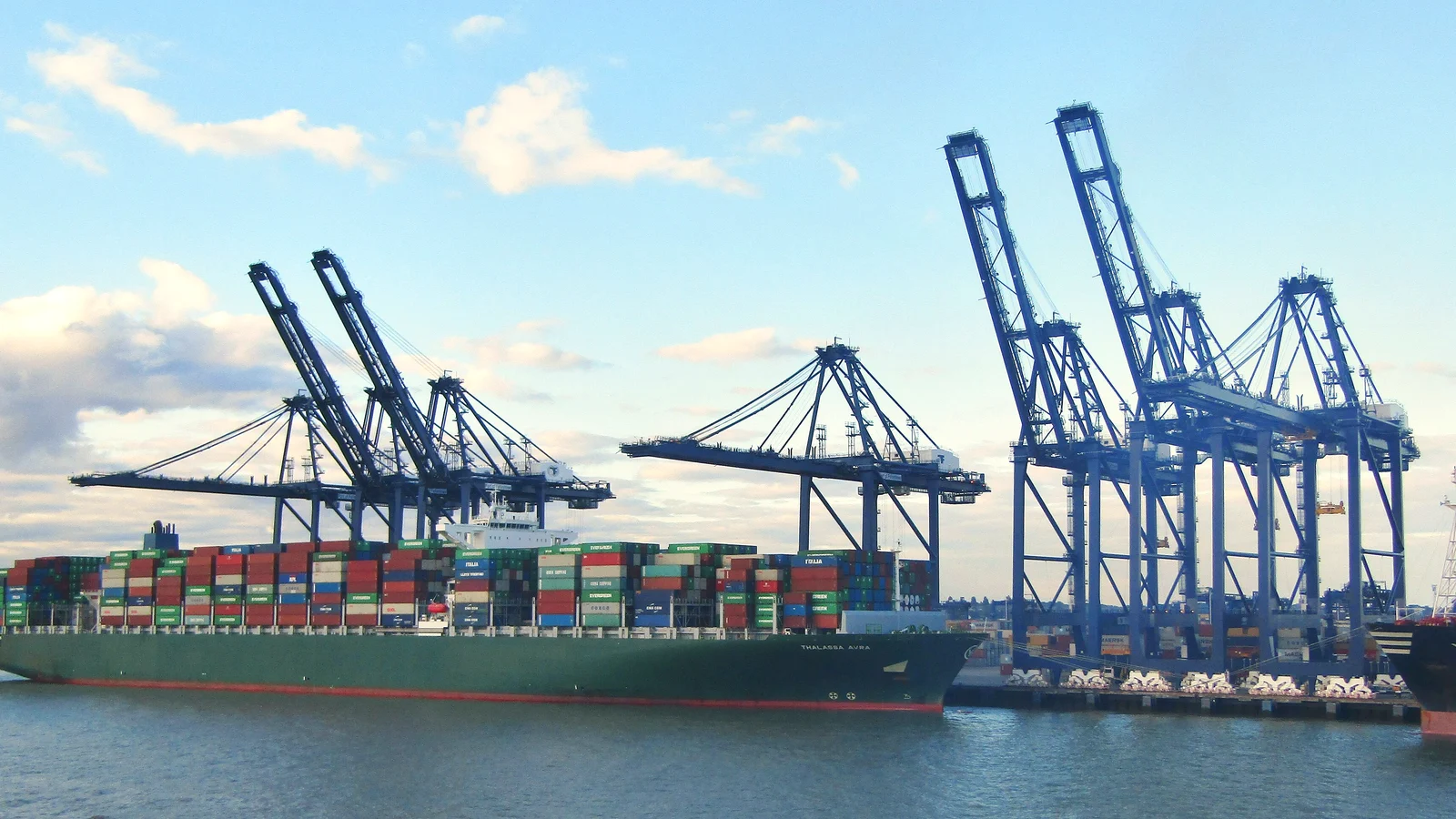
When shipping from China to the UK, HMRC counts freight, insurance and terminal charges up to the UK border in the customs value, and import VAT is charged on that value plus the duty.
Tax is charged on the freight too
HMRC’s guidance on delivery costs puts transport, insurance, loading and handling, container and terminal charges into the customs value, with all inland transport in the country of export and the costs up to the place of introduction into the UK. The bunker and currency adjustment factors count, and so do peak season, security, war risk and UK port congestion surcharges. For VAT, the VAT guidance then adds the duty and incidental expenses such as customs clearance charges, handling and storage up to the first UK destination, and the haulage to a further destination when that place is known at the time of import.
Take T-shirts under commodity code 6109 10 00 10. The UK Trade Tariff lists a third-country duty of 12% for goods from China, and adult clothing carries VAT at the standard 20% (most children’s clothes are zero-rated). Every £1,000 of freight and surcharges therefore adds £120 of duty, and £224 of VAT on the £1,120 that the duty brings the VAT value to. That is £344 of tax per £1,000 of transport, before any incidental expenses.
A VAT-registered importer can use postponed VAT accounting, which declares the import VAT and reclaims it as input tax on one VAT return, subject to the normal rules. A regular importer can defer duty and VAT through an HMRC account, which needs a bank guarantee. The duty rate comes from the commodity code, the same code that decides whether an import licence is needed.
Round Africa or through the Red Sea
A forwarder quoting 25 days and one quoting 45 may both be right. DP World’s China to UK route page lists weekly sailings from Shanghai, Ningbo, Shenzhen, Qingdao and Guangzhou to Felixstowe, Southampton and London Gateway, and says the crossing takes 25 to 35 days. Origin port, shipping line and direct versus transshipment service all move that number, DP World says, and direct sailings from Shanghai or Ningbo are generally fastest.
Shippo, a UK LCL forwarder, splits the lane by routing on a page it last reviewed in August 2026. Its current table assumes ships keep avoiding the Red Sea. Guangzhou and Shenzhen cargo then spends 35 to 41 days on the water, Shanghai and Ningbo cargo 43 to 49, and Qingdao, Tianjin and Xingang cargo 45 to 51, and Shippo tells customers to allow 8 to 9, 9 to 10 and 10 to 11 weeks door to door. A second table covers a return to the Red Sea, with 25 to 27, 30 to 32 and 34 to 42 days on the water and no door-to-door weeks.
Which one applies depends on the loop. Between 15 September and 15 October 2026, Alphaliner saw ships using the Red Sea on 24 of the 46 direct Far East to Europe services run by the ten largest carriers. That was 58% of the capacity on the North Europe trade and 70% on the Mediterranean one. Some loops sail through the Red Sea westbound and still come back to Asia round the Cape of Good Hope. Maersk announced in its October update that four more Gemini services will route via Suez, voyage by voyage.
Where the Europe lane stands this month
Drewry’s World Container Index publishes Shanghai to Rotterdam for North Europe. Rotterdam is not a UK port, so read the figures as the direction of the lane. The rate fell 2% to $3,337 per 40ft container in the assessment of 8 October, taken during China’s Golden Week, rose 6% to $3,522 on 15 October and stood at $3,632 on 22 October, after the 13 consecutive weekly declines on the Asia to Europe trade that Drewry counted. Drewry counted eight blank sailings announced for the following week, up from two, as carriers cut capacity to push rates up.
Spot rates by carrier list 20ft and 40ft prices with transit time for lanes nearer the UK, and vessel schedules show which loops call at Felixstowe or London Gateway.
An EORI number and a customs agent
An importer into England, Wales or Scotland needs an EORI number starting with GB. A business without UK premises usually cannot get one and appoints someone to deal with customs, whose own number is then used. Most importers hand the declaration to a transporter or customs agent anyway, per GOV.UK’s import steps, and the declaration carries the commodity code and the value of the goods.
A VAT-registered importer shipping from China to the UK can claim back import VAT paid at the border with the Import VAT Certificate (C79). HMRC requires importers to keep commercial invoices and customs paperwork, the C79 included.
Frequently asked questions
Does freight cost count towards UK import duty?
Yes. HMRC puts transport, insurance, loading, handling, container and terminal charges up to the UK border into the customs value, including surcharges such as bunker, peak season and war risk. Duty is charged on that value, and import VAT on the value plus duty.
How long does sea freight from China to the UK take?
DP World quotes 25 to 35 days for the crossing. Routing decides the rest: with ships avoiding the Red Sea, one UK forwarder lists 35 to 51 days on the water depending on the Chinese port, and 8 to 11 weeks door to door.
Who can use postponed VAT accounting?
VAT-registered importers. They declare the import VAT and reclaim it on the same VAT return, so no cash leaves at the border. A business without UK VAT registration can use a UK agent instead, though the agent's service carries VAT the trader cannot reclaim.