






















In 2011 the FMC’s inspector general found that 17 companies were still advertising freight forwarder services after losing their licenses. Anyone working out how to advertise a freight company today faces the same license rules, plus a Google Ads click that averages $5.42 and an SEO case where rankings took just under 12 months to double.
2016 to 2026: the click now costs twice as much
WordStream has run its benchmark report for ten years. The 2026 edition covers more than 13,000 US-based search campaigns on Google and Microsoft Ads, run between April 2025 and March 2026 across 23 industries. The average click cost $5.42, and the report notes its averages are technically medians. In the first report, in 2016, a click cost $2.32. Cost per lead was $66.69 in 2026 and $59.18 in 2016. Cost per lead went down in 2026 for the first time in five years.
WordStream does not split out freight, so anyone asking how to advertise a freight company on a budget gets one range, from a freight marketing agency, comparethecarrier.com: $4.50 to $11.00 a click for keywords like “LTL shipping rates”, and a monthly budget of $2,500 to $6,000 for mid-sized logistics providers. The agency sells campaign management, and the page gives no method or source for the range. It also says Google Ads can bring leads within hours of launch.
Twelve months at Truckstop.com
Truckstop.com is a load board and freight management software company for carriers and brokers. The SEO agency Virayo worked on its search presence, and the agency’s case study lists four jobs. Keyword research covered both the carrier and the broker persona, and each keyword got a page type, such as product page, solution page, competitor landing page or blog post. Each month Virayo sent briefs with target keywords, word counts and outlines to Truckstop’s own writers, then reviewed their drafts for internal links, URL structure and titles. Backlinks to key pages and schema markup came on top.
A quote on the page, signed Chad Connally, says that in just under 12 months Truckstop more than doubled its top-three rankings and grew monthly non-brand organic traffic by over 150%, with qualified leads and sales following. The page headline says 155%. Both numbers come from the agency’s own site, and the page gives no lead counts and no cost.
An ocean lane page can carry a figure readers verify themselves, like the indicative weekly spot rates out of Asia.
September 2011: seventeen companies still advertising after the license was gone
The Federal Maritime Commission’s Office of Inspector General reviewed the bond program for ocean transportation intermediaries in a report dated September 2011. The sample covered notices sent in July and August 2010: of 181 bond termination notices, 111 licensees obtained a new bond. The other 70 were removed from the FMC’s public list. The report adds that 17 of those 70 companies still kept an active website advertising freight forwarder or NVOCC services months after the license was cancelled or revoked. Two of the 17 claimed to hold a valid FMC license.
Section 515.31(j) of the FMC’s rules says no person may advertise or hold out to act as an OTI unless that person holds a valid OTI license or is registered. Paragraph (a) adds that a licensee does business only under the name and number the Commission assigned. Property brokers have a separate rule on misrepresentation, section 371.7, and it names advertising.
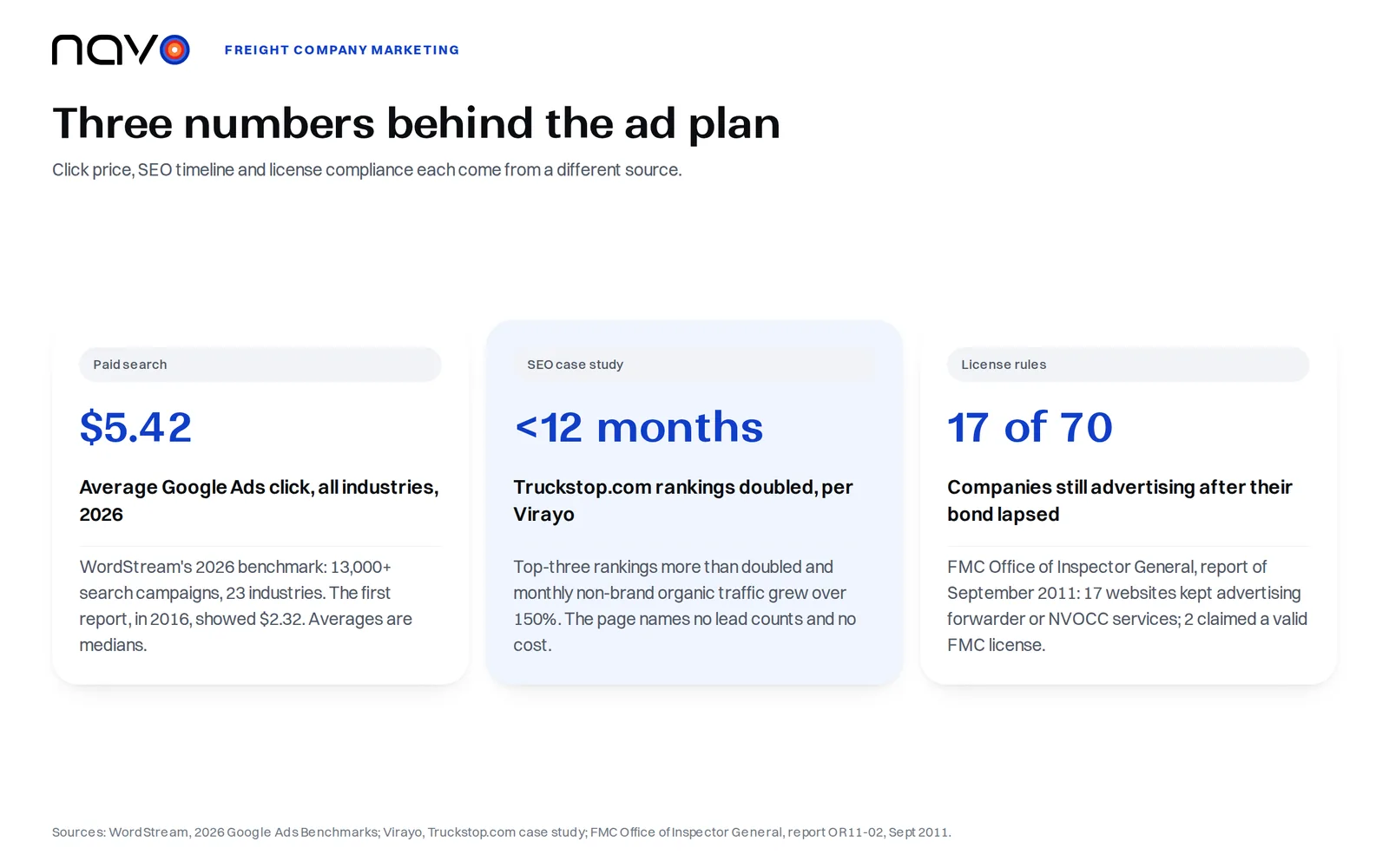
The OIG report does not say what happened to the 17 companies afterward. Truckstop’s page gives traffic growth and no revenue.
Frequently asked questions
Can a freight broker write "our trucks" in an ad?
Under 49 CFR 371.7(b) a broker may not, directly or indirectly, represent its operations to be those of a carrier, and any advertising has to show the broker status of the operation. Copy such as "our fleet" or "our trucks" sits badly with that sentence when the company only arranges the move.
Can a partner use my FMC license number in its own marketing?
No, unless the partner is your employee or agent. 46 CFR 515.31(c) bars an ocean transportation intermediary from letting anyone else use its name, license or license number. A separate company that sells OTI services in its own name needs its own license, proof of financial responsibility and, where it applies, a published tariff. A branch office can use the parent's license if its address was reported to the Commission.
Does the FMC license number have to appear on a forwarder's paperwork?
Yes, in two places. Under 46 CFR 515.31(a), when the licensee's name appears on shipping documents, its license or registration number must be included as well. Paragraph (b) requires the name and number to be permanently imprinted on office stationery and billing forms.