





















Maersk Line’s release of 26 June 2017 describes refrigerated containers that already carried a GPS unit, a modem and a SIM card. In the first six months of that year the system had flagged more than 4,500 incorrect temperature settings on customers’ reefers, according to Veconinter’s report of the release. Nine years on, container shipping technology is still part of the sale at Maersk and Hapag-Lloyd. Below: what the offers say and where their numbers stop.
Price and space come before sensors
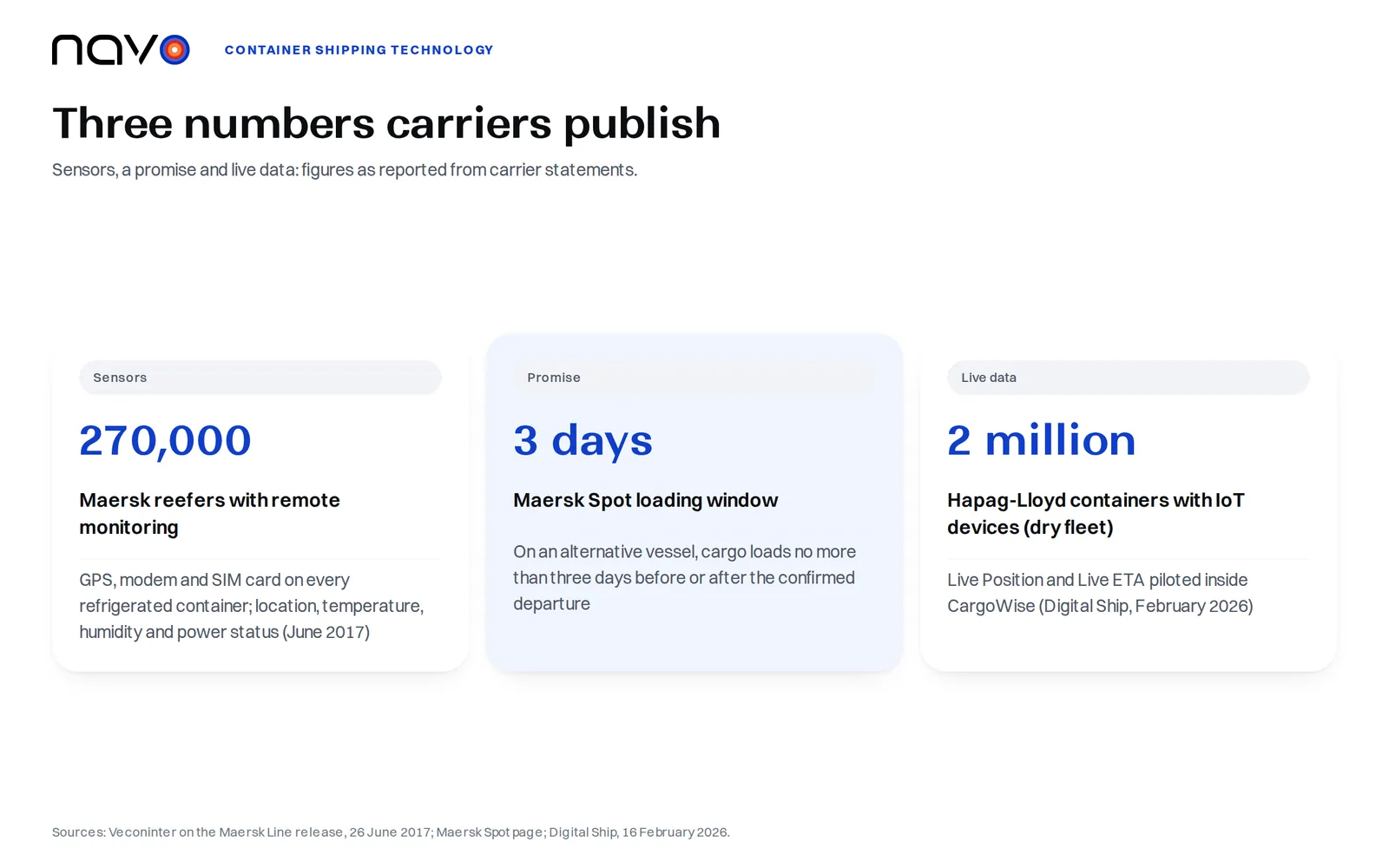
Buyers meet the carrier’s screen long before its sensors, so the quote form is often the first container shipping technology a customer meets. On Maersk Spot the shipper gets an instant price and a booking confirmation, and can amend the booking online and receive a revised confirmation. The loading guarantee sits next to the price. In Maersk’s own FAQ wording it is a space guarantee on the booked vessel, and a number appears only when the ship changes: cargo moved to an alternative vessel loads no more than three days before or after the scheduled departure confirmed in the booking. For bookings with an inland leg the promise remains on timely loading in the first ocean port, with the inland delivery made in time to catch the first vessel.
What happens when the guarantee fails is described on a different page. Maersk’s support FAQ says the shipper can apply for a compensation fee, Maersk reviews the case, and an eligible fee is applied to the invoice. For inland moves the fee applies only if Maersk fails to pick the cargo up in time for the vessel’s departure. So the guarantee works as a claim you file and Maersk reviews. Separately, the Spot page lets a shipper mark non-time-sensitive freight as rollable to get compensation in case of a rollover, and the page excerpt names no amount.
Hapag-Lloyd’s Quick Quotes takes the other road: a quote in 30 seconds, ocean and inland rates to 600 ports, no online negotiation. Most surcharges are in the price but not all, and the page sends the buyer to the local surcharge and inland cost pages for the rest. Maersk Spot, for its part, promises “all costs up front for the full shipping journey” and “no hidden charges”.
Live Position is bought with the quote
Hapag-Lloyd’s Live Position page says the tool is available for all dry containers equipped with a smart IoT device, and it explains where to buy it: inside a Quick Quotes quotation, or on an existing booking under Additional Services. There is a deadline: Live Position can be added only until the sea freight invoice is submitted. The price depends on who moves the box. With merchant haulage on both the export and import legs, or when Hapag-Lloyd moves the containers to an inland ramp, it costs USD 15 per container. If any leg runs on carrier haulage, a door move, Live Position is added automatically and free of charge.
The deadline is the detail a buyer should underline. A buyer who decides after the invoice is in cannot add it, and the haulage terms decide whether it costs anything. Compare two offers on freight alone and you may be comparing one with tracking against one without. The fee sheet the page links is dated 04/24, so check today’s charges.
Maersk’s 2017 RCM data came with a price structure. Access to Remote Container Management data was free to customers, and a subscription fee based on the number of containers shipped applied to downloading the data from a container’s full journey. During 2022 more than 80% of its reefer fleet was upgraded to report hourly instead of daily, and in March 2023 the Captain Peter Integrated release let a contractual customer pull the raw temperature log by API into its own transportation management system and give shippers and consignees a login to view shipment details. Maersk ties the hourly data to “reducing the risk of damaged goods and food waste.”
Hapag-Lloyd wants its data inside the software the buyer already runs. In February 2026 Digital Ship covered a pilot that pipes Live Position and Live ETA into WiseTech’s CargoWise. The article counts 2 million containers with IoT devices and claims a 75% gain in delivery time accuracy on door-to-door shipments the carrier manages, against static schedule forecasts. How to tell a truthful ETA from a hopeful one is covered in truthful ETAs, and a box from a covered carrier can be followed on the container tracking page.
Read the offer before you copy it
Each figure above has an edge, and the edges are where a buyer’s questions belong.
Price first. Hapag-Lloyd’s page says most surcharges are included, not all, and offers no online negotiation, so a Quick Quote set against a contract rate is not like for like until someone asks what sits outside it. Maersk’s loading window, when cargo moves to another vessel, runs three days before to three days after the confirmed departure: a six-day spread. On an inland booking the promise stays on timely loading in the first ocean port, and compensation applies only if Maersk fails to pick up the cargo in time for the vessel’s departure.
The reefer numbers date from 2017 and 2022. Veconinter’s report of the release gives the 4,500 alerts but not how many containers or customers triggered them, and nothing in these pages says what the Maersk fleet reports in 2026.
The 2 million is a count with three descriptions. Digital Ship writes “fleet of 2 million containers”, Hapag-Lloyd’s director says “entire dry container fleet”, and the Live Position terms say “the majority” of the fleet is equipped. Reefers sit in a separate product, Hapag-Lloyd LIVE, offered under its own terms. A shipper with special equipment should ask which product covers it, and whoever hears about the CargoWise pilot should ask whether the feed is live on their own account. The pilot is there to test whether WiseTech can ingest and process the data, and to refine data quality and usability with joint customers.
The 75% has no method behind it: no year, no shipment count, no baseline beyond “static schedule forecasts”. Anne Sophie Zerlang, then Head of Reefer at Maersk Line, said in 2017 that she expected RCM to lift perishable reefer volumes and open up pharmaceuticals. That is a forecast, and none of these pages reports whether it came true.
Hapag-Lloyd’s Annual Report 2025 says a global customer survey named it the leading provider worldwide for digital customer experience. The strategy line lists “#1 Digital CX vs. peers” as a target next to an NPS above 50. The excerpt shows no actual NPS and no survey name or sample, and none of these pages links bookings or revenue to any of the tools.
The sales effect is still unmeasured in any of these pages, and a forwarder who sells these tools can measure it. Pull last quarter’s quotes and count how many became confirmed bookings with no phone call, then repeat the count a quarter after your first change ships. Two habits are worth testing: a price page that says what the price leaves out, and one promise a buyer can check against the booking.
Frequently asked questions
Since when can Maersk customers see reefer conditions in Captain Peter?
Maersk's March 2023 release says customers have had visibility to the conditions inside its reefers through the virtual reefer assistant Captain Peter since December 2019. The 2023 release added the API data log.
Does Hapag-Lloyd Live Position cover reefers?
No. The Live Position page says it is available for dry containers equipped with a smart IoT device. Hapag-Lloyd's terms for Hapag-Lloyd LIVE, its separate reefer product, say the reefer fleet carries remote monitoring devices for position and data such as on/off time and temperature.
Can dangerous goods be selected in a Hapag-Lloyd Quick Quote?
According to the Quick Quotes page, the tool lets shippers choose from multiple container types and from commodities that include dangerous goods cargo. The page does not describe acceptance conditions for that cargo.