





















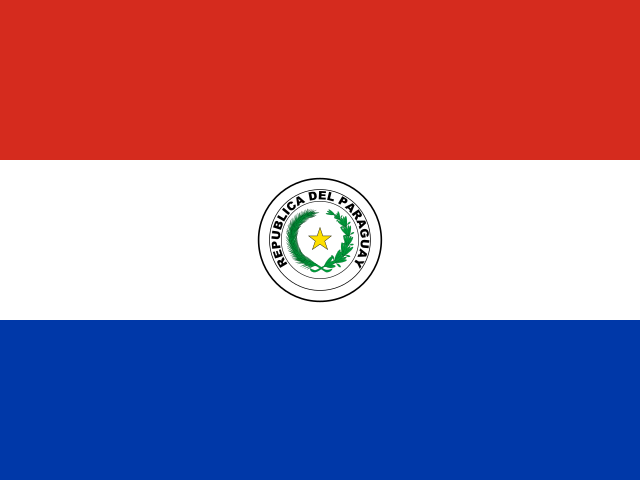
 Logistics services in Paraguay.
Latin America & Caribbean · Upper middle income · capital Asuncion · landlocked
Paraguay scores 2.7 of 5 on the World Bank Logistics Performance Index 2022, 84th of 169 countries: mid-table worldwide.
It has no sea coast. Ocean cargo moves through ports abroad; the closest by road is Rosario in Argentina, 1,025 km from Asuncion.
Its container ports handled 37,901 TEU in 2020 (147th in the world).
Merchandise trade in 2025: $11.1 billion exports and $19.1 billion imports.
Source: World Bank Open Data, latest year reported per indicator; ranks count only countries with data.
Paraguay logistics overview: modes, trade and gateways
Logistics services in Paraguay rely on river, road, and air connections. Cargo uses Puerto de Asuncion on the Paraguay River and road corridors to seaports in Argentina, Brazil, Uruguay, and Chile. Shippers can route containers and breakbulk via Rosario, Porto Alegre, Montevideo, and Antofagasta, at about 1,000 to 1,900 km from Asuncion. Air freight moves through three main international airports, while limited rail infrastructure supplements road haulage for specific links.
Customs, documentation, and tracking are supported by Paraguay’s participation in the WTO and Mercosur. The logistics performance index score of about 2.7, with customs at 2.4 and infrastructure at 2.5, indicates moderate efficiency with room for improvement. Tracked shipments and international shipments rate at 2.8 and 2.7, while timeliness is relatively stronger at 3.0, which helps time-sensitive cargo planning.
| Main exports | soybeans, beef, electricity, corn, soybean meal |
|---|---|
| Export partners | Argentina 33%, Brazil 25%, Chile 10%, USA 2%, Uruguay 2% |
| Main imports | broadcasting equipment, refined petroleum, fertilizers, cars, pesticides |
| Import partners | China 33%, Brazil 24%, USA 8%, Argentina 7%, Germany 2% |
Source: CIA World Factbook, top five goods and partners by value.
Freight forwarders in Paraguay
Freight forwarders in Paraguay need to coordinate inland legs from Asuncion to foreign seaports and manage river and road transits. Using road gateway ports such as Rosario, Porto Alegre, Montevideo, and Antofagasta, they arrange cross-border trucking and onward ocean freight. Offices of carriers like CMA CGM, COSCO, Evergreen, Hapag-Lloyd, MSC, Maersk, ONE, CNC, and ZIM in Asuncion support scheduling and documentation.
When selecting freight forwarders in Paraguay, shippers should look closely at performance in customs and infrastructure, where LPI scores are 2.4 and 2.5. Experience with main export goods such as soybeans, beef, electricity, corn, and soybean meal and import goods like broadcasting equipment, refined petroleum, fertilizers, cars, and pesticides is useful. Forwarders familiar with Mercosur procedures and Paraguay’s core partners in Argentina, Brazil, Chile, China, the USA, Uruguay, and Germany can streamline regional and global flows.
FCL and LCL shipping to and from Paraguay
FCL and LCL shipping from and to Paraguay moves through river and road corridors to seaports abroad. Puerto de Asuncion, classified as a very small port, serves river traffic with a cargo pier depth of about 1.8 m. The country handles about 38,000 TEU and ranks between 147th and 168th worldwide, with a relatively low liner shipping connectivity index of about 1.9.
For deep-sea container services, shippers typically truck FCL and LCL cargo from Asuncion to ports such as Rosario in Argentina, Porto Alegre in Brazil, Montevideo in Uruguay, or Antofagasta in Chile, over road distances of roughly 1,000 to 1,900 km. Major container lines including CMA CGM, COSCO, Evergreen, Hapag-Lloyd, MSC, Maersk, ONE, CNC, and ZIM maintain offices in Asuncion, which helps coordinate inland haulage, bookings, and documentation with ocean services on the east and west coasts of South America.
Gateway seaports for Paraguay
Paraguay has no sea coast. Shortest road distances from Asuncion to large and medium seaports abroad.
| Port | UN/LOCODE | Country | By road | Drive |
|---|---|---|---|---|
| Rosario | ARROS | Argentina | 1,025 km | 12.4 h |
| Porto Alegre | BRPOA | Brazil | 1,083 km | 15.5 h |
| Montevideo | UYMVD | Uruguay | 1,337 km | 16.4 h |
| Antofagasta | CLANF | Chile | 1,855 km | 23.1 h |
Road distance: OSRM on OpenStreetMap, car routing, 31 Oct 2026. Truck time is longer.
Shipping lines with offices in Paraguay
 CMA CGMAsuncion
 CNCAsuncion
 COSCOAsunción
 EvergreenAsuncion
 Hapag-LloydAsuncion
 MaerskAsuncion
 MSCAsuncion
 ONEAsunción
 ZIMAsuncion
Source: the lines' own office and agent pages, checked 25 Oct 2026.
Air freight in Paraguay
Air freight in Paraguay uses Silvio Pettirossi International Airport, Guaraní International Airport and Teniente Ramon A. Ayub Gonzalez International Airport, all handling scheduled traffic. Total air cargo volume is modest at about 1 million tonne-km, so capacity is smaller than in larger regional hubs.
Air transport makes sense for higher value imports like broadcasting equipment, refined petroleum products, specialized fertilizers, parts for cars, pesticides and time-sensitive components. For exports, air can complement river and road routes when moving urgent consignments of agricultural or industrial goods to main partners such as Argentina, Brazil, Chile, the USA and Uruguay.
Airports for air cargo
3 airports with scheduled passenger and cargo service.
AGTGuaraní International AirportCiudad del Este · SGESASUSilvio Pettirossi International AirportAsunción · SGASENOTeniente Ramon A. Ayub Gonzalez International AirportEncarnación · SGENSource: OurAirports open data.
Rail and road freight in Paraguay
Rail and road freight in Paraguay provide the inland backbone to connect with foreign seaports and neighboring markets. The rail network extends about 30 km and plays only a minor role compared with road transport. Border road crossings link Paraguay to Argentina over about 2,531 km, Brazil over about 1,371 km, and Bolivia over about 753 km, enabling truck-based trade flows.
Typical road corridors run from Asuncion to gateway ports such as Rosario, about 1,025 km away, Porto Alegre at roughly 1,083 km, Montevideo at about 1,337 km, and Antofagasta at roughly 1,855 km. Road haulage carries export commodities like soybeans, beef, electricity, corn, and soybean meal to these ports, and brings in imports such as broadcasting equipment, refined petroleum, fertilizers, cars, and pesticides. Road performance and border procedures matter, given Paraguay’s landlocked position and dependence on these corridors.
| Railway network | 30 km |
|---|---|
| Land borders | Argentina 2,531 km; Bolivia 753 km; Brazil 1,371 km |
Source: CIA World Factbook.
Customs clearance in Paraguay
Paraguay is a member of the World Customs Organization, with membership recorded since 1969, and participates in the World Trade Organization and the Mercosur trade bloc. The average applied tariff is about 4.63 percent, shaping duty exposure for most imports. On the logistics performance index, customs scores 2.4 compared with a world median of 2.6, indicating slightly less efficient procedures than the global midpoint.
Median import and export tariffs are complemented by relatively short border processing times. Exports take about 3 days and imports about 2 days. For customs clearance, shippers should prepare a commercial invoice, packing list and transport document aligned with declared HS codes and values. Close coordination with local brokers helps manage inspections and ensure that documents match cargo and contractual terms.
| World Customs Organization | Member since 1969 |
|---|---|
| World Trade Organization | Member |
| Trade and economic blocs | Mercosur |
| Average applied tariff | 4.6% (2022, weighted mean, all products) |
| LPI customs score | 2.40 / 5 (world median 2.6) |
| Export lead time, port or airport | 3.0 days median (2018) |
| Import lead time, port or airport | 2.0 days median (2012) |
Every shipment needs at least a commercial invoice, a packing list and a transport document (bill of lading, air waybill or CMR). See Incoterms for who clears customs at each end.
Sources: Wikidata (customs authority, WCO membership), CIA World Factbook (WTO, blocs), World Bank (tariff, LPI, lead times). Rules change; confirm with a licensed customs broker.
Logistics Performance Index 2022: Paraguay
Six survey scores from 1 to 5. The grey tick is the world median. Every LPI component sits at or below the world median; customs trails it the most.
Source: World Bank LPI, survey of logistics professionals.
Logistics in Paraguay: FAQ
Which seaports serve Paraguay?
Paraguay is landlocked. By road from Asuncion: Rosario, Argentina (1,025 km); Porto Alegre, Brazil (1,083 km); Montevideo, Uruguay (1,337 km). Containers continue by truck or rail.
How does customs clearance work in Paraguay?
Paraguay has been a World Customs Organization member since 1969. Average applied tariff: 4.6% (2022). LPI customs score 2.4 against a world median of 2.6.
Which shipping lines have offices in Paraguay?
CMA CGM, CNC, COSCO, Evergreen, Hapag-Lloyd, MSC, Maersk, ONE and 1 more, according to the lines' own office pages.
How to choose a freight forwarder in Paraguay?
Freight forwarders in Paraguay need to coordinate inland legs from Asuncion to foreign seaports and manage river and road transits. Using road gateway ports such as Rosario, Porto Alegre, Montevideo, and Antofagasta, they arrange cross-border trucking and onward ocean freight. Offices of carriers like CMA CGM, COSCO, Evergreen, Hapag-Lloyd, MSC, Maersk, ONE, CNC, and ZIM in Asuncion support scheduling and documentation.
How good is logistics in Paraguay?
Paraguay scores 2.7 of 5 on the World Bank LPI 2022, 84th of 169. Every LPI component sits at or below the world median; customs trails it the most.
Which airports in Paraguay handle air freight?
Airports with scheduled service: Guaraní International Airport (AGT), Silvio Pettirossi International Airport (ASU), Teniente Ramon A. Ayub Gonzalez International Airport (ENO).
Neighbours and Latin America & Caribbean
 Argentina · LPI 2.8
 Bolivia · LPI 2.4
 Brazil · LPI 3.2
 The Bahamas · LPI 2.7
 El Salvador · LPI 2.7
 Dominican Republic · LPI 2.6
 Guatemala · LPI 2.6
 Ecuador · LPI 2.9
Data built 31 Oct 2026. Text written from these figures and checked against them. Flags: flag-icons (MIT). Something out of date? [email protected].