





















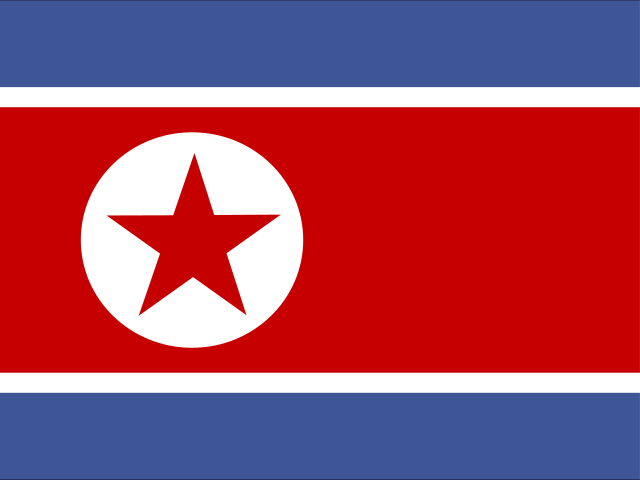
 Logistics services in North Korea.
East Asia & Pacific · Low income · capital Pyongyang
The World Port Index lists 8 ports here; the biggest is Nampo (KPNAM).
Merchandise trade in 2025: $611 million exports and $2.9 billion imports.
Source: World Bank Open Data, latest year reported per indicator; ranks count only countries with data.
North Korea logistics overview: modes, trade and gateways
International freight moves by sea, air and rail. The country has a coastline of about 2,495 km and around 10 seaports, with 8 listed in port indexes. Nampo, Najin, Ch'ongjin, Hungnam and Wonsan are among the main seaports and all have rail connections to the hinterland.
Air freight uses a small network of scheduled airports, led by Pyongyang Sunan International Airport together with Orang (Chongjin), Sondok and Wonsan Kalma. Rail covers about 7,435 km, linking ports and border crossings with China, South Korea and Russia. Cross-border trade is heavily oriented to China, which accounts for about 74% of exports and about 97% of imports.
| Main exports | fake hair, iron alloys, tungsten ore, electricity, cars |
|---|---|
| Export partners | China 74%, Poland 3%, Senegal 3%, Angola 3%, Austria 3% |
| Main imports | processed hair, plastic products, garments, fabric, soybean oil |
| Import partners | China 97%, Togo 1%, Peru 1%, Gabon 1%, India 0% |
Source: CIA World Factbook, top five goods and partners by value.
Freight forwarders in North Korea
When selecting freight forwarders in North Korea, align their strengths with the country’s specific trade patterns and infrastructure. Container connectivity is weak, with a liner shipping connectivity index of 0.89 in 2012 and a regional rank of 34 of 34, so experience consolidating services via foreign hubs is important.
Most trade is with China on both the export and import side, so forwarders familiar with Chinese partners and cross-border procedures are relevant. Seaport handling is centered on smaller ports such as Nampo, Najin, Ch'ongjin, Hungnam and Wonsan, which all have rail links. Use partners who can explain how their performance compares with global logistics practice, using the world median Logistics Performance Index scores of about 2.7 for overall logistics, 2.6 for infrastructure and 2.6 for customs as a reference point.
FCL and LCL shipping to and from North Korea
Sea freight uses a coastal network of about 10 ports, with 8 ports listed in global port indexes. Nampo and Najin are among the main container-capable seaports, supported by Ch'ongjin, Hungnam and Wonsan. All of these are classified as small ports, with cargo pier depths between about 4.9 m and 12.5 m, and rail access for inland moves.
Liner connectivity is limited, reflected in a liner shipping connectivity index of 0.89 in 2012 and a world rank of 168 of 169. The national merchant marine counts about 264 vessels, including around 10 bulk carriers, 5 container ships, 191 general cargo vessels, 29 oil tankers and 29 other ship types. Exports were about 611 million USD and imports about 2,869 million USD in 2025, so shippers typically plan FCL and LCL flows carefully around infrequent services.
Seaports in North Korea
8 ports in the World Port Index:6 small, 2 very small.
| Port | UN/LOCODE | Size | Harbour type | Cargo pier depth | Rail access |
|---|---|---|---|---|---|
| Nampo | KPNAM | SmallS | River (Natural) | 12.5 m | Yes |
| Najin | KPRJN | SmallS | River (Basins) | 9.4 m | Yes |
| Ch'ongjin | KPCHO | SmallS | Coastal (Natural) | 7.9 m | Yes |
| Hungnam | KPHGM | SmallS | Coastal (Breakwater) | 6.4 m | Yes |
| Wonsan | KPWON | SmallS | Coastal (Natural) | 4.9 m | Yes |
| Haeju Hang | KPHAE | SmallS | Coastal (Breakwater) | 3.4 m | Yes |
| Kimch'aek | KPSON | Very SmallXS | Open Roadstead | 9.4 m | Yes |
| Kyomip'o | KPSGN | Very SmallXS | River (Natural) | - | - |
Source: NGA World Port Index, Pub. 150. Depths are charted values, not today's draft limits. Old names are kept in brackets.
Air freight in North Korea
Airports for air cargo
4 airports with scheduled passenger and cargo service.
FNJPyongyang Sunan International AirportPyongyang · ZKPYRGOOrang (Chongjin) AirportHoemun-ri · ZKHMDSOSondok AirportSŏndŏng-ni · ZKSDWOSWonsan Kalma AirportWonsan · ZKWSSource: OurAirports open data.
Rail and road freight in North Korea
Rail and road freight in North Korea supports both seaborne and cross-border trade. The rail network is about 7,435 km long and connects to key ports including Nampo, Najin, Ch'ongjin, Hungnam and Wonsan, all of which have rail links.
Overland trade relies on borders with China, South Korea and Russia, with frontier lengths of about 1,352 km, 237 km and 18 km respectively. These routes connect port cities and inland production areas to primary trade partners, especially China.
| Railway network | 7,435 km |
|---|---|
| Land borders | China 1,352 km; South Korea 237 km; Russia 18 km |
Source: CIA World Factbook.
Customs clearance in North Korea
North Korea is not a member of the World Trade Organization and has no recorded date of accession to the World Customs Organization. Customs procedures should therefore be approached conservatively, using a clear commercial invoice, packing list and transport document for every shipment.
There is no national Logistics Performance Index score for direct comparison, but the world median gives a reference of about 2.6 for customs and 2.7 for logistics overall. Most trade is with a narrow group of partners, led by China for both exports and imports, so customs clearance is often framed around bilateral arrangements rather than broad multilateral rules.
| World Trade Organization | Not a member |
|---|
Every shipment needs at least a commercial invoice, a packing list and a transport document (bill of lading, air waybill or CMR). See Incoterms for who clears customs at each end.
Sources: Wikidata (customs authority, WCO membership), CIA World Factbook (WTO, blocs), World Bank (tariff, LPI, lead times). Rules change; confirm with a licensed customs broker.
Logistics in North Korea: FAQ
What are the main ports in North Korea?
By World Port Index harbour size: Nampo (KPNAM), Najin (KPRJN), Ch'ongjin (KPCHO), Hungnam (KPHGM). 8 ports in total.
How to choose a freight forwarder in North Korea?
When selecting freight forwarders in North Korea, align their strengths with the country’s specific trade patterns and infrastructure. Container connectivity is weak, with a liner shipping connectivity index of 0.89 in 2012 and a regional rank of 34 of 34, so experience consolidating services via foreign hubs is important.
Which airports in North Korea handle air freight?
Airports with scheduled service: Pyongyang Sunan International Airport (FNJ), Orang (Chongjin) Airport (RGO), Sondok Airport (DSO), Wonsan Kalma Airport (WOS).
Neighbours and East Asia & Pacific
 China · LPI 3.7
 South Korea · LPI 3.8
 Russia · LPI 2.6
 Japan · LPI 3.9
 Indonesia · LPI 3.0
 Philippines · LPI 3.3
 Australia · LPI 3.7
 Malaysia · LPI 3.6
Data built 31 Oct 2026. Text written from these figures and checked against them. Flags: flag-icons (MIT). Something out of date? [email protected].