





















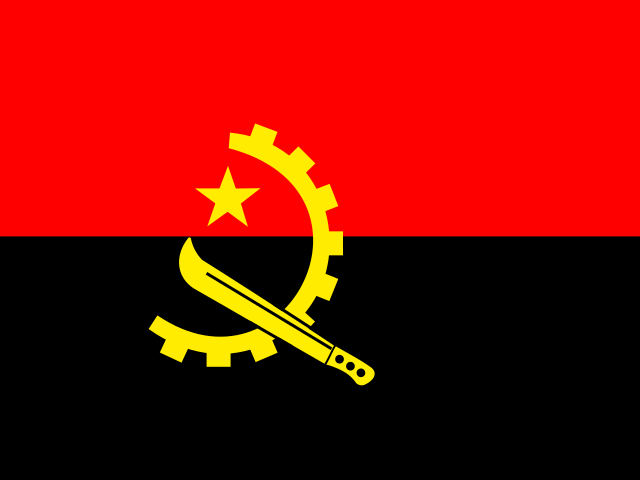
 Logistics services in Angola.
Sub-Saharan Africa · Lower middle income · capital Luanda
Angola scores 2.1 of 5 on the World Bank Logistics Performance Index 2022, 159th of 169 countries: in the lower third of the world ranking.
The World Port Index lists 16 ports here; the biggest is Lobito (AOLOB).
Its container ports handled 709,221 TEU in 2024 (82nd in the world).
Merchandise trade in 2025: $32.5 billion exports and $15.0 billion imports.
Source: World Bank Open Data, latest year reported per indicator; ranks count only countries with data.
Angola logistics overview: modes, trade and gateways
Logistics services in Angola rely on sea, air, rail and road connections along a long Atlantic coastline of about 1,600 km. Containers and bulk cargo move mainly through seaports such as Luanda, Lobito, Namibe and Cabinda, supported by several oil terminals including Malongo and Palanca.
Angola has about 2,761 km of railway, with rail access at ports like Lobito, Luanda and Namibe. Air freight uses a network of 14 airports with scheduled services, including international hubs at Luanda and Dr. Antonio Agostinho Neto International Airport. Cross-border road freight links to the Democratic Republic of the Congo, Republic of the Congo, Namibia and Zambia.
| Main exports | crude petroleum, diamonds, natural gas, ships, refined petroleum |
|---|---|
| Export partners | China 40%, India 9%, UAE 6%, Spain 6%, Netherlands 5% |
| Main imports | refined petroleum, wheat, ships, cars, trucks |
| Import partners | China 19%, Portugal 10%, UAE 7%, India 6%, USA 5% |
Source: CIA World Factbook, top five goods and partners by value.
Freight forwarders in Angola
Freight forwarders in Angola need strong experience with Luanda, Lobito, Namibe and Cabinda, as these handle container and oil-related trade. Angola’s logistics performance index is 2.1, below the world median of 2.7, with a customs score of 1.7, so shippers should check a forwarder’s track record with clearance and schedule reliability.
Major export flows go to China, India, UAE, Spain and the Netherlands, while imports come mainly from China, Portugal, UAE, India and the USA. Membership in the WTO, SADC and the AU shapes procedures and preferences, so a freight forwarder or customs broker for Angola should be comfortable working within these regional arrangements. Global shipping lines with local offices, such as Hapag-Lloyd, APL, CMA CGM, MSC, Maersk, COSCO and OOCL, can also be part of a coordinated routing plan.
FCL and LCL shipping to and from Angola
FCL and LCL shipping from and to Angola moves through a coastline of about 1,600 km, with 21 ports, including 17 oil terminals. Container traffic is about 709,000 TEU in 2024. Main commercial ports are Lobito, Luanda, Namibe and Cabinda, served by rail at Lobito, Luanda and Namibe. Key facilities include oil terminals such as Malongo, Palanca, Takula, Estrela Oil Field and others.
Liner shipping connectivity stood at 23.39 in 2021, placing Angola between 70 and 169 worldwide and between 6 and 32 in Sub-Saharan Africa. Global freight forwarders can work with several shipping lines with offices in Angola. Hapag-Lloyd, APL, CMA CGM, MSC and Maersk all have offices in Lobito and Luanda, with some also present in Namibe and Cabinda. COSCO and OOCL have offices in Luanda.
Seaports in Angola
16 ports in the World Port Index:7 small, 9 very small. The 12 largest are below.
| Port | UN/LOCODE | Size | Harbour type | Cargo pier depth | Rail access |
|---|---|---|---|---|---|
| Lobito | AOLOB | SmallS | Coastal (Natural) | 14.7 m | Yes |
| Luanda | AOLAD | SmallS | Coastal (Natural) | 10.5 m | Yes |
| Namibe | AOMSZ | SmallS | Open Roadstead | 10.5 m | Yes |
| Cabinda | AOCAB | SmallS | Open Roadstead | 3.4 m | - |
| Malongo Oil Terminal | AOMAL | SmallS | Open Roadstead | - | - |
| Palanca Terminal | AOPAT | SmallS | Open Roadstead | - | - |
| Takula Terminal | AOTAK | SmallS | Open Roadstead | - | - |
| Dalia Terminal | AODAL | Very SmallXS | Open Roadstead | 23.2 m | - |
| Greater Plutonio Terminal | AOGPO | Very SmallXS | Open Roadstead | 23.2 m | - |
| Porto Amboim | AOPBN | Very SmallXS | Open Roadstead | 10 m | - |
| Soyo Angola Lng Terminal | AOSZA | Very SmallXS | River (Natural) | 7.5 m | - |
| Porto Do Ambriz | AOAZZ | Very SmallXS | Coastal (Breakwater) | 5 m | - |
Source: NGA World Port Index, Pub. 150. Depths are charted values, not today's draft limits. Old names are kept in brackets.
Shipping lines with offices in Angola
 Hapag-LloydCabinda · Lobito · Luanda · Namibe
 APLCabinda · Lobito · Luanda
 CMA CGMCabinda · Lobito · Luanda
 MaerskLobito · Luanda · Namibe
 MSCLobito · Luanda · Namibe
 COSCOLuanda
 OOCLLuanda
Source: the lines' own office and agent pages, checked 25 Oct 2026.
Air freight in Angola
Air freight in Angola uses 14 airports with scheduled services and about 107 airports in total, with main cargo gateways including Dr. Antonio Agostinho Neto International Airport, Quatro de Fevereiro International Airport in Luanda, Albano Machado Airport, Cabinda Airport and Catumbela Airport. Recorded air freight volume reached about 71 million tonne-km in 2023.
Air makes particular sense for higher-value components and urgent shipments that support exports of crude petroleum, diamonds, natural gas and refined petroleum, and imports of refined petroleum, wheat, ships, cars and trucks. It also connects inland production to coastal ports when time is critical.
Airports for air cargo
14 airports with scheduled passenger and cargo service; the first 12 are listed.
NBJDr. Antonio Agostinho Neto International AirportLuanda (Ícolo e Bengo) · FNBJLADQuatro de Fevereiro International AirportLuanda · FNLUNOVAlbano Machado AirportHuambo · FNHUCABCabinda AirportCabinda · FNCACBTCatumbela AirportCatumbela · FNCTDUEDundo AirportChitato · FNDUSDDLubango Mukanka International AirportLubango · FNUBMEGMalanje AirportMalanje · FNMASSYMbanza Congo AirportMbanza Congo · FNBCSPPMenongue AirportMenongue · FNMEGXGNegage AirportNegage · FNNGVPENgjiva Pereira AirportNgiva · FNGISource: OurAirports open data.
Rail and road freight in Angola
Rail and road freight in Angola support coastal ports and inland trade flows. The rail network extends about 2,761 km and connects directly to ports such as Lobito, Luanda and Namibe, enabling inland moves of containers, bulk and oil-related cargo.
Road freight crosses borders with the Democratic Republic of the Congo, Republic of the Congo, Namibia and Zambia, using shared frontiers of 2,646 km, 231 km, 1,427 km and 1,065 km respectively. These corridors link inland shippers and receivers to Angolan seaports rather than foreign gateway ports, since Angola is not landlocked.
| Railway network | 2,761 km |
|---|---|
| Land borders | Democratic Republic of the Congo 2,646 km (of which 225 km is the boundary of discontiguous Cabinda Province); Republic of the Congo 231 km; Namibia 1,427 km; Zambia 1,065 km |
Source: CIA World Factbook.
Customs clearance in Angola
Customs clearance in Angola takes place within a country that is a member of the WTO and the World Customs Organization, with WCO membership since 1990-09-26. Angola applies an average tariff of about 8.85 percent and participates in SADC and the AU, which can affect duties and procedures for regional trade.
The logistics performance index customs score is 1.7 compared with a world median of 2.6, indicating that clearance can be slower and less predictable than in many markets. Export and import lead times are both about 14 days, based on earlier data. For each shipment, shippers should prepare a commercial invoice, packing list and transport document aligned with Angolan requirements to limit delays.
| World Customs Organization | Member since 1990 |
|---|---|
| World Trade Organization | Member |
| Trade and economic blocs | SADC, AU |
| Average applied tariff | 8.8% (2022, weighted mean, all products) |
| LPI customs score | 1.70 / 5 (world median 2.6) |
| Export lead time, port or airport | 14.0 days median (2016) |
| Import lead time, port or airport | 14.0 days median (2016) |
Every shipment needs at least a commercial invoice, a packing list and a transport document (bill of lading, air waybill or CMR). See Incoterms for who clears customs at each end.
Sources: Wikidata (customs authority, WCO membership), CIA World Factbook (WTO, blocs), World Bank (tariff, LPI, lead times). Rules change; confirm with a licensed customs broker.
Logistics Performance Index 2022: Angola
Six survey scores from 1 to 5. The grey tick is the world median. Every LPI component sits at or below the world median; timeliness trails it the most.
Source: World Bank LPI, survey of logistics professionals.
Logistics in Angola: FAQ
What are the main ports in Angola?
By World Port Index harbour size: Lobito (AOLOB), Luanda (AOLAD), Namibe (AOMSZ), Cabinda (AOCAB). 16 ports in total.
How does customs clearance work in Angola?
Angola has been a World Customs Organization member since 1990. Average applied tariff: 8.8% (2022). LPI customs score 1.7 against a world median of 2.6.
Which shipping lines have offices in Angola?
Hapag-Lloyd, APL, CMA CGM, MSC, Maersk, COSCO, OOCL, according to the lines' own office pages.
How to choose a freight forwarder in Angola?
Freight forwarders in Angola need strong experience with Luanda, Lobito, Namibe and Cabinda, as these handle container and oil-related trade. Angola’s logistics performance index is 2.1, below the world median of 2.7, with a customs score of 1.7, so shippers should check a forwarder’s track record with clearance and schedule reliability.
How good is logistics in Angola?
Angola scores 2.1 of 5 on the World Bank LPI 2022, 159th of 169. Every LPI component sits at or below the world median; timeliness trails it the most.
Which airports in Angola handle air freight?
Airports with scheduled service: Dr. Antonio Agostinho Neto International Airport (NBJ), Quatro de Fevereiro International Airport (LAD), Albano Machado Airport (NOV), Cabinda Airport (CAB), Catumbela Airport (CBT) and 9 more.
Neighbours and Sub-Saharan Africa
 Republic of the Congo · LPI 2.6
 Namibia · LPI 2.9
 Zambia · LPI 2.5
 Cameroon · LPI 2.1
 Eritrea · LPI 2.1
 Sierra Leone · LPI 2.1
 Niger · LPI 2.1
 Burundi · LPI 2.1
Data built 31 Oct 2026. Text written from these figures and checked against them. Flags: flag-icons (MIT). Something out of date? [email protected].