





















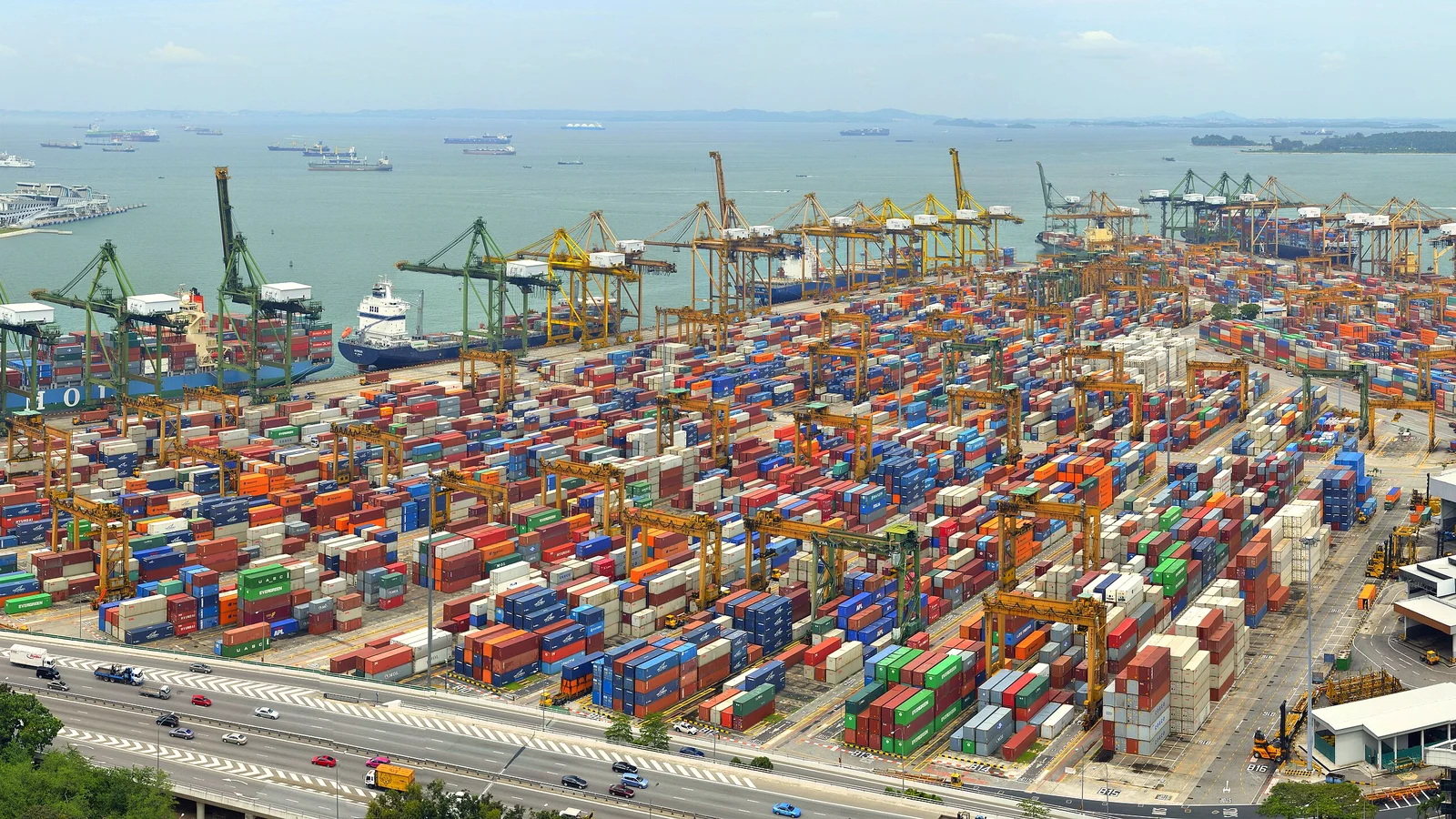
Which coast? That is the first decision in shipping from Singapore to the US. Inland cargo can land on the Pacific side and go on by rail, or sail to the east coast through Suez or round the Cape. The price depends on that pick, and the sailing distances put a number on the gap.
Pacific or Suez: the sailing distances
Navo24’s own route calculation, at a steady 14 knots with no port calls, no transhipment and no waiting, gives these distances and sailing times. From Singapore, Los Angeles is 7,777 nautical miles, about 23.1 days, straight across the Pacific. Seattle is 7,171, about 21.3 days. Going east through the Suez Canal, New York is 10,184 nautical miles, about 30.3 days, and Savannah 10,683, about 31.8. New York lies 2,407 nautical miles beyond Los Angeles, which is 7.2 days of steaming. Houston, also via Suez, is 11,766 and about 35 days.
Services take longer than that. ONE’s FP2 loop, to which ONE announced the addition of a Haiphong call in January 2026, runs Singapore, Laem Chabang, Cai Mep, Haiphong, Yantian and Pusan before it reaches Tacoma and Vancouver. A box loaded in Singapore on that rotation sees five other ports before the Pacific crossing, so the 21.3 days we calculated for Seattle (Tacoma is its neighbour on the same sound) are sailing time only. ONE’s VSE loop, in the network the line announced in December 2025, goes Singapore, Cai Mep, Haiphong and then Los Angeles/Long Beach, a shorter chain to the Pacific. On the east side, CMA CGM’s product sheet for its Columbus Suez service, dated May 2025 and marked non-contractual, prints 36 days from Singapore to New York and 43 to Savannah, against 30.3 and 31.8 days of steaming if the ship is still on Suez.
The Pacific route also adds a rail leg that the sailing figures leave out. Ask the forwarder to quote the rail days next to the ocean days.
Suez or Cape is now a line on the booking
ONE’s December 2025 announcement of its 2026 East-West network says the port rotations are based on routes via the Cape of Good Hope while the line watches the Red Sea. A later change is not confirmed on ONE’s pages. In that network the east coast loop EC3 reads Singapore, Colombo, Cape of Good Hope, New York, Jacksonville, Savannah and Charleston. The Journal of Commerce reported on 23 October that MSC and Zim have resumed the Suez Canal for a shared Asia-US East Coast service. JOC does not name the service in its free section or say whether it loads at Singapore.
For shipping from Singapore to the US east coast, two quotes for the same port pair can therefore assume different routings. A Cape routing is expected to be longer than the Suez figures above. Ask which service and which routing the price is built on.
Singapore is a hub, and the rotations show it. PSA calls its Singapore operation the world’s largest transhipment hub, with 44.5 million TEU handled in 2025. Take ONE’s PS3 loop: it reaches Singapore from Nhava Sheva and Pipavav, then stops at Cai Mep and Yantian before Los Angeles/Long Beach. Navo24’s schedules page lists each sailing with its transit time and transhipment legs, grouped by the physical vessel.
What the public rate indices show
Drewry’s World Container Index of 22 October 2026: Shanghai to Los Angeles USD 8,007 per 40-foot container, Shanghai to New York USD 10,166. Drewry leaves out surcharges for inland transport, so the rail leg inland comes on top of the Los Angeles figure.
On the Freightos Baltic Index page we saved on 23 October, FBX01 (China/East Asia to the North America West Coast) reads USD 8,126 and FBX03 (to the East Coast) USD 9,713, again per 40-foot container.
Drewry has no Singapore lane. The Freightos region does include Singapore among its origin ports, but FBX01 and FBX03 are regional benchmarks for China and East Asia, and neither index is a quotation. A price for inland US delivery has to come as two options, with the rail leg on its own line. Navo24’s freight page shows spot rates from Asia carrier by carrier, and a Singapore port pair has to be looked up there.
Duty in October 2026: the free-trade rate and 12.5% on top
Goods that qualify as originating under the US-Singapore Free Trade Agreement enter under the SG symbol (HTSUS General Note 25). CBP says the agreement provided for a complete duty phase-out by 1 January 2013 and that SGFTA goods are free of the merchandise processing fee. The preference is claimed on the entry summary by putting the letters SG in front of the HTS subheading. Goods under the Integrated Sourcing Initiative use tariff item 9999.00.84 instead (19 CFR 10.510).
Products of Singapore carry 12.5% under heading 9903.05.68 if they were entered on or after 12:01 a.m. eastern time on 24 July 2026 (CBP guidance CSMS 69326983, Federal Register notice 91 FR 47318). Before it, a 10% tariff under Section 122 applied, which Singapore Customs says has expired.
Why does an SG claim not help? Note 52 to the chapter 99 subchapter covers products eligible for special tariff treatment under General Note 3(c)(i), a list that includes SG, and subjects them to the additional duty unless the note provides otherwise. The duty is 12.5% of entered value. Some products are named as exempt, so the broker checks the HTS number against that list.
Is it still in force? On 8 September 2026 Singapore’s trade minister told parliament that the 12.5% rate follows from Singapore having neither an import ban on goods made with forced labour nor an Agreement on Reciprocal Trade with the US, and that talks with USTR continue. Neither the CSMS nor the notice sets an end date. Check the status again before booking.
Filings before the container is loaded
The Importer Security Filing, known as 10+2, is due no later than 24 hours before the cargo is loaded on the vessel at Singapore (19 CFR 149.2(b)). Eight elements are due by then: seller, buyer, importer of record number, consignee number, manufacturer, ship-to party, country of origin and the HTS number. The container stuffing location and the consolidator follow as early as possible, and no later than 24 hours before arrival at a US port. A late, inaccurate or incomplete filing can cost USD 5,000 per violation in liquidated damages, CBP says. Brokers and software vendors file it for the importer.
Entry normally follows within 15 calendar days after landing, though the entry documents can go in before arrival. They are CBP Form 3461 or its electronic equivalent, evidence of the right to make entry (usually the bill of lading), the commercial invoice and a packing list where appropriate. The entry summary, CBP Form 7501, goes in with estimated duties within 10 working days after entry unless it is filed at the time of entry. Goods are generally not released until a single-entry or continuous customs bond is on file (19 CFR 142.4(a)).
The 24-hour clock starts before the box leaves Singapore, so the US importer’s number, the manufacturer’s details and the HTS number have to reach the forwarder at booking, together with the supplier’s production records for the origin claim.
Frequently asked questions
Does a shipment under USD 2,500 still need an Importer Security Filing?
Yes, for cargo that arrives by vessel. 19 CFR 149.2(a) names bulk cargo as the exception, and CBP says a shipment valued under USD 2,500 can use a Type 11 (informal) ISF. The bond is a separate question. Under 19 CFR 142.4(c) a port director may waive the surety or cash deposit when the goods are worth no more than USD 2,500, the entry summary is filed and estimated duties are paid before release, and the importer has not been delinquent or otherwise remiss with Customs. The waiver does not apply to quota goods, goods that are hard to appraise or classify, or goods with a redelivery question.
Does the Singapore supplier have to issue a certificate of origin?
CBP's SGFTA page says a preference claim must be supported by a certificate of origin and offers a template that is optional, while 19 CFR 10.510 lets the importer base the claim on its own knowledge or on information in its possession. When CBP asks, a responsible official or authorized agent of the importer signs a supporting statement under 19 CFR 10.511, with the producer's details if known, the exporter's if different, the HTS classification, the rule of origin used and pertinent cost and manufacturing data. Get the production data from the supplier before the entry is filed.
My supplier loads in Singapore but made the goods in Malaysia. Which Section 301 rate applies?
Origin is the test, and the loading port is not. Heading 9903.05.68 covers articles the product of Singapore at 12.5%, and the same CSMS lists Malaysia separately under 9903.05.54 at 10%. The SG preference follows its own test in General Note 25: goods wholly obtained or produced in Singapore or the United States, or transformed there under the product-specific rules. Ask the supplier for production records and take them to the broker.