





















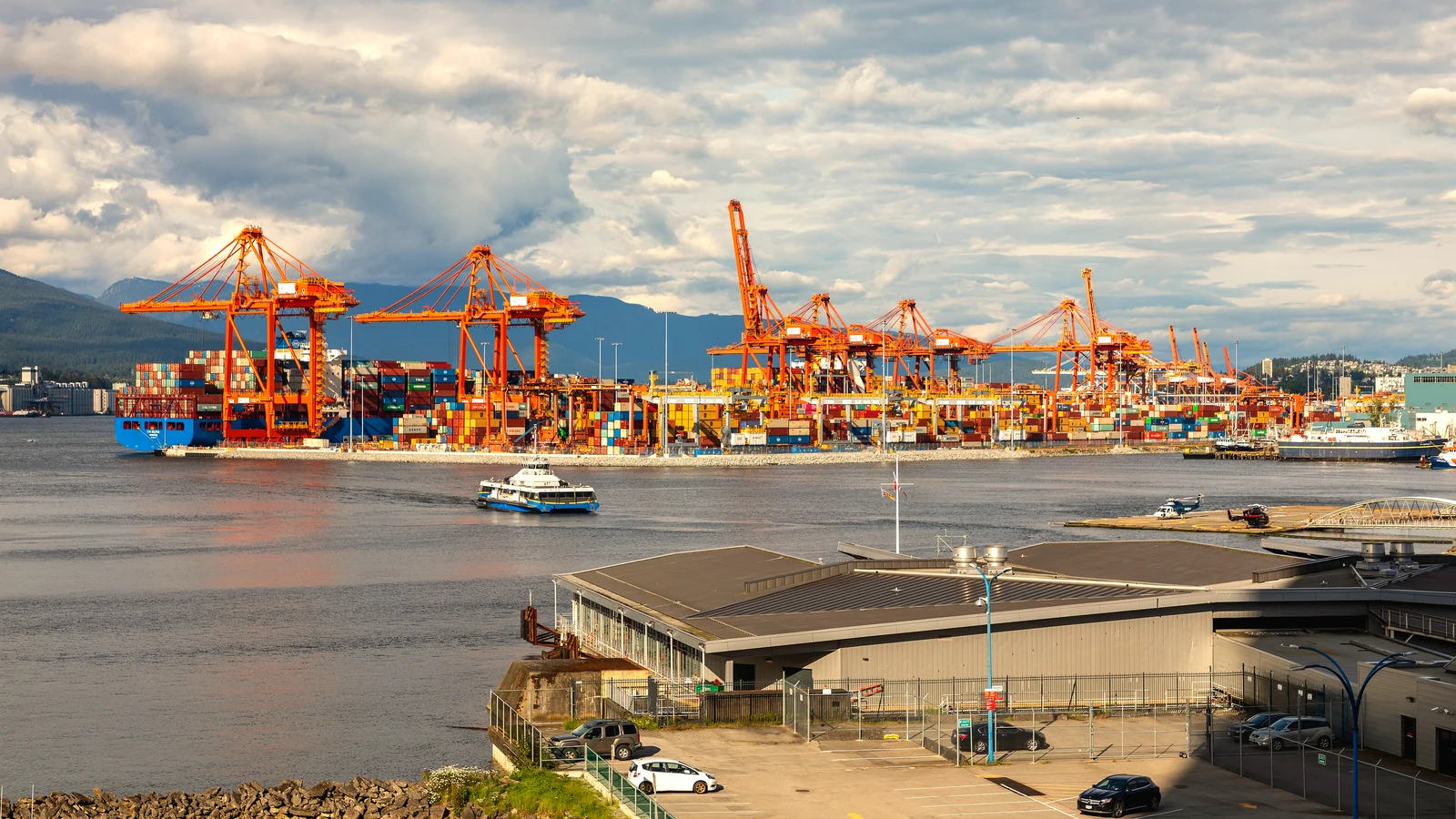
Shanghai to Prince Rupert is 5,000 nautical miles and Shanghai to Halifax through the Panama Canal is 11,031, according to Navo24’s route API. That gap frames the choice in shipping from China to Canada for a Toronto-bound container: a Pacific port with a train east, or the Atlantic side by sea.
The Panama route more than doubles the distance
Navo24’s route API returned six port pairs, computed at a steady 14 knots, with no port calls, no transhipment and no waiting. Shanghai to Prince Rupert comes out at 5,000 nm, or 14.9 days, and Vancouver at 5,165 nm, or 15.4. Yantian sits further south. From there Prince Rupert is 5,678 nm (16.9 days) and Vancouver 5,843 nm (17.4 days). The Panama routes are a different scale. Halifax is 11,031 nm from Shanghai, 32.8 days. Montreal is 11,988 nm, 35.7 days. These are calculated sailing times. Flexport Atlas, an aggregator, lists COSCO’s CPNW leaving Shanghai on day 6 and reaching Prince Rupert on day 17 by calendar days, so a scheduled service may still run faster than the 14-knot figure.
Compared with Prince Rupert, a Shanghai box to Halifax sails 6,031 nm more, about 18 days of steaming, and to Montreal 6,988 nm more. The two Pacific ports sit close together, since Prince Rupert is 165 nm nearer to Shanghai than Vancouver, about half a day. Prince Rupert’s port authority advertises 500 nautical miles and up to 60 hours saved against other Pacific Northwest ports. Against Vancouver, measured from Shanghai, the gap is the 165 nm above.
Which loops reach Canada first
The port authority prints the weekly services at its Fairview terminal on its terminal page. Gemini’s TP1/WC3 runs Yantian, Shanghai, Busan, Yokohama, then Prince Rupert and Vancouver. Ocean Alliance’s CPNW runs Yantian, Hong Kong, Ningbo and Shanghai, then goes to Prince Rupert. The page marks both as calling at Prince Rupert before any other West Coast port. On Ocean Alliance’s CEN loop a Shanghai box sees Long Beach first, and MSC’s Chinook reaches Seattle and Vancouver before Prince Rupert.
Vancouver and Tacoma rotations look different. The Yantian terminal’s schedule page showed Ocean Alliance’s OPNW1 running Kaohsiung, Yantian, Shanghai, Busan, Vancouver and Seattle on 23 October. ONE’s network notice of 15 December 2025 (for April 2026) lists three loops that call at Vancouver and Tacoma. PN3 sails Ningbo, Shanghai, Busan, Vancouver, Tacoma, so Canada comes first. PN1 and FP2 both reach Tacoma first. FP2 runs Yantian, Busan, Tacoma, Vancouver and calls at Shanghai and Ningbo only on the way back, and PN1 has no Shanghai call at all.
Each extra call comes on top of the sailing figures above, so the loop name and its full rotation tell you more than the port pair on a quote does. Navo24’s schedules group sailings by the physical vessel, which helps when two carriers sell slots on the same ship.
On the Atlantic side, ONE’s EC2 and the PEC2 loop on Yantian’s page both end at Halifax, after Savannah, Norfolk and New York. A Halifax box therefore sits behind three American calls. No loop on the pages we saved calls at Montreal, so its figure above is a calculation only.
Rail to Toronto, and what waits at the port
The port authority’s gateway page lists average rail time to Toronto at 4.5 days from Prince Rupert against 6 days from Seattle and from Los Angeles. CN’s own page for the port, dated 14 February 2024, gives 5.5 days. The two sources disagree by a day, and we did not find a first-party Vancouver to Toronto time. Dwell is the part that moves week to week. The port authority’s dwell release of 19 October 2026 shows Fairview average dwell for weeks 41 and 42 at 6.2 and 6.9 days in a row labelled Canada and 2.9 and 4.8 days in a row labelled U.S.A., without defining the rows. It forecasts 2.6 days for week 43 and an upward trend for week 44. Its status lines read that the terminal continues normal operations and is receiving increased rail supply as demand continues to increase.
Kuehne+Nagel’s port update for 14 to 20 October gives Vancouver a seven-day average vessel wait of about 2.6 days. It says delays continue and lists inland rail performance among the constraints.
C.H. Robinson’s update of 1 October calls Canadian West Coast delays an inland transit issue. For imports there it says to include terminal-to-rail transfer time when setting the expected final delivery date.
One metal, two tariff lines, two different bills
China has no CPTPP rate in Canada’s tariff: the CBSA’s 2026 list of countries shows China with MFN only. A Chinese box pays the MFN rate on its tariff line, and since 22 October 2024 some lines pay a surtax on top.
Two aluminum lines from Chapter 76 of the 2026 tariff, issued on 1 January 2026, show how far apart two bills can sit. Item 7615.10.00, table, kitchen or other household articles of aluminum, carries an MFN rate of 6.5%. Item 7604.21.00, aluminum hollow profiles, carries an MFN rate of Free. Schedule 2 of the China Surtax Order (2024) lists 7604.21.00 and omits 7615.10.00. Where a line is listed, the surtax is 25% of the value for duty on goods that originate in China. CBSA Customs Notice 24-36 adds that it sits on top of other duties owing, anti-dumping duties among them.
The household articles are the simple case. None of the three surtax schedules we checked lists 7615.10.00, so the duty is the MFN 6.5% of value for duty, before GST. The CBSA’s list of anti-dumping and countervailing measures in force names no household aluminum articles.
The profiles are harder. They start from an MFN of Free, add the 25% surtax, and can meet a separate measure. The CBSA’s aluminum extrusions measure (code AE) lists 7604.21.00.10 and 7604.21.00.90 among the tariff numbers usually used for the subject goods from China. The measure covers extrusions that fit its product definition and are not on its exclusion list. Where the exporter has not been issued its own normal values, the anti-dumping duty is 101% of the export price. Where it has not been issued its own amount of subsidy, the countervailing duty is 15.84 renminbi per kilogram.
Electric vehicles left the surtax on 1 March 2026, according to CBSA Customs Notice 24-32. Steel and aluminum remain in Schedule 2. The consolidated order on Justice Laws is current to 30 September 2026. Re-check the tariff line at booking.
A second order has applied since 31 July 2025. The Steel Goods and Aluminum Goods Surtax Order puts 25% on certain steel and aluminum goods that contain steel melted and poured in China or aluminum smelted and cast in China. CBSA Customs Notice 25-28 exempts goods that already carry the China surtax. It also sets a threshold: when the cumulative value for duty of the goods subject to this order on one Commercial Accounting Declaration does not exceed CAD 5,000, they are not subject to the surtax. Goods outside the order do not count toward the CAD 5,000. The 7604.21.00 profiles appear in this order’s schedule too. A third order, on steel derivative goods from all countries and in force since 26 December 2025, steps aside for goods already under either China measure.
What the CBSA needs, and when
A commercial importer needs three things in CARM: an account in the CARM Client Portal, a 9-digit business number and a 6-character import program account such as RM0001. The last two together form the 15-character BN15. The portal lets the importer delegate authority to a licensed customs broker. If the broker’s own number goes on the declaration, the broker is jointly responsible with the importer for the duties and taxes owing. The CBSA does not regulate brokerage fees and says to discuss them before hiring.
For containerized cargo loaded outside the United States, CBSA Memorandum D3-5-1 sets the cargo data deadline at 24 hours before loading. On consolidated freight, freight forwarders have to send house bill data to the CBSA, and the CBSA’s ACI page gives 24 hours for marine.
Rates: an index covers part of the lane
Drewry’s index dated 22 October 2026 shows USD 8,007 for a 40 ft box from Shanghai to Los Angeles. Its composite across the trade routes it covers is USD 4,585. Drewry names no Canadian lane. Freightos’ FBX01, China and East Asia to North America West Coast, read USD 8,126 per 40 ft box when we saved the page. Vancouver sits in that port basket without a price of its own. For shipping from China to Canada these indexes show where the Pacific market stands and give no price for Vancouver or Prince Rupert. Navo24’s freight page lists spot rates only for lanes that have live rates, each an indicative figure stamped with the date it moved, so check whether a Canadian lane is listed. A firm quotation is a separate step.
Start the account before the carriers answer
A non-resident importer has a first step that depends on the Canada Revenue Agency. It contacts the CRA for a business number, because only Canadian resident businesses can register for one inside CARM. Registration in the CARM Client Portal and enrolment in the importer program follow.
Frequently asked questions
Where does the China surtax go on the CARM declaration?
In field 85, Surtax, of the Commercial Accounting Declaration, together with the surtax code. CBSA Customs Notice 24-36 gives the codes 24187B for steel and 24187C for aluminum. An importer who uses the self-declare option in CARM calculates the amount itself and enters it in the same field. A refund of an overpaid amount is requested by adjusting the declaration through the CARM Client Portal, EDI or API.
Does the surtax still apply if the goods leave China through another country?
Yes. The surtax follows origin and ignores the route. CBSA Customs Notice 24-36 says it applies to goods that originate in China, meaning goods eligible to be marked as goods of China, and that it applies to commercial and personal importations even when they are shipped to Canada from a country other than China.
What happens if the cargo data changes after the forwarder has sent it?
The 24-hour clock starts again. CBSA Memorandum D3-5-1 says that before loading, electronic changes restart the 24 hour clock and a new estimated time of loading must be sent. The same memorandum says the CBSA systems can answer with a Do not load message.