





















SeaRates published three tips for forwarders on 21 September 2020: automate office work, build partnerships across sectors and countries, and set cost benchmarks. It also called freight factoring the best way to keep cash flow positive. No tip came with a figure, and freight forwarder profitability fits into one split the post never shows. McKinsey’s 2022 analysis of forwarder earnings says that between 62 and 85 percent of a forwarder’s revenue goes into buying carrier capacity, and that EBIT margins run 1 to 11 percent. The cost and factoring tips are set below against figures from McKinsey, Kuehne+Nagel, IATA, FCI and the US Federal Reserve. The automation tip meets only IATA’s paperless billing for air freight, and the partnership tip has no comparable data and stays with the original post.
Carriers take 62 to 85 of every 100
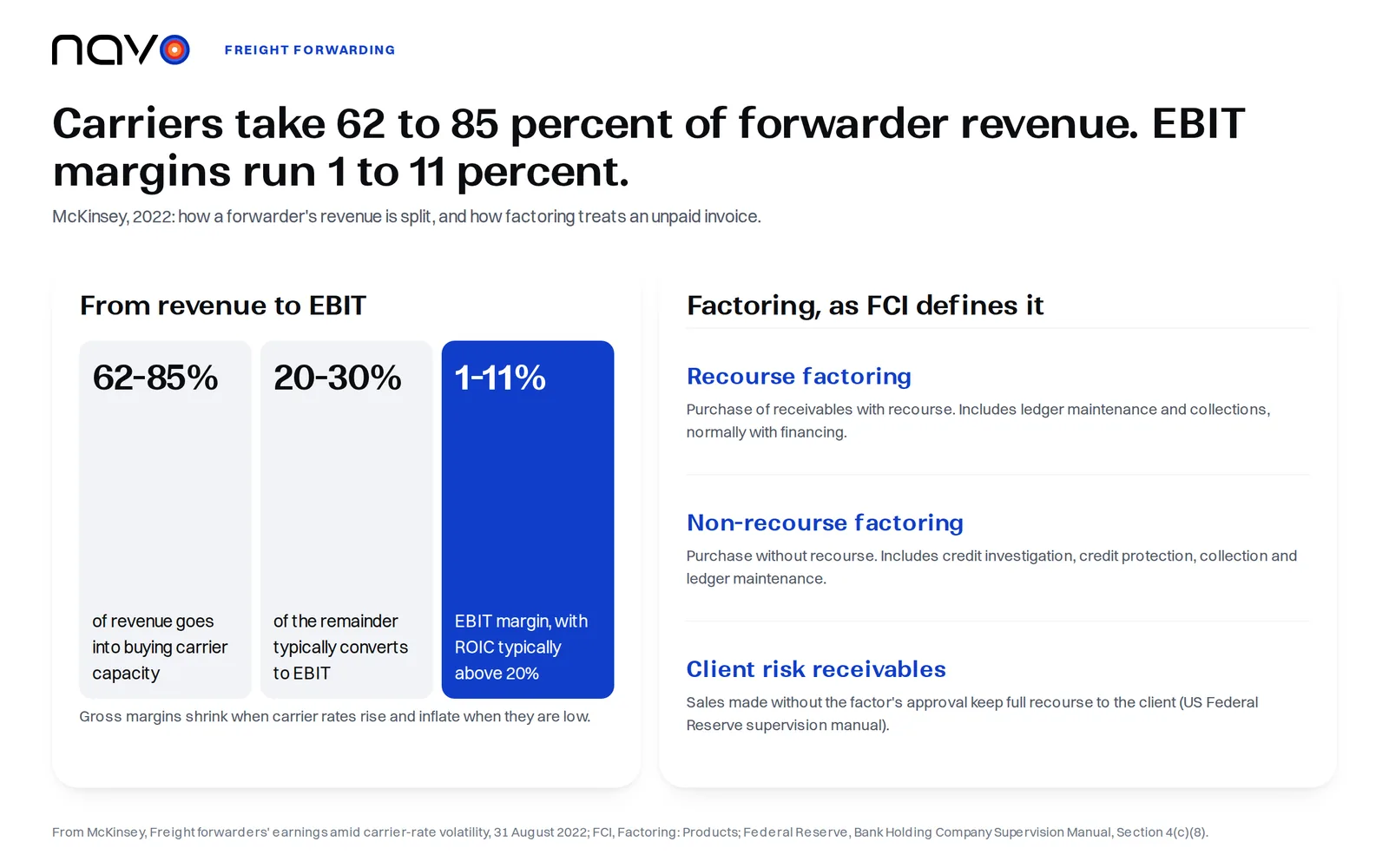
Take 100 of revenue. McKinsey’s figures leave 62 to 85 of it with the carrier. Of what remains, forwarders typically convert 20 to 30 percent into earnings before interest and taxes (EBIT), and because they own few assets, return on invested capital typically stays above 20 percent. On those ranges that is 15 to 38 of gross profit and about 3 to 11 of EBIT, which sits inside McKinsey’s 1 to 11 percent margin range.
The split moves with the rate cycle. For both ocean and air freight, gross profit margins shrink when carrier rates rise and inflate when rates are low, while absolute profit improves as rates rise. McKinsey wrote in 2022, with margins at a ten-year low and rates at their highest, and expected carrier rates to fall and forwarders’ earnings to trend down.
Kuehne+Nagel’s 2024 annual report gives figures for a listed forwarder, and not all of them fall inside that 20 to 30 percent. Group EBIT was 19.1 percent of gross profit in 2024 against 21.7 percent in 2023. In Sea Logistics the same ratio went from 58.1 percent in 2022 to 43.8 in 2023 and 41.1 in 2024, while the division’s gross profit fell from CHF 3,479 million to CHF 2,073 million over those two years.
Day 7 against day 45
A Tier2 Systems blog post from 14 April 2026 gives one vendor’s scenario: the forwarder pays the carrier on 7-day terms and collects from the customer on 45. Tier2 sells forwarding software, so read the page as a pitch. What follows is the author’s arithmetic on those two dates and McKinsey’s split. For 38 days the forwarder is out of pocket by 62 to 85 of every 100 billed, and the profit it is waiting on is 3 to 11. The carrier bill is roughly 6 to 28 times that EBIT. That pairs the opposite ends of the two ranges.
For freight forwarder profitability on a lane, the carrier cost can be compared with current Asia-origin ocean spot rates by carrier.
Air freight has a published settlement scheme. IATA’s Cargo Accounts Settlement System (CASS) bills and settles accounts between airlines and forwarders. IATA lists consolidated invoicing across participating airlines, a single-payment settlement process, paperless billing and reconciliation, and a digital dispute workflow. FlexiPay, its payment-terms option, covers prepayment and extended terms. CASS operates in more than 90 countries and territories and serves over 20,000 industry participants, IATA says.
What an 80 to 90 percent advance covers
The original post calls factoring the best way to keep cash flow positive, and compares it with nothing. FCI supplies the number: in international export factoring the export factor pays 80 to 90 percent of the invoice in advance, backed by the import factor’s buyer risk coverage. FCI describes this for exporters’ invoices to foreign buyers. Before fees and reserves, a 90 percent advance would cover the carrier bill even at the top of McKinsey’s range; an 80 percent advance would leave a file with an 85 percent carrier share 5 short. That pairing is the author’s, not FCI’s or McKinsey’s.
FCI describes recourse factoring as the purchase of receivables with recourse, with ledger maintenance and collections, normally with financing, and non-recourse factoring as purchase without recourse, with notification, with or without financing, and with credit investigation, credit protection, collection and ledger maintenance.
Non-recourse has a catch that the Federal Reserve’s supervision manual spells out, though the manual covers factoring in general, not forwarding. The usual process has the client contact the factor’s credit department before filling a sales order on credit terms. Sales made without the factor’s approval are client risk receivables, with full recourse to the client if the customer fails to pay. The manual lists the most common reasons for rejection: sales to affiliates, sales to known bad risks, sales to customers whose credit cannot be verified, and sales to customers whose outstanding payables exceed the factor’s credit line. A rejected sale can still be completed, at the client’s own risk.
Frequently asked questions
Does non-recourse factoring cover a disputed freight invoice?
Not automatically. The US Federal Reserve's supervision manual describes a typical factoring agreement in which receivables subject to shipping disputes and errors, returns and adjustments are chargeable to the client, because they do not represent bona fide sales. Read the contract for that clause before assuming a non-recourse deal absorbs every unpaid invoice.
Does a forwarder need accreditation before joining IATA CASS?
Yes. IATA's CASS page says any freight forwarder must first be accredited by the IATA Cargo Agency Accreditation/Cargo Intermediary or CASS Associate in order to join CASS. IATA says the application takes only 25 days.
What is the difference between disclosed and undisclosed factoring?
In FCI's international factoring products, disclosed (notified) factoring has the export factor oblige the exporter to inform the buyers about the assignment and ask them to pay only the import factor. In undisclosed factoring the buyers keep paying the supplier directly, and the factors agree a disclosure period, usually 30 to 60 days after the due date.