





















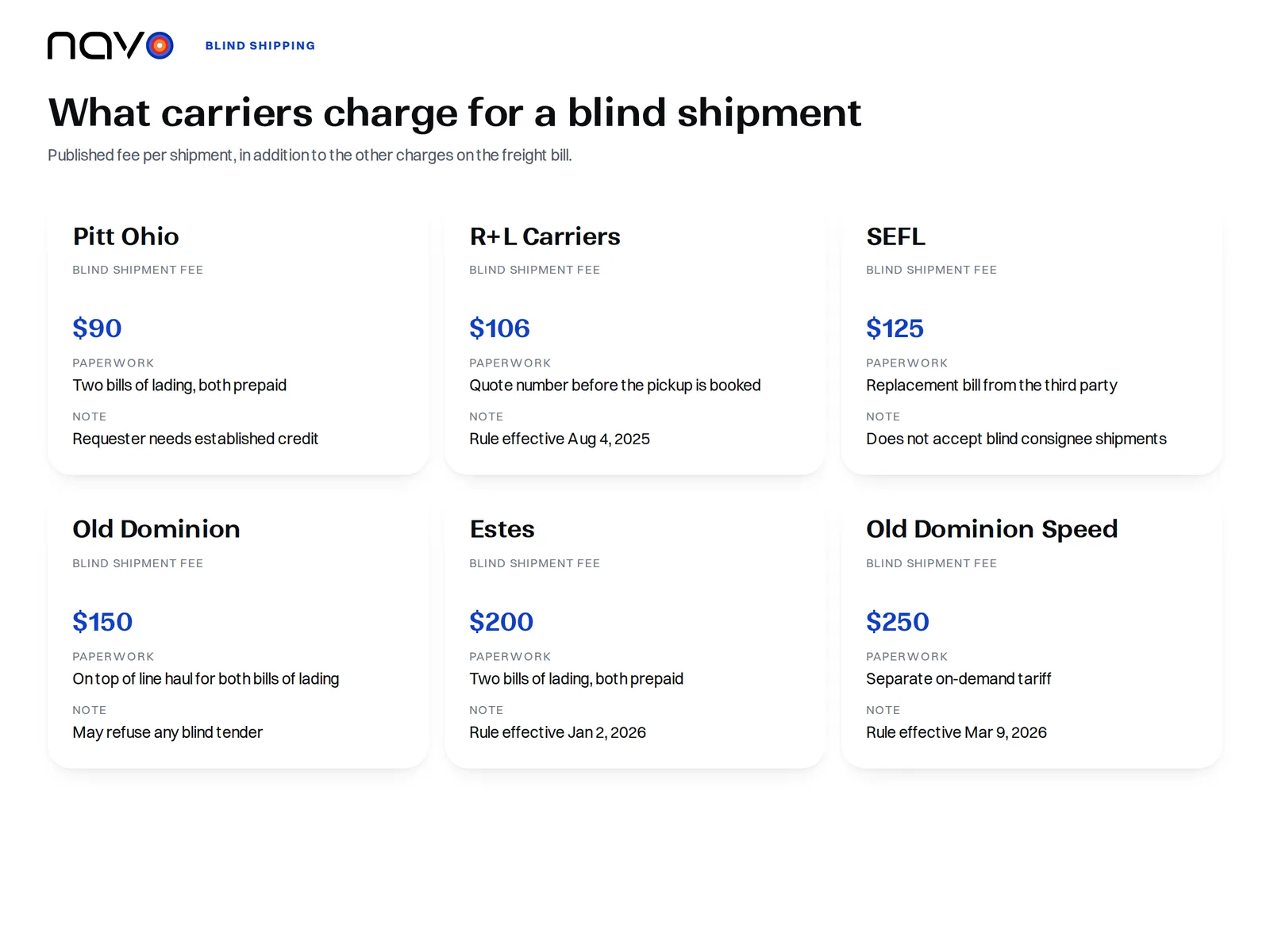
Blind shipping costs $90 at Pitt Ohio, $106 at R+L Carriers, $125 at Southeastern Freight Lines (SEFL), $150 in Old Dominion’s main rules tariff, $200 at Estes and $250 in Old Dominion’s Speed Service On Demand tariff. Each figure is the carrier’s own published rule, and the editions differ in date, so confirm the current number before you quote it to a customer.
The spread is $160 per shipment. Between Pitt Ohio and Estes alone the gap is $110. The fee is not the whole price either. Old Dominion’s tariff says its $150 comes on top of line haul charges for both bills of lading, and blind shipping needs two of them. The bill of lading number is also what you track an ocean container by, and Navo has a guide to tracking a container by bill of lading.
What the second bill of lading does
Unishippers says the arrangement keeps a manufacturer from attempting to do business directly with a distributor’s customer, or vice versa. Pitt Ohio’s tariff defines a blind shipment in one line: a third party controls the movement of the freight but does not want the shipper or consignee to know the name of the other.
The mechanics are close at Pitt Ohio, Saia, SEFL, Estes and Old Dominion. The physical shipper writes an original bill of lading that shows who is really loading the truck. It is consigned to a carrier terminal: Saia says the terminal serving the shipper, SEFL says the named shipper in care of its origin service center, Pitt Ohio and Estes say the third party in care of the terminal serving the consignee. The third party supplies a second, corrected bill (SEFL calls it a replacement). Pitt Ohio, Estes and Saia invoice from that one. Old Dominion spells out the legs: one bill from the pickup location to the carrier’s origin terminal, one from the terminal to the final consignee.
What the corrected bill says differs by carrier. At Pitt Ohio and Estes it names the third party as shipper, with the shipper’s city, state and zip code. At Saia it names the carrier itself as shipper.
The conditions that catch people
Every carrier named here asks for the request before pickup. SEFL’s blind shipment form says so in a disclaimer above all its fields, and the others say the same in their rules. At Pitt Ohio, Estes, Old Dominion and Saia a request that arrives late is handled as a reconsignment. At Old Dominion the provisions and charges of both the blind shipment and the reconsignment then apply. SEFL’s rules page lists a $70 charge under its reconsignment item for a change of consignor or consignee before delivery is tendered.
The rest is carrier by carrier:
- R+L Carriers wants a quote number from its rate department before the pickup is booked, and takes no responsibility for incorrect billing or delivery if the customer skipped that step. Its rules tariff also says every shipment must show the originating city and state of the pickup point.
- Old Dominion has no implied obligation to accept a blind shipment and may refuse any tender at any time. The requester agrees to defend and indemnify the carrier against claims that it lacked authority to control the freight.
- Estes and Pitt Ohio require established credit from the requesting party, and the charges, line haul included, must be billed prepaid to that party. Estes, like Pitt Ohio and Saia, says Section 7 of the bill of lading cannot be signed.
- Saia asks for a letter of authority before pickup.
- SEFL says on its form that it does not process or accept blind or hidden consignee shipments, and cannot accept them going to a partner carrier. Read its $125 figure with that exclusion in mind.
Confidentiality is not promised
Saia’s tariff says it will not ensure the confidentiality of the transaction. Pitt Ohio and Estes will make a diligent effort and take no responsibility if the service is not executed. A brokerage’s terms go further: Logistic Dynamics writes that neither it nor the motor carrier guarantees blind information will not become known, and it assumes no liability if a third party learns it, regardless of fault. Unishippers adds that if the wrong bill of lading is used, the freight can go to the wrong place or show the consignee where the shipment came from.
A 2014 FreightPros white paper describes how differently carriers treat a dummy bill. Some let the name, street and contact details be false but insist that city and zip code are right, others only check the zip code, and some accept any address at all. Unishippers says each carrier has a specific way of handling blind shipments, so check with the carrier before the freight moves.
DHL’s logistics dictionary draws the line this way: in a plain blind shipment only the buyer is kept in the dark, while in a double blind shipment the distributor hides the identity of the shipper and the buyer from each other. FreightPros counts three bills for double blind: a dummy bill at pickup, a dummy bill at delivery, and the real one the carrier keeps with both addresses correct.
A theft that used blind shipment techniques
In April 2026 trucks were loaded at the Lynn, Massachusetts warehouse of Global Protection Corp. with a Walmart-bound shipment valued at about $1.7 million. The shipment never arrived. The company told FreightWaves that hackers had allegedly taken over a legitimate carrier’s credentials, posed as a broker, hired real drivers and used blind shipment techniques to bypass its existing security procedures. The products have not been recovered.
For truckload shipments Global Protection now requires the power unit number, the driver’s name and the driver’s phone number on the bill of lading before freight is released, and its staff call the broker for a second confirmation.
That was a truckload case, and the LTL tariffs above do not mention it. What they do show is carriers asking the requester for proof: Old Dominion’s indemnity clause, Saia’s letter of authority before pickup.
Drop shipping on a marketplace is a different problem
Amazon’s drop shipping rules, as summarized in a Seller Forums post, require the seller to be the only seller of record named on packing slips, invoices and external packaging. Packing slips or other documents that identify a different seller or third-party supplier have to be removed before the order ships.
The post is dated 14 June 2023, so read the policy page itself before a listing depends on it.
Frequently asked questions
What does a carrier want from the party who orders a blind shipment?
Pitt Ohio says it must receive shipping instructions from the third party and be satisfied that the third party has the legal authority to control the shipment. It also requires established credit and bills the blind shipping charge and the line haul to that party, prepaid.
Do marking charges apply to a blind shipment at Pitt Ohio?
No. Pitt Ohio's blind shipment rule says the charges under its Item 581, Marking of Freight, do not apply to shipments handled under the blind shipment item.
What is blind drop shipping?
Unishippers says blind shipping is sometimes referred to as blind drop shipping. FreightPros describes a blind shipment as an LTL shipment where the shipping address, the consignee address, or both, are altered to keep their identity hidden from the opposite party.