

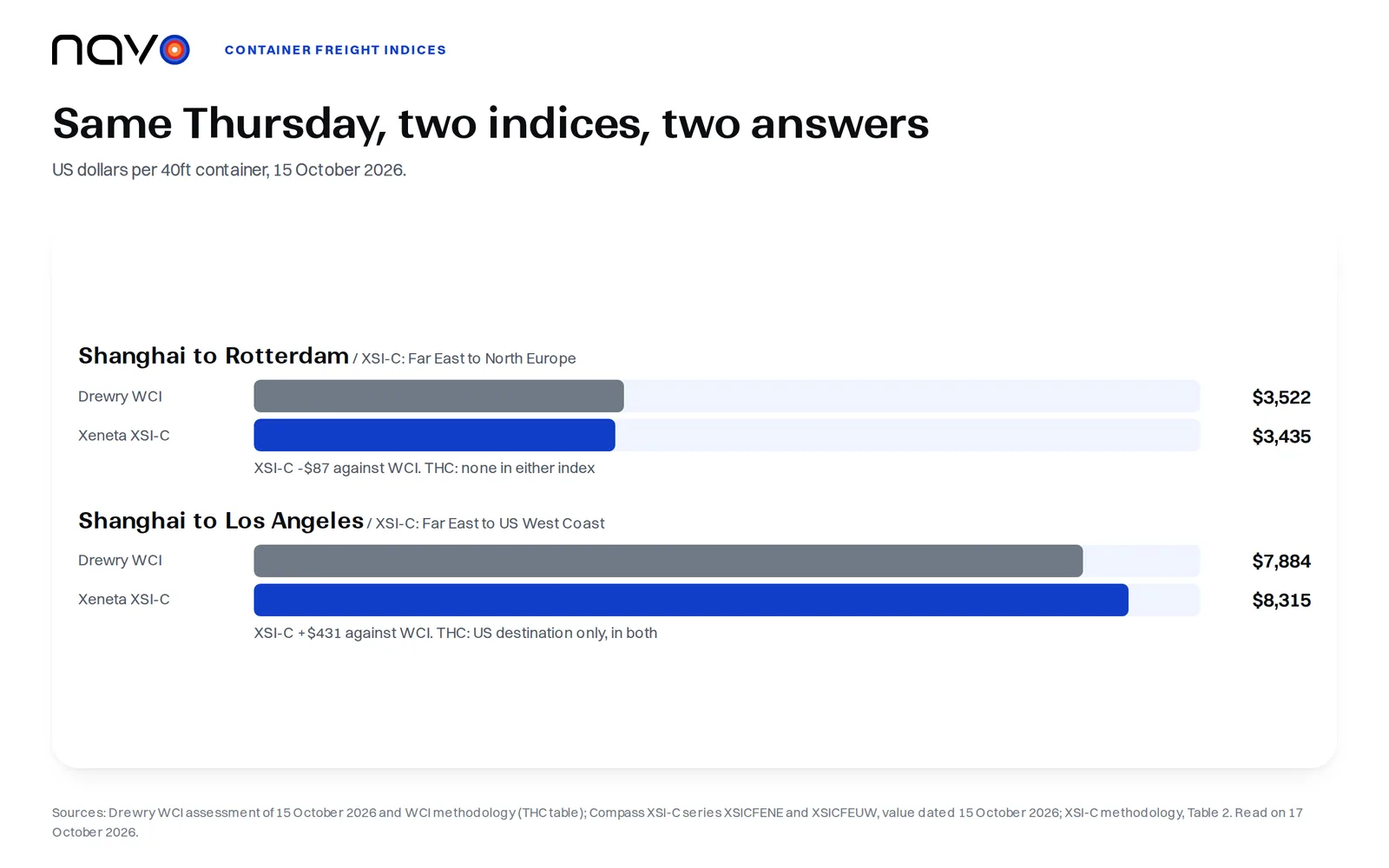
Two container benchmarks gave different answers on Thursday 15 October. Drewry published its weekly World Container Index that day, and the XSI-C, which Xeneta and Compass co-own, has a daily figure for the same date. Both quote the price of a 40ft box on the two big Asian export trades. Drewry uses single port pairs, Xeneta uses regions. The gap changed sign between the two trades.
In this freight rate index comparison, Asia to Europe comes first, where Drewry’s WCI put Shanghai to Rotterdam at $3,522. XSI-C for Far East to North Europe has a 15 October value of $3,435 in its series, which is $87 lower. Across the Pacific the order flipped. Drewry had Shanghai to Los Angeles at $7,884. The series for Far East to US West Coast shows $8,315 for that day, which is $431 higher. XSI-C moved by $4 and $7 the next day, so a day of timing explains little of gaps this size.
Level is only half of it. Drewry reported Shanghai to Rotterdam up 6% on the week, while the Compass series for Far East to North Europe went from $3,493 on 8 October to $3,435 on 15 October, $58 lower. A clause that adjusts the rate on the weekly change would have raised it under one index and cut it under the other. On the transpacific both rose, Drewry by 3% and the Compass series by $19, from $8,296.
The published THC rules do not explain these two gaps
Terminal handling charges (THC) are the first line to check when two indices differ. On these two lanes the methodology tables treat them alike. Drewry’s table excludes THC at both ends of Shanghai to Rotterdam, and the XSI-C table lists none for Far East to North Europe. On the transpacific both count the US destination THC and neither counts the Asian one. The XSI-C text is not uniform here: its outlier-check section speaks of origin and destination THC in general, and Table 2 sets the rule per lane, so the table is the line to quote.
The two part ways on the Atlantic. For New York to Rotterdam the WCI table includes THC at both ends, while XSI-C’s US East Coast to North Europe line carries destination THC only.
The Baltic Exchange’s benchmark statement says FBX covers container yard to container yard service and leaves out origin and destination port charges and import customs. Neither that statement nor the FBX Guide uses the term THC. The nearest wording is the exclusion of port charges, and it is not mapped to specific terminal fees, so how a given fee is treated is a question for the Baltic Exchange as administrator or Freightos as calculating agent.
A panel of forwarders against a pool of customer quotes
Drewry’s methodology describes a panel of forwarders and NVOCCs in Europe, North America and Asia, each sending up to four assessments a week per route. Only rates agreed with a carrier on cargo that moves or is expected to move count. Quotes, tariffs, estimates, bids and offers are out. Drewry takes the median, drops anything more than 30% away from it, averages by carrier, then averages the carrier averages. Shanghai to Rotterdam is a single port pair.
Xeneta’s pool is built differently. Its XSI-C methodology uses committed quotes reported by Xeneta customers, rolling short-term FAK rates valid for less than 32 days. Compass takes the median for each customer and carrier pair and weights those medians by the number of data points. A lane is a region: 24 Far East ports, seven in North Europe with UK ports left out, five on the US West Coast. Shanghai to Los Angeles is one pair inside that basket, next to Seattle and Oakland.
A weekly panel on a port pair and a daily customer pool across a region are different baskets, so a single lane should not be expected to give the same number in both, even with identical THC.
FBX is a third kind of number
FBX is produced jointly by Freightos as calculating agent and the Baltic Exchange as administrator, and it is built from tariffs, a different input from Drewry’s agreed rates. Per the Baltic Exchange statement, forwarders and NVOCCs enter rates in Freightos software, and the index is the median all-in port-to-port price for a 40ft box, weighted by carrier. It runs daily across twelve lanes, and a weekly average of the five business days comes out each Friday, according to the Freightos FAQ. The FBX lane pages read on 17 October show a current value with no date, so FBX is covered here for method only and stays out of the dated comparison above.
How old a tariff may be depends on the document. The Freightos FAQ describes rates created or modified in the last three months and valid inside a 48-hour window. The administrator’s FBX Guide, version 5.2 of April 2026, says 35 days, valid on or seven days before publication, and its revision history records the change from three months in February 2023. The benchmark statement, last updated 14 May 2025, still says three months, valid on the publication day. For FBX the version of the document matters.
What an index-linked clause has to name
Drewry calls WCI the go-to independent reference for index-linked contracts, and Xeneta calls XSI-C ready for index-linked contracting. Freightos makes a similar claim for FBX, so all three are describing their own product. The Baltic Exchange documents above disagree with each other on tariff age, and XSI-C Table 2 gives THC per lane, so an index-linked freight contract that holds up names one index in full, one lane, the unit and the publication day, and writes down the THC treatment for that lane. It does not average two indices, since the average has no published method behind it. Xeneta also publishes an XSI Contract Market index for contracts longer than 88 days, so “the Xeneta number” can mean either one, and its disclaimer says XSI-C may not be strictly representative of the rate level on a particular lane.
Between publication days a dated lane number is useful, and FreightRatesMCP on navo24.com shows 20ft, 40ft and 40HC spot prices per lane from public carrier and market listings, refreshed daily and stamped with the date the lane last moved, with a daily trend series. Navo describes it as an indicative spot number to anchor on before asking anyone for a quote. The page does not say it feeds any of the three indices.
A date to watch sits in Drewry’s 15 October note. Carriers are trying to push Asia-Europe FAKs of $4,500 to $4,800 per 40ft from 19 October, and Drewry calls success uncertain with more capacity returning through Suez. It expects Asia-Europe rates to stay stable next week.
Frequently asked questions
Can I pull index history for my lane before I sign a contract?
It depends on the index and the tier. Xeneta offers a CSV download of the XSI-C rates per trade lane, asks that the data is credited to the Xeneta Shipping Index by Compass, and says historical data or daily values come by email or through registration on the Compass site. Freightos says some FBX metrics are free and that data exports and more granular data need a paid account. Its platform page lists 30-day historical trends in the free access and five-year history in the full platform. Drewry publishes the weekly WCI assessment, and its methodology says only the final rate per route is released, never individual panellists or carriers.
Does Drewry count terminal handling on the return legs too?
It differs by lane. In the WCI methodology table, Rotterdam to Shanghai includes the European THC and excludes the Asian one, and Los Angeles to Shanghai includes the US THC and excludes the Asian one. New York to Rotterdam and Rotterdam to New York include THC at both ends. Shanghai to Genoa excludes it at both ends, like Shanghai to Rotterdam. The methodology adds that THC counts when it is common market practice to include it.
Will an index cover my port pair?
Drewry's World Container Index publishes eight trade lanes, XSI-C reports eight regional lanes and FBX covers twelve. For other pairs Drewry sells Container Freight Rate Insight, which it describes as covering 6,700 port pairs updated monthly and fortnightly depending on popularity. Xeneta says it holds benchmarks for more than 160,000 port pairs through its wider platform, and the public XSI-C lanes are regions of ports, so a single pair such as Shanghai to Los Angeles sits inside a basket.