

Shipping from the UK to the USA by container means the first eight data elements of a US security filing go in a day before loading in England, then 25 or 29 days to Savannah on the Georgia Ports tables. Georgia Ports publishes route maps for two weekly loops that call at Southampton, so that is the lane used here.
The deadline that falls before the ship does
CBP’s 10+2 rule counts back from the moment the cargo is laden aboard at the foreign port. The Importer Security Filing, ISF or 10+2, starts with seller, buyer, importer of record number and consignee number, which have to be with CBP, in English, 24 hours before that. The Georgia Ports table shows 25 days from Southampton to Savannah on TA2, and the filing deadline is tied to loading, so it falls before day one of that count.
The importer or its customs broker or other authorised agent files, and the importer of record number is the IRS, EIN or Social Security number of whoever owes the duties, or a number CBP assigned.
Manufacturer, ship-to party, country of origin and commodity number share that 24-hour deadline. For those four, the first filing may use the best data available, and it must be updated as soon as better data exists and no later than 24 hours before arrival. Container stuffing location and consolidator come last: as early as possible and no later than 24 hours before the ship reaches a US port. Miss the 24-hour deadline and CBP can claim $5,000 per violation in liquidated damages under the importer’s bond. CBP’s 2008 final rule says a demand is subject to mitigation case by case, with mitigation the exception and not the rule.
Two loops, and the port that is on neither
TA2 is run by Hapag-Lloyd and Maersk under Gemini. The Georgia Ports table gives 25 days from Southampton to Savannah and 15 back, and 17 from Hamburg, with Hamburg the fourth call on the Maersk rotation. Maersk announced on 23 June that the rotation would run Southampton, Antwerp, Rotterdam, Hamburg, Saint John, Charleston, Savannah and Norfolk.
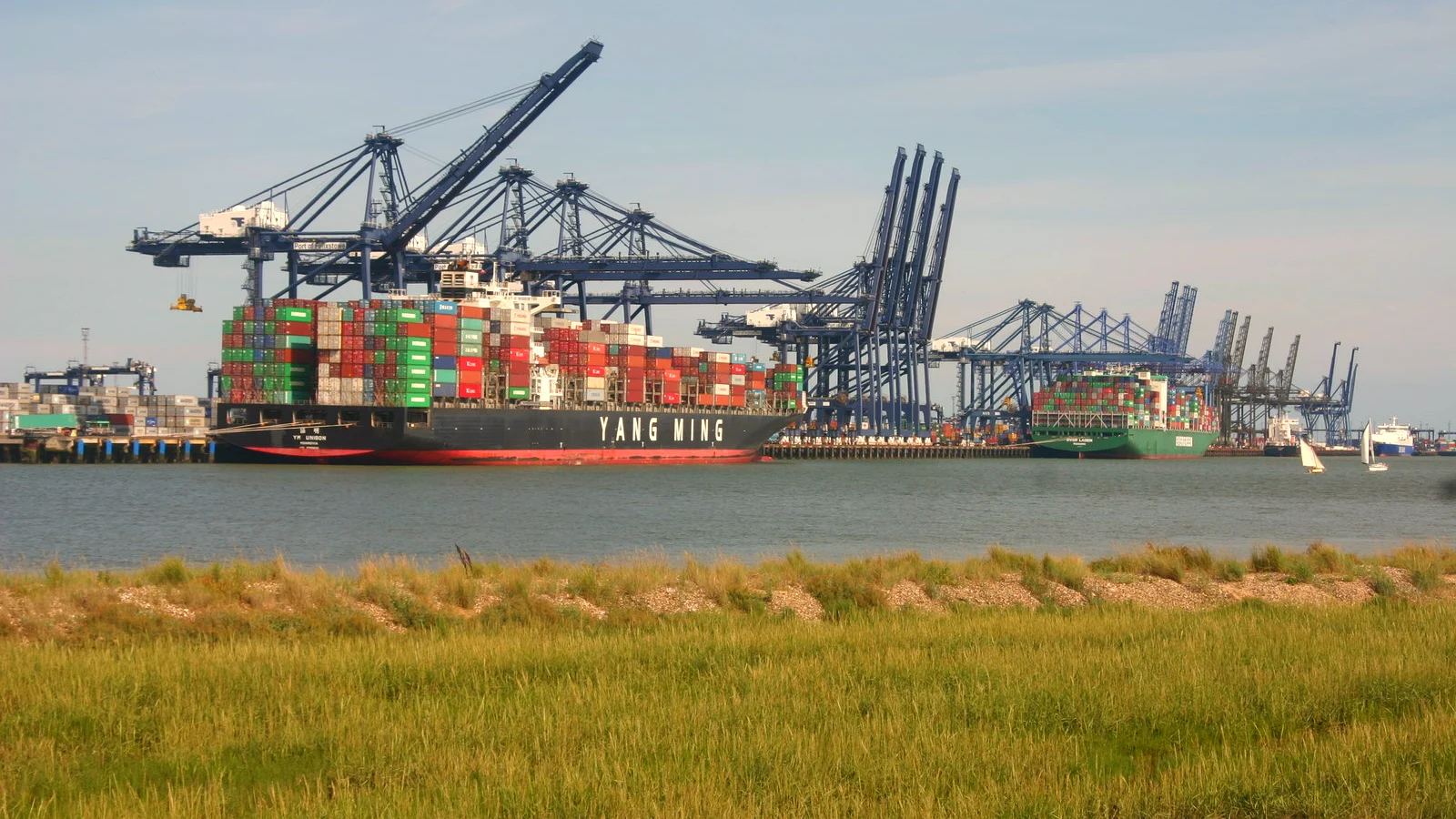
AT1, Liberty Bridge, is the slower loop at 29 days out and 19 back, four more than TA2 to the same coast, and the map credits it to CMA CGM, Evergreen, COSCO, OOCL, ONE and Yang Ming.
Felixstowe is on neither. Hapag-Lloyd’s November 2024 notice on the Gemini network left Felixstowe out and kept the Southampton transatlantic services. On the Georgia Ports maps the only loop with Felixstowe on it is MSC’s Mexico Gulf Express, and the service also lists New Orleans, Mobile and Houston among its ports.
That loop does Savannah to Felixstowe in 14 days. Felixstowe to Savannah, the direction an exporter needs, is blank. Norfolk and Charleston show a dash in the TA2 table too, although TA2 calls at both. Skypace, a booking site, lists voyage 646W of the vessel AL Safat from Antwerp on 15 November. It names the carriers but not the service, so matching it to TA2 rests on the Savannah day count alone. It is shown reaching Charleston on 3 December, Savannah on 7 December and Norfolk on 11 December, which Skypace counts as 19, 22 and 26 days. Savannah at 22 days equals the Georgia table figure for Antwerp. Hapag-Lloyd is the only carrier listed on the Norfolk leg. For a Southampton departure, get the day count to those two ports from the carrier or a sailing search.
New York on the AL1 loop, six days closer
Shipping from the UK to the USA through New York rather than Savannah means a different loop. Hapag-Lloyd’s AL1 service page lists westbound days from Southampton: 19 to New York, 23 to Norfolk, 25 to Philadelphia and 29 to Saint John. New York is the first US call, and the ship arrives there on a Saturday. Eastbound, New York to Southampton is 20 days, arriving on a Sunday.
AL1 reaches New York in 19 days, while TA2 takes 25 to Savannah. The same table shows 15 days from Rotterdam to New York and 11 from Hamburg.
A December 2025 notice changed AL1’s North American order to New York, Norfolk, Philadelphia and Saint John, Philadelphia came in and Baltimore went out. The transit table is dated 21 January 2026, so confirm the figure at booking.
A tariff that arrived while ships were at sea, and what entry costs
On 24 July a 10 percent Section 301 tariff began to apply to products of the United Kingdom, except as the annexes to the USTR notice provide. The tariff attaches at entry, not at loading: entry for consumption, or withdrawal from warehouse for consumption, at or after 12:01 a.m. Eastern on 24 July.
The notice was published in the Federal Register on 28 July. Cargo loaded onto a vessel and in transit on its final mode before 12:01 a.m. Eastern on 24 July, and entered before 12:01 a.m. on 28 July, was exempt. That gave a ship already on the water four days.
That window has closed, so a box of UK-origin goods entered after 28 July pays the 10 percent unless Annex I or II of the notice exempts it.
On a formal entry the merchandise processing fee is 0.3464 percent of value, floored at $34.58 and capped at $670.86 from 1 October (Federal Register 2026-15530). The harbor maintenance fee is 0.125 percent of the appraised value, the same basis as the duty, on commercial cargo unloaded at a covered port, and it is collected on formal entries (19 CFR 24.24). Savannah and New York Harbor are both on the port list in that section.
Frequently asked questions
Can a UK seller still send a small parcel to a US buyer under the $800 de minimis rule?
No. On 24 June 2026 CBP published two interim final rules that suspend the exemption indefinitely, one for every mode except the international postal network and one for mail. A shipment worth $800 or less now goes through formal or informal entry, or through the postal informal entry process for certain mail merchandise.
Does a pallet sent by air from the UK need an ISF?
No. The filing in 19 CFR 149.2(a) covers cargo arriving by vessel.