

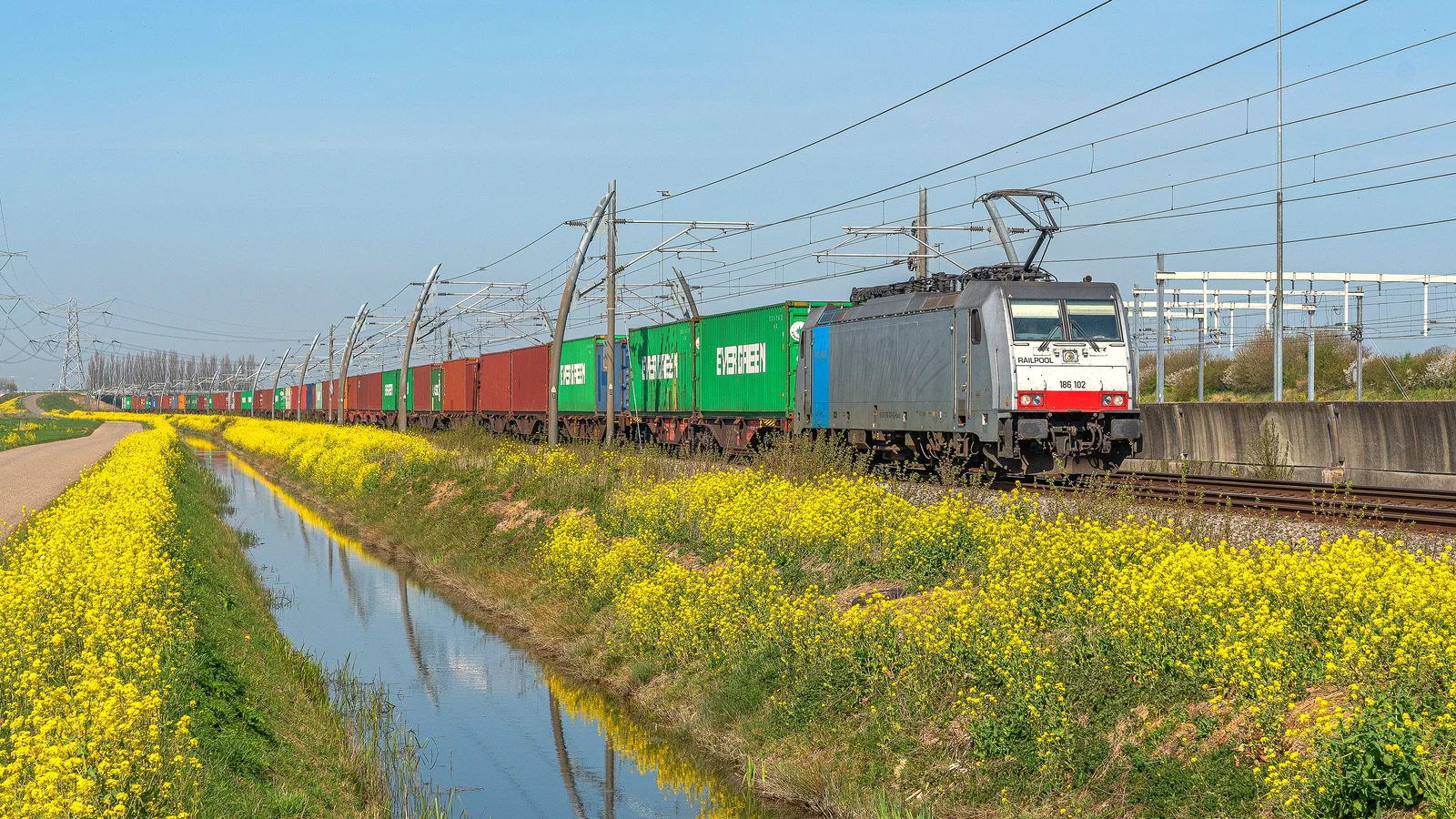
Shipping from China to Germany in October 2026 starts with the service string, because Yang Ming’s June tables give Ningbo to Hamburg as 45 on FE5 and 59 on FE6. The sheet prints no unit, and the numbers are read as days. Same carrier, same destination, 14 more on the second string.
Pick the string, not the carrier
Yang Ming’s June 2026 Asia–Europe sheets print a westbound table for FE4, FE5 and FE6. Shanghai to Hamburg reads 47 on FE5, 50 on FE4 and 56 on FE6, and Ningbo to Hamburg reads 45 on FE5 and 59 on FE6. On FE6 the Ningbo row reads 44 at Felixstowe, 47 at Antwerp and 59 at Hamburg, a 12-day step after Antwerp. All three go round the Cape of Good Hope.
Bremerhaven is a different question. Yang Ming has no call there on these sheets (a sailing search by port pair shows which services do call), while Hapag-Lloyd’s NE4 does: the rotation Hapag-Lloyd published in February runs Qingdao, Ningbo, Tanjung Pelepas, London Gateway, Bremerhaven, Hamburg, Rotterdam, Algeciras, and it called NE4 “one of the fastest products in the market from Ningbo to Germany”.
In September NE4 left the Cape. Marchen Maersk 635W was due out of Tanjung Pelepas for Suez on 21 September, while Hapag-Lloyd’s September network sheet still says the Gemini network “mainly” runs via the Cape. Maersk’s 14 September advisory promises “more efficient transit times” and gives no day count.
Hapag-Lloyd’s operational update for week 41 says Hamburg Express 638W on NE2 will omit Shanghai and Rotterdam Express 637W will omit Yantian.
Hamburg against Rotterdam and Antwerp, by the tables
The same sheets show what the port choice costs in days. Hapag-Lloyd’s NE2 service page gives Shanghai to Rotterdam as 39 days, Hamburg 43, Antwerp 47 and London Gateway 55. Yantian is 34 to Rotterdam and 38 to Hamburg. The page is dated 11 February 2026. Hapag-Lloyd’s 27 February notice then set an April rotation that calls Antwerp between Rotterdam and Hamburg, so the Hamburg figure of 43 comes from the older order and needs a check against a current sailing.
Yang Ming’s June sheets order the ports differently. On FE4 Shanghai to Rotterdam reads 43 and Hamburg 50. On FE5 the Shanghai row reads 47 at Hamburg, 51 at Rotterdam and 56 at Antwerp, because Hamburg is the first of the three on that string. On FE6 Antwerp reads 44 and Hamburg 56.
Which port is quicker depends on the string. These tables end at the quay, so for a consignee near Hamburg a discharge at Rotterdam leaves the onward leg on top of the sea days.
Hamburg is also built for the onward leg. HHLA says around half of the port’s hinterland containers move by rail, and that about 210 freight trains run on the Hamburg Port Railway every day (HHLA). The Port of Hamburg reported 8.3 million TEU for 2025, with container traffic with China up 6.5 percent.
The ICS2 filing is due in China, before loading
The CLECAT and FIATA forwarder guide to ICS2 gives the Entry Summary Declaration deadline as 24 hours before the goods are loaded onto the vessel that brings them into the EU. For shipping from China to Germany the load port is in China, so the deadline falls there. The EU’s ICS2 page says customs may reject an incomplete ENS or issue a referral asking for more data, for high-risk screening, or “not to load the cargo”. Customs-broker sites say the description has to be specific, with a commodity code of at least six digits.
Two Maersk surcharges for Germany
Maersk’s Q4 emissions surcharge from Far East Asia to North Europe is USD 85 per 20-foot and USD 170 per 40-foot from 1 October. It covers EU ETS and FuelEU Maritime costs and follows the average allowance price. For bookings from mainland China, Maersk says it adds the surcharge to the base freight rate for regulatory reasons, and that the base rate is adjusted quarterly.
Maersk’s heavy load surcharge has its own line for Germany: USD 400 on 20-foot equipment above 25 tonnes for Germany and Poland from 19 October, against 28 tonnes for the rest of North Europe.
Rail starts inland and the border decides it
Rail is the other way of shipping from China to Germany, and the border is where it can stop. The Małaszewicze crossing between Poland and Belarus carries roughly 90 percent of China–Europe rail freight, according to trade press. Poland closed it on 12 September 2025 after drone incursions.
More than 100 trains were blocked in the two weeks it stayed shut, and Prime Minister Tusk warned that border closures could return if security tensions escalate.
In June 2026 the chairman of METRANS Małaszewicze said the Brest–Terespol crossing was running at 60 to 70 percent of capacity. He added that Russia was favouring military transport and adding customs restrictions on cargo from China.
CDRD, a rail operator, reports 22.5 days on average from Chengdu to Duisburg across its last 98 trains, with 90 percent inside 27 days. Those are station to station days from the operator’s own data, and they start in an inland city. On its busiest westbound lane, Chengdu to Małaszewicze, CDRD counts 119 trains over 90 days at 17.3 days on average.
Trade press wrote in September 2025 that some trains were rerouted over the Middle Corridor through Kazakhstan and the Caspian Sea, “though capacity remains limited”.
Frequently asked questions
Does a Chinese supplier need an EORI number to ship to Germany?
Not by default. zoll.de gives acting as declarant in customs declarations or as carrier as examples of when one is needed. The German importer should apply for one in good time before it starts customs activity. It is free, and from 1 October 2026 the application goes through the Zoll-Portal, with the old paper form accepted only in exceptional cases.
Is there a duty on a small parcel from China to Germany?
Yes, since 1 July 2026. The EU charges a flat EUR 3 customs duty per item on consignments worth up to EUR 150 in distance sales such as online orders, under Council Regulation (EU) 2026/382. It applies until 1 July 2028, after which normal duties return.