

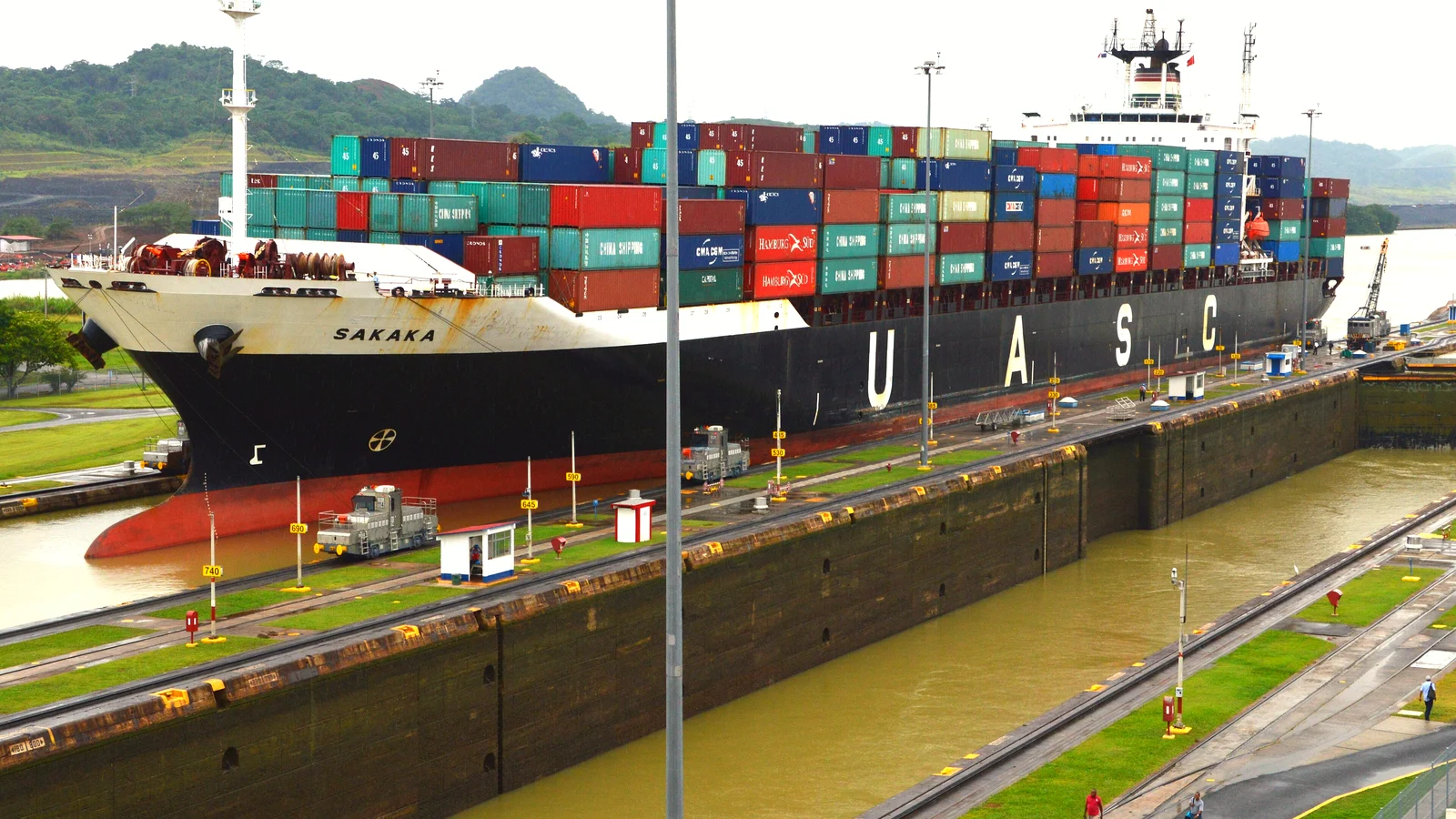
Marfret has chartered the only ship on its NASP service to CMA CGM for 12 months, and the stated reason is Panama Canal transit slots. Its 2,506 TEU ship Marius moved to CMA CGM from the Melbourne call on 20 October. Marfret chief executive Guillaume Vidil said, as the Daily Cargo News reported on 28 October, that the ship “now benefits from our partner’s ranking, making it easier to secure passage slots”. CMA CGM becomes the sole operator of the weekly service, and Marfret a slot charterer on it.
How the canal hands out its slots
Marfret describes the system in a few lines. A vessel books a passage slot in advance, and slots are allocated by ranking: the more transits a shipowner makes each year, the higher its ranking. When the bookable slots are gone, last-minute auctions are the only option left. Marfret says it has bid in them several times, and that “prices have reached unprecedented levels this year, and the chances of winning are increasingly uncertain”.
The canal’s own notices show how few Panama Canal transit slots there are. The Panama Canal Authority cut daily slots on 20 August to nine at the Neopanamax locks from 3 September and to 23 at the Panamax locks from 15 September, citing below-expected rainfall in the watershed. The same notice makes customer ranking only the tiebreaker for container ships in the Neopanamax locks, behind TEU capacity. The September operations summary, Advisory A-38-2026, shows oceangoing transits averaging 32.63 a day and 291 of 339 auctioned slots used.
The 28 September advisory raised the Neopanamax allocation to 10 slots a day, 33 in total, from 15 October.
On 21 October the authority said that recent near-average rainfall and water-saving measures had let it sustain Panamax transits, and Advisory A-39-2026 reinstated the Last-Minute Reservation service at the Panamax locks, offered when a slot frees up and at the authority’s sole discretion. It repeated that the booking system remains the only mechanism to guarantee a transit date and that vessels without a reservation may face extremely extensive delays. The notice is dated the day after the Marius changed charterer. A ship of 2,506 TEU is Panamax-sized, though the sources do not say which locks it uses.
Auction prices
The authority told Reuters that median auction prices averaged about $55,000 between October and February and had reached roughly three times that level by late August, according to Baird Maritime. A South Korean shipper agreed to pay a record $5.3 million for a crossing on 1 September, Bloomberg reported. The Conveyor still named it the record on 25 September, as a bid by SK Gas for an LPG carrier, per Kuehne+Nagel. Gas carriers sit in a different auction group from container ships, so the figure shows the top of the market and says little about what a liner service pays. The authority says high bids reflect each client’s urgency and commercial priorities as well as supply and demand.
Marfret’s alternative to the canal for NASP is sailing around South America, which in its words “would add several days to the voyage”.
The filing came four weeks before the ship moved
CMA CGM and Marfret filed Agreement No. 201477, a space charter under which CMA CGM charters space to Marfret between US Atlantic ports and Australia, New Zealand, the French Pacific Islands, Peru, Colombia, Jamaica, Belgium, the Netherlands, France and Ireland. The FMC page gives 21 September as the filing date and 5 November as the effective date. A Federal Register notice ran on 29 September. The Daily Cargo News calls the filing news “last week”, which does not match either date.
Marfret says cargo and booking arrangements for its customers do not change.
For the Marius the ranking in use is now CMA CGM’s, which is the point of the charter in Vidil’s words. None of the sources says who bids if that ranking falls short. The service structure has changed too: the Daily Cargo News reports a new off-season structure with the Atlantic leg excised for six months, and Container News, citing DynaLiners, says the new filing together with CMA CGM’s planned vessel deployment indicates a standalone CMA CGM operation. Schedule data, including the reliability scores in Navo’s SchedulesMCP, shows how a service has run and cannot show whether its next transit is booked. A shipper on this lane has to ask the carrier whether the named vessel holds a confirmed canal reservation for its transit date or depends on a last-minute slot.
Canal costs on the invoice
Hapag-Lloyd announced on 21 September a Panama Canal Charge of $155 per TEU for applicable shipments from Oceania to the US East Coast and Latin America, the same trade as NASP, from 17 October “except where FMC tariff filing and notice requirements apply”. It is shown as a separate line on the freight invoice and the page gives no reason for it. On a lane that depends on the canal, that line and its start date are the first thing to check.