

In March 1956 a London shipper wrote to a loading broker about 100 barrels of concentrated orange juice bound for Hamburg on the Titania. One line of the instructions mattered later: “We also require clean on board bills of lading.”
The barrels reached the dock old and leaking. The Court of Appeal judgment records liquid seeping between the seams and a tally clerk writing “old and frail” on his card. The broker told the shipper the state of the barrels, and the same judgment says the facts called for a claused bill. The shipper still wanted a clean one. The broker’s director admitted in cross-examination that bankers are apt not to advance money except against clean bills, which is why shippers ask for them. The brokers, signing for the ship’s master, issued a bill reading “shipped in apparent good order and condition” in return for the shipper’s written promise to cover any loss.
The shipowners later assigned their right under that promise to the brokers, who sued on it and lost. TT Club’s summary of Brown Jenkinson v Percy Dalton (1957) says the English court treated the shippers’ letter of indemnity as a fraud on subsequent buyers, void for illegality. Handybulk adds a caution: the decision does not make every indemnity tied to a clean bill unenforceable, and the question is whether the indemnity formed part of a deliberate or reckless deception or came from a genuine dispute about the goods.
The partial text of the judgment on vLex names the buyer’s bank (Slavenburgs) and does not mention a documentary credit, and the case predates UCP 600. The bind of a seller with a bank between him and his money is the same. UCP 600 says banks deal with documents and not with goods, so the leak had to be dealt with before the paper existed. The open route would have run through the buyer: tell him about the leak while the tally clerk’s note was fresh and ask whether he would take a claused bill. The partial judgment text does not show whether the shipper tried it. Under a credit, any change to its terms needs an amendment, which a credit can receive only with the agreement of the issuing bank, the confirming bank if there is one, and the beneficiary. The BAFT guide says to seek it from the applicant and not to rely on a promise that it will follow.
What counts as clean
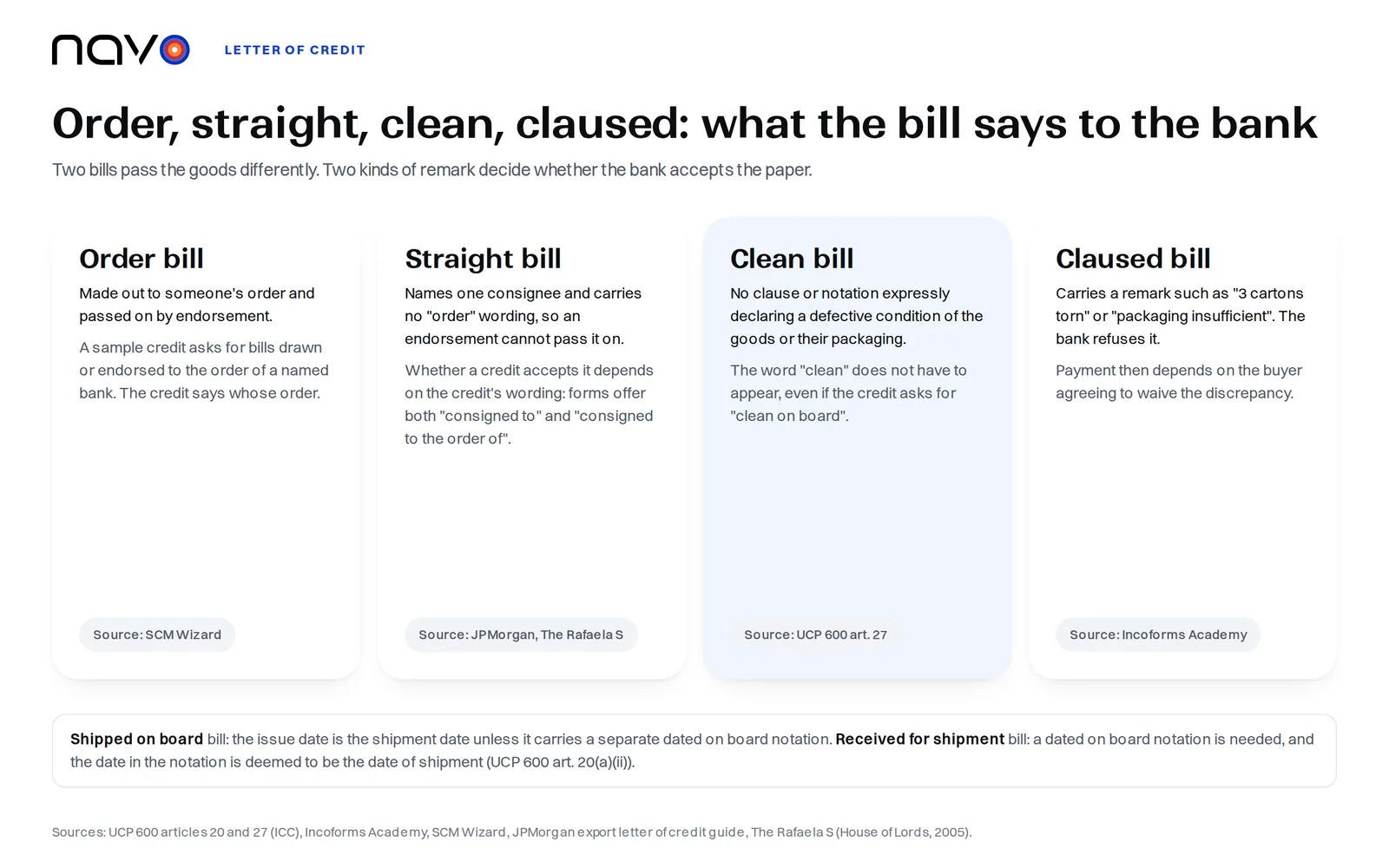
Article 27 of UCP 600 sets the test: a bank accepts only a transport document bearing no clause or notation expressly declaring a defective condition of the goods or their packaging. The word “clean” need not appear, even if the credit asks for “clean on board”.
The word “expressly” is the test. Incoforms Academy gives “3 cartons torn” and “packaging insufficient” as remarks that make a bill claused (Incoforms Academy on discrepancies).
The carrier has its own reason to care about a clean bill. TT Club explains that, at common law and under the Hague-Visby Rules, a clean bill in the hands of a consignee who took it in good faith is conclusive evidence of the cargo’s condition, and the carrier cannot later show the damage was there at loading. The Club calls indemnity deals like the Titania one dangerous for carriers. For the shipper Incoforms has plainer advice: repack damaged items before loading.
The stamp decides the shipment date
The credit sets a latest shipment date and the bank reads it off the bill. On a bill pre-printed “shipped on board”, the issue date is the shipment date unless a separate dated on board notation says otherwise. On a bill pre-printed “received for shipment”, the dated notation is what shows loading, and under article 20(a)(ii) the date in the notation is deemed to be the date of shipment. Where the bill names an “intended vessel”, the notation must give the date and the actual vessel.
So a container that misses its sailing on a received-for-shipment bill moves the shipment date, whatever date sits at the top of the bill. JPMorgan’s list of common discrepancies on marine bills includes a notation that is not dated or signed, and late shipment.
The seller then has 21 calendar days from that date to present the original bills, and never beyond the expiry of the credit. A credit can set its own period, and JPMorgan’s request form leaves a blank for it. Incoforms Academy lists, among typical mistakes, waiting for the original bills from the forwarder until day 19 of 21.
Order bill or straight bill
The Titania bills were to be made out to order, with the buyer only as notify party. An order bill is made out to someone’s order and passes by endorsement. A sample field 46A on SCM Wizard asks for a full set of shipped on board clean bills drawn or endorsed to the order of a named bank, and JPMorgan lists a bill “issued or endorsed to the wrong party” among its discrepancies.
A straight bill names one consignee and carries no “order” wording, so an endorsement cannot pass it on (the House of Lords described such a bill as one that could not be transferred by endorsement in The Rafaela S, an English-law case). Whether a credit accepts one depends on its wording. JPMorgan’s form for requesting a credit offers both “consigned to” and “consigned to the order of”.
When the bank says no
Under article 16 the bank has until the close of the fifth banking day after presentation. It sends one notice that says it refuses, lists each discrepancy and says what happens to the documents. The issuing bank may ask the buyer for a waiver, and that does not extend the five days. BAFT adds that the issuing bank is not obliged to accept a waiver the buyer has agreed to, and that some buyers use the discrepancy to negotiate a discount in return for it.
JPMorgan’s export letter of credit guide lists among its marine bill discrepancies an unclean bill and a notation without date or signature, then ports that differ from the credit, a bill issued or endorsed to the wrong party, a wrong consignee or notify party, transhipment where the credit prohibits it, and late shipment.
Transhipment is the one that often turns out to be a false alarm. Where the goods travel in a container, trailer or LASH barge as the bill shows, and one bill covers the entire carriage, a bill saying they will or may be transhipped is acceptable even if the credit prohibits it. Incoforms Academy makes the same point.
The ICC Academy’s article on common discrepancies by Xavier Fornt adds the kind that spans documents: beneficiary name, goods description, quantities or shipment details that differ between invoice and bill. JPMorgan’s example is cartons on the invoice and cases on the bill. Fornt is a member of the ICC Banking Commission, and the article carries his views, not official ICC policy.
Before the vessel sails
BAFT advises that documents the beneficiary does not issue itself, such as the bill and the insurance paper, go to the forwarder, the carrier or its agent, or the insurer together with a copy of the credit, before the goods are shipped. Incoforms Academy describes a master data sheet per shipment, holding the credit’s exact goods description, the weights from the weighbridge ticket and the consignee as the credit states it, with every document produced from that sheet.
Fornt points at field 47a, the additional conditions of the SWIFT MT700 message, where in his words “the devil is often hiding”. On a document with an error his 25 tips say to prepare new documents when one has an error, and his other article calls it much better, if possible, to issue the document again.
At the discharge port the carrier wants an original bill or a release. Navo’s post on customs release vs carrier release covers how the customs release and the carrier release get mixed up.
Frequently asked questions
My forwarder issued the bill, not the shipping line. Will the bank refuse it?
Not on that ground alone. UCP 600 lets a party other than the carrier, owner, master or charterer issue a transport document, provided it meets the requirements of the article for that document, which for a bill of lading is article 20. The ICC's banking practice guide ISBP 821 adds that a credit line saying house bills are not acceptable is disregarded, unless the credit spells out how the bill must be issued and signed. A 2018 JPMorgan export guide still lists a bill issued by a forwarding agent among its common discrepancies, so it is worth asking your advising bank before the forwarder prints anything.
The credit asks for a bill of lading, but my line only issues sea waybills. What now?
Go back to the buyer before you book and ask for an amendment. UCP 600 examines a bill of lading under one article and a non-negotiable sea waybill under another, each with its own checks, and a presentation complies only if it follows the credit's terms, the applicable UCP articles and international standard banking practice. A waybill offered against a credit that names a bill of lading is the kind of mismatch a bank can refuse.
What does a refused presentation cost me?
The fee is the visible part. BAFT's guide says discrepancy fees often run from the equivalent of USD 25 to USD 500 per presentation, and Incoforms Academy says issuing banks often charge a flat USD 50 to 150, so the two figures are not like for like. Incoforms names the delay in payment and a buyer who uses the discrepancy to renegotiate the price as the bigger costs. What happens next is your choice among four routes, as Incoforms lists them: correct the documents and present again while the credit and the presentation period are still open, ask the buyer for a waiver, get paid under reserve or against an indemnity by a nominated bank that keeps the right to recover the money, or send the documents on approval, which makes the credit work like a documentary collection. On approval you are paid only if the buyer accepts.