

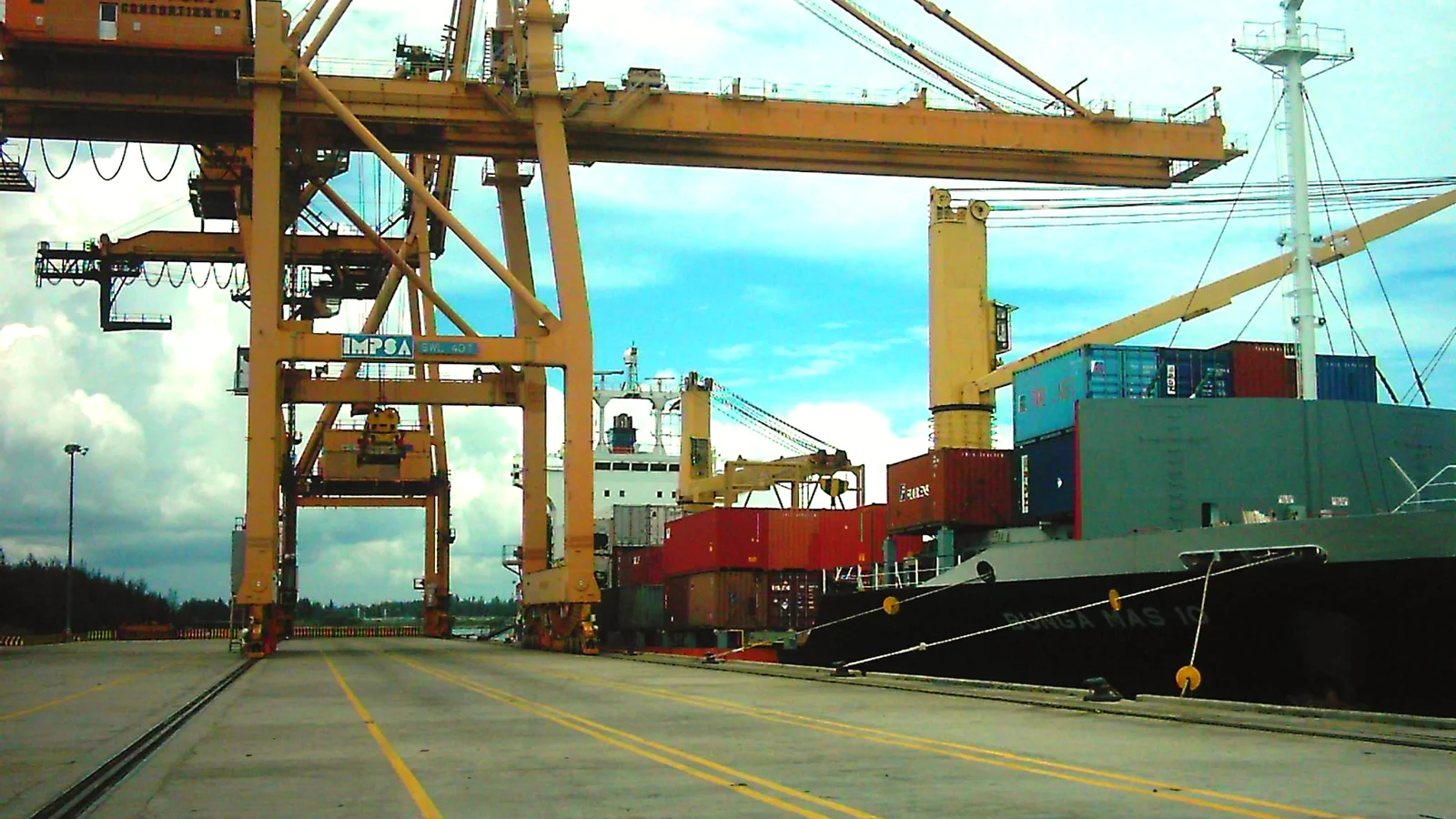
In about January 1990 four containers of printing machinery were damaged between Felixstowe and Boston, and the House of Lords decided on 16 February 2005 which liability regime governed the claim against the carrier, Mediterranean Shipping Company, in the case known as The Rafaela S.
The consignor vs consignee labels fit that case at first glance: J I MacWilliam Company of Boston, the buyer, was named as consignee on a straight bill of lading, and the shipper and seller was Coniston International Machinery of Liverpool. With liability assumed, the argument was about the document. As the House of Lords reports it, the document was assumed for the Felixstowe to Boston leg, in the same form as the straight bill issued at Durban for the first leg. The consignee’s side alleged that the Hague-Visby Rules applied, which would put the package limitation claim at the order of US$150,000, while the carrier argued for the US Carriage of Goods by Sea Act 1936 and US$2,000. The question was whether a straight bill is “a bill of lading or any similar document of title”. The House held that it is.
The word in the consignee box
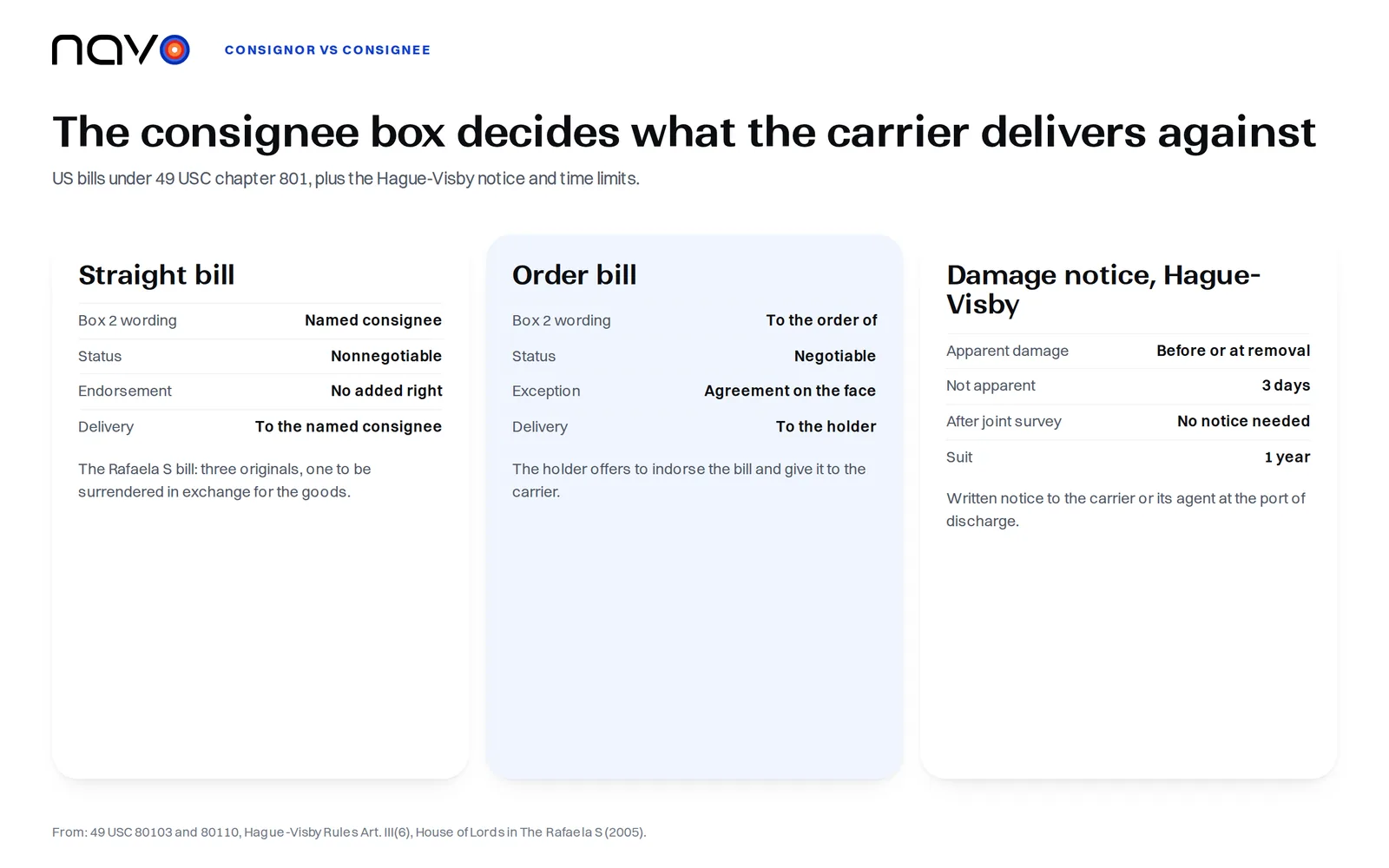
The carrier’s form printed “Consignee: (B/L not negotiable unless ‘ORDER OF’)” in box 2. The buyer’s name went in without those words, and that omission made the bill straight, so the consignee on this bill of lading was a named company and not a holder of an endorsed original. US law reads the same wording. 49 USC 80103 applies to bills that chapter 801 covers, and section 80102 puts a common carrier’s bill for carriage from a US State to a foreign place inside it. Goods to be delivered to the order of a consignee make the bill negotiable, unless the face of the bill carries an agreement with the shipper that it is not. A bill stating that they go to a consignee is nonnegotiable, and endorsing it gives the transferee no additional right. Naming a person to be notified of arrival does not limit a negotiable bill and is no notice to a purchaser of any right that person has to the goods.
Box 11 of the same bill set the number of originals at three, and one of them had to be surrendered duly endorsed in exchange for the goods.
Lord Bingham saw a commercial reason for that on a straight bill: the shipper will not wish to part with an original to the consignee or buyer until that party has paid, and requiring the bill for delivery is the most effective way of stopping a consignee who has not paid from taking the goods. He quoted the description of a bill as “a key which in the hands of a rightful owner is intended to unlock the door of the warehouse”, and said he would, if necessary, hold production of the bill a precondition of requiring delivery even where no clause says so. Outside that judgment, ovrseas says P&I insurers caution that a carrier may deliver to the named consignee of a straight bill on proof of identity without always requiring an original, and that practice varies by jurisdiction and carrier.
For US export bills the delivery duty sits in 49 USC 80110, written for common carriers under that chapter. Unless the carrier establishes an excuse provided by law, it must deliver on demand of the consignee named in a nonnegotiable bill or the holder of a negotiable one, once that person offers in good faith to satisfy the carrier’s lien, has possession of the bill (and, for a negotiable bill, offers to indorse it and give it to the carrier) and agrees to sign a receipt on delivery if asked.
What the sale contract and the carrier’s terms add
On customs, freight and insurance the consignor vs consignee labels say little. Incoterms, in the trade.gov description, give every rule a line on who obtains the export license and clears the goods for export, who does the same on import, who, if anyone, must contract for the carriage and who, if anyone, must provide cargo insurance. Packing and pre-shipment inspection are covered too. The page also lists what they leave out, among them the contract price, the payment terms, when title passes and which documents the seller must supply for the buyer’s customs clearance. The chosen rule allocates the clearance tasks between seller and buyer, within local customs law.
On the receiving side, iContainers lists the arrival notice, release documents, customs, destination charges and inland delivery as things a consignee may carry. Which of them it does carry depends on the Incoterm, the transport contract, customs rules and the sale agreement. The same page says a consignee is not always the owner. Ownership turns on the sales contract, payment terms, the type of bill and any endorsement, and being named as notify party does not by itself create a duty to clear, pay or collect. A consignee holding only a bill of lading number can look the container up by that number, since the page takes a container number, a bill or a booking.
One rule falls on the shipper from the transport side. The Hague-Visby Rules add a duty on the shipper in Article III(5): it is deemed to have guaranteed the accuracy of the marks, number, quantity and weight it furnished at the time of shipment, and it indemnifies the carrier for loss, damage and expense that inaccuracies cause.
Written notice of damage and the time bar
Where national law or the bill’s paramount clause applies the Hague-Visby Rules, removal of the goods is under Article III(6) prima facie evidence that the carrier delivered them as described in the bill, unless written notice of the loss or damage and its general nature reaches the carrier or its agent at the port of discharge before or at the time of removal. Where the damage is not apparent, notice is due within three days. A joint survey or inspection of the goods at the time of receipt removes the need for written notice. The carrier is discharged from all liability, subject to paragraph 6bis, unless suit is brought within one year of delivery or of the date the goods should have been delivered. The parties may extend that year by agreement once the cause of action has arisen.
Section 3(6) of US COGSA (46 USC 30701 note) sets the same three days from delivery for damage that is not apparent and the same exemption for a joint survey, and lets the notice be endorsed on the receipt for the goods given by the person taking delivery. Its one-year period carries a proviso: missing notice does not prejudice the shipper’s right to sue within that year.
Neither text names the party who must give the notice; the Hague-Visby text says only that it goes in writing to the carrier or its agent at the port of discharge.
Frequently asked questions
Can one company be named as shipper and as consignee on the same bill of lading?
O Trucking, a trucking company whose guide covers US domestic freight, says the consignor occupies the shipper field and the consignee the receiver field, separate boxes even when one company moves freight between its own facilities. iContainers adds that the shipper named on a bill may be an exporter, seller, manufacturer, trading company, forwarder or NVOCC, and that the consignee and the notify party may be the same company.
Whose name goes in the consignee box when the sale is paid by letter of credit?
ovrseas, a documents platform, says a credit usually asks for a bill made out 'to order of the issuing bank', that naming the buyer as consignee can be a discrepancy the bank refuses, and that you should copy the credit's consignee line word for word. Ceyltech, another secondary source, adds that the notify box is then the only box naming the buyer, and that 'same as consignee' would point to the bank.
A forwarder is named as shipper on the bill. Who answers for the verified gross mass of the container?
IMO Circular MSC.1/Circ.1475, paragraph 2.1.12, defines the shipper as the legal entity named as shipper on the bill of lading or sea waybill and/or the party in whose name or on whose behalf the contract of carriage was concluded. Paragraph 4.1 says the duty to obtain and document the verified gross mass lies with that shipper (the binding requirement is SOLAS regulation VI/2, which the circular implements), and paragraph 6.2 says the declaration should be signed by a person duly authorized by the shipper. A container that arrives without a verified gross mass may be weighed by the master or terminal on the shipper's behalf; the guidelines leave whether and how, and who pays, to the commercial parties.